
Does the value premium vary systematically with the state of the economy? More specifically, do value and growth stocks respond differently to negative macroeconomic shocks? In their September 2008 paper entitled “Value versus Growth: Time-Varying Expected Stock Returns”, Huseyin Gulen, Yuhang Xing and Lu Zhang investigate the relationship between economic conditions (recession or expansion) and the value premium. Using monthly returns for a broad sample of stocks over the period 1954-2007 (648 months), along with contemporaneous firm fundamentals and macroeconomic data, they conclude that:
- Over the entire sample period, a hedge portfolio that is long (short) the 10% of stocks with the highest (lowest) book-to-market ratios earns an average monthly return of 0.48% with a monthly volatility of 4.28%, meaning the average return is more than 2.8 standard errors from zero.
- The expected value-minus-growth return tends to spike upwards rapidly during recessions and then decline gradually in the ensuing expansions.
- In other words, as a recession deepens, value firms quickly become riskier because they lack the flexibility to adjust to adverse economic conditions, and investors therefore demand a higher risk premium for holding their stocks.
The following chart, taken from the paper, presents the year-by-year returns for an annually formed equal-weighted portfolio that is long (short) the 10% of stocks with the highest (lowest) book-to-market ratios. Visual inspection suggests countercyclical variations in the value premium. A rough pattern of value first sinking below and then rising above growth is evident for the recessions of 1957-58, 1981-82, 1990-91 and 2001. Value underperforms growth by 13.8% in 2007, suggesting that the U.S. economy is heading towards or is already in a recession at the end of the sample period.
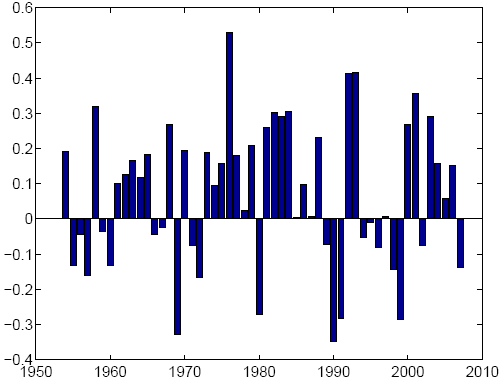
In summary, investors may be able to exploit time variation of the value premium based on the state of the economy, moving out of (into) value as recessions approach (end).
