
Do individuals who use investment advisors achieve higher returns than those who do not? Two closely related papers entitled “Investment Advice and Individual Investor Portfolio Performance” of January 2009 by Marc Kramer and “The Impact of Financial Advisors on Individual Investor Portfolio Performance” of March 2012 by Marc Kramer and Robert Lensink address this question. Using monthly portfolio returns for thousands of advised and self-directed individual Dutch investors during April 2003 through August 2007 (52 months), they conclude that:
“Investment Advice and Individual Investor Portfolio Performance”, based on over 600,000 monthly portfolio returns (encompassing individual equities, funds, bonds and derivatives) for 16,053 investors, finds that:
- The percentage of investors seeking advice rises with portfolio size.
- Portfolio turnover is on average a little higher for self-directed investors (5.5% per month) than for advised investors (4.4% per month).
- Portfolios of self-directed investors are less diversified, in terms of both asset classes and number of issues, than those of advised investors. The median self-directed (advised) portfolio is all (43%) equity.
- The average net monthly return of self-directed portfolios exceeds that of advised portfolios by 0.24%. However, for common stocks positions only, the average net monthly return of advised investors exceeds that of self-directed investors by 0.07%. Outside advice is most beneficial for investors with the smallest portfolios.
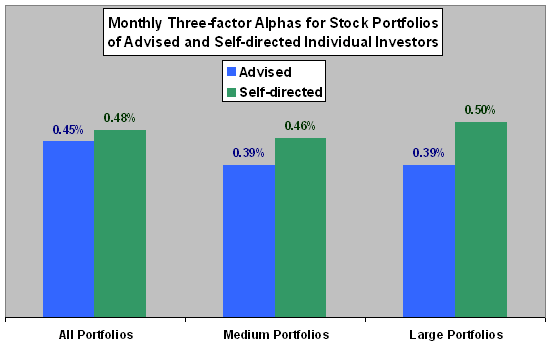
- Overall, the average Sharpe ratio of advised portfolios is a little higher than that of self-directed portfolios. Risk-adjusted returns (market, size and book-to-market) for the two groups are positive and approximately equal (see chart below).
- Overall, evidence does not support a belief that advised investors either outperform or underperform self-directed investors.
The following chart, constructed from data in the paper, shows the three-factor risk-adjusted returns for the equally weighted common stock portfolios of advised and self-directed individuals over the entire sample period. It suggests that advisors do not aid individual investors with respect to stock picking, especially (more sophisticated?) investors with larger portfolios.
“The Impact of Financial Advisors on Individual Investor Portfolio Performance”, based on a subset of these observations encompassing more than 193,418 monthly common stock return observations for 5,661 investors, finds that:
- Based on raw gross (net) returns, sampled investors on average underperform (underperform) the overall stock market by 0.04% (0.20%) per month.
- Returns are marginally higher for advised than for self-directed investors.
- Monthly volatility of returns is slightly lower for advised than for self-directed investors.
- Advised investors hold more positions and have higher turnover than self-directed investors.
- Trading activity has a positive (negative) effect on gross (net) returns.
- Corrected for other potential sources of influence, unbiased advisors improve the portfolio decision making of retail investors.
In summary, financial advisors tend to influence individual investors toward more diversified portfolios. Evidence does not support beliefs that advisors substantially help or hurt risk-adjusted returns for mixed portfolios or equity-only portfolios.
It seems reasonable, however, to question whether some of the conclusions from the first study depend on the generally bullish state of equity markets during 2003-2007. Diversification across asset classes may be substantially advantageous (favoring advised investors) during bear markets.
