
Can investors tell which secondary equity offerings (SEO) are most likely to indicate future stock underperformance? In their November 2009 paper entitled “Managers’ Private Information, Investor Underreaction and Long-Run SEO Underperformance”, Pawel Bilinski and Norman Strong investigate whether the level of surprise in an SEO announcement (indicating the magnitude of management’s private information) systematically relates to future returns for the stock. They define and measure this level of surprise based on market and firm accounting variables available before the SEO announcement and related to: firm overvaluation and firm value uncertainty; costs of issuing stock; options for firm growth; firm leverage and financial constraints; and, stock liquidity. Using firm accounting, characteristic and stock price data associated with 4,422 SEOs and matched non-issuing firms over the period January 1970 through December 2007 (with the last SEO in December 2004 to allow a three-year holding period), they conclude that:
- The average equally-weighted (value-weighted) abnormal return for the stocks of issuing firms, relative to non-issuing firms matched on size and book-to-market ratio, during the three years after SEO issuance is -24.5% (-20.8%). Average underperformance of Nasdaq issuers is more pronounced than that of NYSE/AMEX issuers.
- While firm management acts rationally on their private information about stock overvaluation in making an SEO, investors tend to underreact to the SEO announcement, with less anticipated SEOs exhibiting lower post-issuance returns.
- Investor underreaction to SEO announcements tends to correct within 17 months of the SEO issue date. After this correction period, rationale risk-reward analysis explains persistence in stock underperformance.
The following chart, taken from the paper, depicts the decomposition of the the impact on stock price of management’s private information revealed on the SEO announcement date (surprise effect) into an immediate drop (announcement effect) and a subsequent gradual decline (delayed market reaction). The study finds that: (1) the delayed market reaction is larger relative to the announcement effect when the announcement is measurably more surprising; and, (2) the duration of the delayed market reaction extends to about 17 months after the SEO issue date.
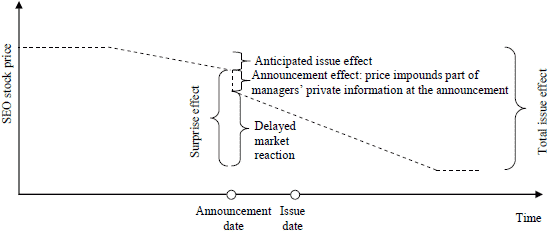
In summary, evidence suggests that investors may be able to predict which SEOs will engender the most pronounced subsequent market underperformance by measuring the level of surprise in the SEO announcement.
