
Can traders reliably exploit the reaction of stocks to scheduled Federal Funds Rate (FFR) decisions? In their October 2007 paper entitled “The Effects of Federal Funds Target Rate Changes on S&P100 Stock Returns, Volatilities, and Correlations”, Helena Chulia-Soler, Martin Martens and Dick van Dijk study the impact of Federal Open Market Committee scheduled announcements of FFR decisions on individual stocks at the intraday level. Using high-frequency price data for components of the S&P 100 index around scheduled FFR decision announcements between between May 1997 and November 2006 (77 announcements), they find that:
- Out of 77 total scheduled FFR announcements, 23 (12) involved FFR increases (decreases). Based on the same-day reactions of FFR futures, 28 (26) are positive (negative) surprises.
- The returns, volatilities and correlations of S&P 100 index stocks react only to the surprise element in these announcements.
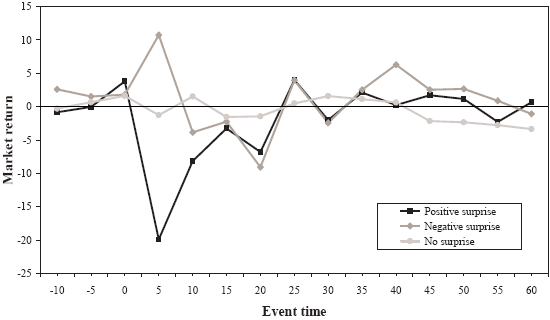
- An unexpected 25-basis point increase in FFR drops stock prices by an average of 113 basis points within five minutes after announcement. The R-squared statistic for this relationship is 0.27, indicating that FFR surprises account for 27% of the short-term variation in stock prices across the sample period. (See the chart below.)
- FFR surprises significantly increase market volatility in the 60-minute window around announcement, with positive surprises provoking a stronger reaction than negative surprises.
- Traders react similarly to bad news (positive surprises) regardless of magnitude, but their reaction to good news (negative surprises) is sensitive to the magnitude of the surprise. In other words, the correlation of returns across stocks increases more for negative
news than positive news. - Reactions to FFR surprises are greatest for financial, information technology and consumer discretionary stocks, while they are smallest for utility stocks.
The following chart, taken from the paper, depicts the average returns of S&P 100 stocks in five-minute intervals (not cumulative) from ten minutes before to 60 minutes after the 77 FFR decision announcements during the sample period. Based on the same-day reaction of FFR futures, the 77 announcements fall into groups involving “No surprise” (23), “Positive surprise” (28) and “Negative surprise” (26). In general, stocks do not react when there is no element of surprise. The negative (positive) average return for positive (negative) surprises, occurs mostly in the five-minute interval immediately after announcement. Average returns between five minutes and 20 minutes after announcement are negative for both negative and positive FFR surprises, suggesting underreaction (overreaction) to bad (good) news.
The study excludes four unscheduled sample period announcements of FFR reductions (10/15/98, 1/3/01, 4/18/01 and 9/17/01), which are largely surprises.
Note that trading all of the surprise in scheduled FFR announcements requires some definition of surprise based on pre-announcement judgment, unlike the end-of-announcement-day data used in the study.
In summary, stocks react to the surprise element in scheduled Federal Funds Rate announcements. There may be reliable trades in short-term continuation (reversal) of stocks after an initial spike down (up), especially for financial and information technology stocks.