
Should investors shift from traditional long-only mutual funds to newer and more flexible 130/30 (130% long/30% short) equity funds? In other words, does the flexibility of 130/30 funds to short stocks and expand portfolios enhance returns? In the May 2008 version of his paper entitled “130/30 Investing: Just Another Hype or Here to Stay?”, David Blitz enumerates theoretical advantages and disadvantages of 130/30 investing and discusses ways in which 130/30 fund managers are implementing their flexibility, concluding that:
- 130/30 equity funds are more like traditional mutual funds (measured to a benchmark) than hedge funds (measured to absolute return). See the figure below.
- A 130/30 approach potentially offers three advantages by allowing the fund manager to:
- Exploit negative information about stocks by shorting, as well as positive information about stocks by buying.
- Weight stocks more flexibly within an expanded set of long holdings.
- Increase diversification via an expanded set of long and short holdings.
- The validity of the first two of these three advantages depends on the ability of fund managers to generate alpha from both long and short positions, an ability perhaps better derived from quantitative than fundamental analysis.
- Expenses for 130/30 funds tend to be higher than expenses for comparable long-only funds because of:
- Added trading fees, funding burden and administrative costs involved in shorting.
- Increased transaction costs for an expanded portfolio.
- Greater effort in managing a more complex portfolio (to take more alpha from others) and therefore usually higher fees.
- 130/30 equity funds implemented piece-wise (such as a 100% long portfolio augmented by a 30% market neutral portfolio) sacrifice some of the efficiency offered by an integrated portfolio construction approach.
- Parameter-driven 130/30 fund benchmarking is problematic due to arbitrariness in selecting parameter values.
The following chart, taken from the paper (via Robeco Quantitative Strategies), illustrates the conceptual alpha/beta position of 130/30 funds relative to other investment strategies. 130/30 funds have more alpha-generating opportunities than traditional long-only funds, with comparable exposure to the movement of the overall equity market.
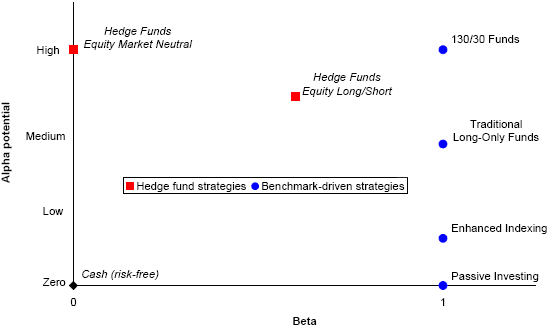
In summary, investors who believe that they can find fund managers who reliably generate alpha should consider the enhanced alpha for higher fee trade-off of 130/30 funds.
Frequently Asked Questions
What is a 130/30 fund and how does it differ from a traditional equity fund?
A 130/30 fund is an equity fund that holds 130% of its capital in long positions and 30% in short positions, keeping net market exposure near 100%. It is more like a traditional mutual fund (measured against a benchmark) than a hedge fund (measured on absolute return). The structure gives the manager more flexibility to short stocks and expand the portfolio than a long-only fund allows.
Do 130/30 funds offer better return potential than long-only mutual funds?
130/30 funds potentially offer more alpha-generating opportunities than long-only funds, with comparable exposure to overall equity market movement. This is a conceptual conclusion from a May 2008 paper by David Blitz, not an empirical test. The benefit depends on managers reliably generating alpha, so investors face an enhanced-alpha-for-higher-fee trade-off.
How do 130/30 funds generate extra alpha through shorting and expanded long positions?
130/30 funds are said to generate alpha in three ways: shorting stocks to exploit negative information as well as buying on positive information, weighting stocks more flexibly within an expanded set of long holdings, and increasing diversification through more long and short holdings. The first two advantages depend on managers generating alpha from both long and short positions, an ability perhaps better derived from quantitative than fundamental analysis.
Are 130/30 funds the same as hedge funds, and how do they compare to long-only funds?
130/30 funds are not the same as hedge funds, since they are measured against a benchmark rather than on absolute return, making them more like traditional mutual funds. Compared with long-only funds, they have more alpha-generating opportunities and comparable exposure to overall equity market movement. They typically also carry higher expenses.
What are the drawbacks and risks of investing in 130/30 funds?
130/30 funds tend to have higher expenses than comparable long-only funds because of shorting trading fees, funding burden, administrative costs, higher transaction costs on an expanded portfolio, and the greater effort of managing a more complex portfolio. Funds implemented piece-wise, such as a 100% long portfolio plus a 30% market-neutral portfolio, sacrifice some efficiency of integrated portfolio construction. Parameter-driven benchmarking is also problematic because of arbitrariness in selecting parameter values.