
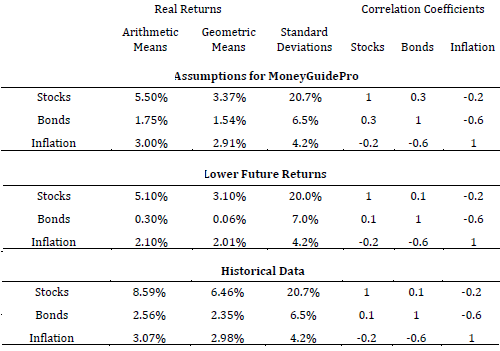
Does the conventional wisdom of a declining allocation to stocks throughout retirement really work best? In their September 2013 paper entitled “Reducing Retirement Risk with a Rising Equity Glidepath”, Wade Pfau and Michael Kitces explore alternative stocks-bonds allocations during retirement. They consider retirees planning for annual withdrawals of an inflation-adjusted 4% or 5% of retirement date assets over 20, 30 or 40 years. They consider three scenarios for future stocks/bonds return statistics (see the table below): (1) assumptions prepared for the MoneyGuidePro financial planning software as of July 2013; (2) a pessimistic scenario more closely calibrated to the current low-interest rate environment, but with an historical equity risk premium; and, (3) an optimistic scenario with stock and bond returns based on historical averages for 1926 through 2011. They assume year-end withdrawals and rebalancings of residual assets to target allocations, with withdrawals covering tax obligations. If a withdrawal pushes the account balance to zero, the portfolio fails. They also consider both the potential failure magnitude and upside potential. They consider 11 at-retirement equity allocations ranging from 0% to 100% in 10% increments gliding linearly to each of 11 at-horizon equity allocations ranging from 0% to 100% in 10% increments (a total of 121 glidepaths). Using outputs from 10,000 Monte Carlo simulations for each of the 121 glidepaths for each combination of withdrawal rate, retirement horizon and future return scenario, they find that:
- Across all withdrawal rate, retirement horizon and future return scenarios, the glidepaths that increase the equity allocation during retirement provide the highest sustainable withdrawal rates for a set 10% failure rate.
- Declining equity glidepaths do not consistently suppress portfolio failure rates, and static allocations generally underperform pronounced upward glidepaths.
- In general, the optimal range for the at-retirement (at-horizon) equity allocation is 20%-40% (40%-80%).
- In simulations that begin with poor returns during the first half of retirement, a downward glidepath misses mean-reverting good returns in the second half of retirement. Conversely, a rising equity glidepath in simulations with strong returns early in retirement boosts the portfolio such that poor returns later are not critical.
The following table, extracted from the paper, summarizes the three scenarios specified above, including expected annual mean returns, expected annual return volatilities (standard deviations), expected correlation of stock returns and bond returns and expected inflation rate. The second (third) scenario is the most pessimistic (optimistic).
In summary, evidence suggests that the optimal lifetime equity exposure looks less like a slow and steady downward slope and more like a U, with minimum stock allocation at the point of retirement and greater allocations both earlier and later.
Cautions regarding findings include:
- The historical sample is very short for estimating parameter values for 20-year, 30-year or 40-year intervals (only two to four intervals of historical data). In other words, confidence that 1926-2011 is representative is statistically low.
- The model methodology (parameter randomization for Monte Carlo simulation) assumes tame return distributions. To the extent that actual distributions are wild (for example, disastrous returns versus poor returns), “normal” interpretations of model outputs break down.
Frequently Asked Questions
What is a rising equity glidepath in retirement?
A rising equity glidepath is a retirement asset allocation strategy in which the stock allocation starts low at retirement and increases over time, rather than declining as is conventionally recommended. In the Pfau and Kitces study, allocations moved linearly from an at-retirement level to an at-horizon level, with the best results typically starting at 20%-40% stocks and rising to 40%-80%.
Does a rising equity glidepath outperform a declining one for retirement withdrawals?
Yes, a rising equity glidepath produced the highest sustainable withdrawal rates for a set 10% failure rate across all tested withdrawal rates (4% and 5%), retirement horizons (20, 30 and 40 years) and return scenarios in the Pfau and Kitces simulations. Declining equity glidepaths did not consistently reduce portfolio failure rates, and static allocations generally underperformed pronounced upward glidepaths. These results come from Monte Carlo simulations rather than actual retirement outcomes.
How are retirement equity glidepaths tested using Monte Carlo simulation?
In the Pfau and Kitces study, 121 linear glidepaths were tested, combining 11 at-retirement and 11 at-horizon stock allocations from 0% to 100% in 10% steps. Each glidepath was run through 10,000 Monte Carlo simulations for every combination of withdrawal rate (inflation-adjusted 4% or 5%), horizon (20, 30 or 40 years) and one of three return scenarios. Withdrawals and rebalancing occurred at year-end, and a portfolio failed if a withdrawal reduced the balance to zero.
Why can a rising stock allocation beat a declining one in retirement?
A rising equity glidepath can beat a declining one because of the order in which returns occur. When returns are poor in the first half of retirement, a declining glidepath holds fewer stocks and misses mean-reverting good returns later. When returns are strong early, a rising glidepath builds a cushion so later poor returns matter less. This suggests optimal lifetime stock exposure resembles a U shape, with its minimum at retirement.
What are the limitations of research supporting rising equity glidepaths in retirement?
The historical sample used to estimate parameters is very short for 20-, 30- or 40-year intervals, containing only two to four such intervals in 1926-2011, so confidence that the period is representative is statistically low. The Monte Carlo methodology also assumes tame return distributions, so if actual returns are wilder, such as disastrous rather than merely poor, normal interpretations of the model outputs break down.