Evidence-based investing research
Value Investing Strategy (Strategy Overview)
Allocations for November 2026 (Final)
Cash TLT LQD SPY
Momentum Investing Strategy (Strategy Overview)
Allocations for November 2026 (Final)
1st ETF 2nd ETF 3rd ETF

Practical Capture of the Volatility Risk Premium?

Steve LeCompte | | Posted in: Volatility Effects

Guide Volatility and the VIX Volatility and returns

Key Insight

Blending a modest slice of Strategy 4 (VIXSHORT/VIXLONG ETN allocation using expected VRP, VIX term structure and VIX level) with a passive SPY portfolio boosted SPY's Sharpe ratio by 20% (Jan 2008–May 2025; modeled ETNs, 0.05% trading frictions).

Can investors safely capture the U.S. stock market volatility risk premium (VRP), the tendency of implied volatility to exceed realized volatility. In their June 2025 paper entitled "The Volatility Edge, A Dual Approach For VIX ETNs Trading", Carlo Zarattini, Andrew Aziz and Antonio Mele concisely review the history of volatility trading. They then investigate whether investors can capture some of VRP via the following four progressively constructed strategies (table from the paper):
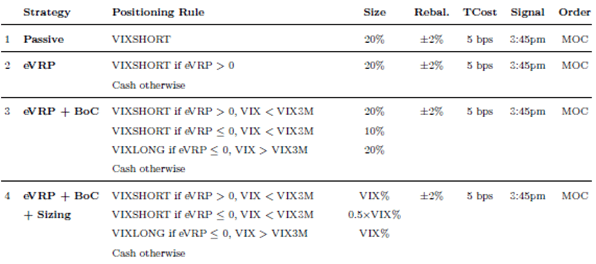
  • Strategy 1 is a benchmark, a continuous 20% position in VIXSHORT (modeled from the S&P 500 VIX Short-Term Futures Inverse Daily Index with 0.80% annual fee). The remaining 80% is in cash with no earned interest. Rebalancing occurs via market-on-close (MOC) trades whenever the VIXSHORT allocation drifts from 20% by at least 2% as measured daily at 3:45pm, with 0.05% trading frictions (Tcost).
  • Strategy 2 is the same as Strategy 1, except the VIXSHORT allocation is made only when the expected VRP (eVRP) is positive when measured daily at 3:45pm as VIX minus the annualized standard deviation of 10-day (3:45pm) SPDR S&P 500 ETF (SPY) returns.
  • Strategy 3 adds a signal to Strategy 2, with allocations to VIXSHORT or VIXLONG (modeled from S&P 500 VIX Short-Term Futures Index Total Return with 0.50% annual fee), depending on whether the 3:45pm VIX term structure is in backwardation or contango (BoC), meaning that 90-day implied volatility (VIX3M) is less than or greater than VIX.
  • Strategy 4 replaces the fixed allocations in Strategy 3 with allocations based on the 3:45pm level of VIX.

Using daily and 1-minute intraday data for the specified input variables during January 2005 through May 2025, they find that:

Subscribe to Keep Reading

Get the research edge serious investors rely on.

  • 1,200+ research articles
  • Monthly strategy signals
  • 20+ years of backtested analysis
$17.99 /month

Cancel anytime

Volatility and the VIX guide

More on volatility and returns

  • Are Low Volatility Stock ETFs Working? Premium Eight low volatility ETFs underperformed their benchmarks on CAGR (equal-weighted portfolio 8.2% vs 10.1% for benchmarks; max drawdown -21% vs -25%; monthly rebalanced; histories…
  • A Low-volatility Factor for Standard Models of Stock Returns? Premium Adding a low-volatility factor to long-minus-short gross-return factor models raised maximum Sharpe ratios by only 0.006, but with net-return market-hedged long legs it raised…
  • Machine Learning Predictions of Stock Returns and Volatilities Premium Double-sorting U.S. stocks on neural-network-predicted volatility and return yields long-short decile portfolios with gross Sharpe ratios of about 3.0 (equal-weighted) and 1.5 (value-weighted), 1.0…
  • Leveraging Low-volatility Stock Portfolios Premium Leveraging a multifactor low-risk global stock portfolio to beta 1.0 (monthly rebalanced, long-only, tracking error controlled) produced 15.2% vs 9.9% gross annualized return for…
  • Ways to Exploit the Low-volatility Effect Premium Three allocations that include a low-volatility strategy (100 lowest 36-month-volatility stocks of the largest 1,000 U.S. stocks) had higher Sharpe ratios than a 60%…

All 162 articles in the Volatility and the VIX guide