
How do exchange-traded-funds (ETF) focused on data centers, an arguably hot theme, perform? To investigate, we consider four such ETFs, all currently available, as follows:
We use Invesco QQQ Trust (QQQ) as a benchmark, assuming investors look at data center stocks as a way to beat other technology stocks. We focus on monthly return statistics, along with compound annual growth rates (CAGR) and maximum drawdowns (MaxDD). Using monthly total returns for the four data center ETFs and QQQ as available through January 2026, we find that:
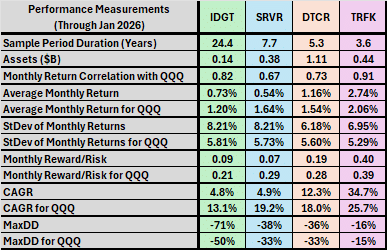
The following table summarizes sample periods and performance statistics based on monthly and full-sample data for the four data center ETFs and QQQ over available sample periods. Notable points are:
- All four data center ETFs exhibit moderately high monthly return correlations with QQQ.
- Only one of four has a higher average monthly return than QQQ.
- All have higher monthly volatilities than QQQ.
- Only the newest of the four has a (barely) higher monthly reward-to-risk ratio (average monthly return divided by standard deviation of monthly returns) than QQQ.
- One (TRFK, the newest with a very short sample) has a higher CAGR than QQQ.
- All four have slightly to moderately deeper MaxDDs than QQQ based on monthly measurements over available sample periods.
For perspective, we look at cumulative performance of the average data center ETF.
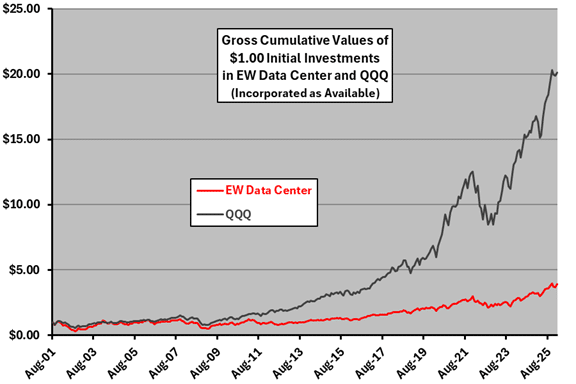
The following chart compares gross cumulative values of $1.00 initial investments in the average (equal-weighted, EW) data center ETF, rebalanced monthly with ETFs added as they become available, and QQQ. Results suggest that data center ETFs overall are less attractive than QQQ, with CAGR 5.8% versus 13.1% and MaxDD -71% versus -50%.
However, only IDGT exists for much of the sample period. What about recent performance?
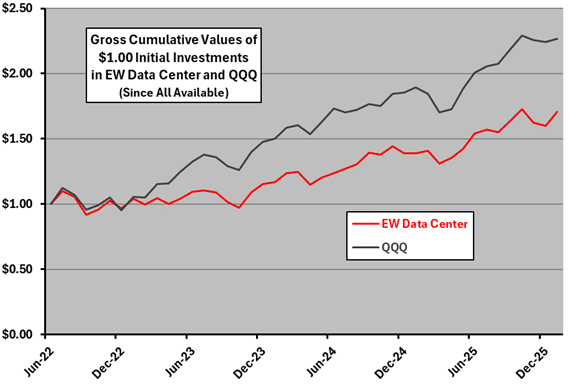
The final chart compares gross cumulative values of $1.00 initial investments in the average data center ETF since all are available in June 2022 and QQQ. Results still suggest that data center ETFs overall are less attractive than QQQ.
In summary, available evidence is that data center ETFs are less attractive than the broader technology exposure offered by QQQ.
Plans to build many more data centers based on artificial intelligence platform demands could change niche dynamics.
Cautions regarding findings include:
- Most available sample periods are short or very short, especially in terms of variety of economic/market conditions, undermining confidence in findings.
- Comparing data center ETFs to each other based on above data is problematic because sample periods differ.
Frequently Asked Questions
What is a data center ETF?
A data center ETF is an exchange-traded fund that holds stocks tied to data centers and digital infrastructure. Examples include IDGT (iShares U.S. Digital Infrastructure and Real Estate), SRVR (Pacer Data & Infrastructure Real Estate), DTCR (Global X Data Center & Digital Infrastructure) and TRFK (Pacer Data and Digital Revolution). Investors may view them as a way to beat other technology stocks.
Do data center ETFs outperform QQQ?
Data center ETFs have not outperformed QQQ based on available data through January 2026. An equal-weighted average of four data center ETFs (IDGT, SRVR, DTCR, TRFK), rebalanced monthly, delivered a 5.8% CAGR versus 13.1% for QQQ. Only TRFK, the newest ETF with a very short sample, had a higher CAGR than QQQ. The same conclusion held for the period since June 2022, when all four ETFs were available.
How can you compare the performance of data center ETFs to QQQ?
Data center ETFs can be compared to QQQ using monthly total returns, compound annual growth rate (CAGR) and maximum drawdown (MaxDD). The analysis also built an equal-weighted average of the four data center ETFs, rebalanced monthly with each added as it became available, and compared cumulative growth of $1.00 invested against QQQ. It also compared monthly average return, volatility, correlation with QQQ and reward-to-risk (average monthly return divided by standard deviation).
Are data center ETFs riskier than QQQ?
Data center ETFs have been riskier than QQQ based on available data through January 2026. All four ETFs had higher monthly volatility and deeper maximum drawdowns than QQQ, and the equal-weighted average had a MaxDD of -71% versus -50% for QQQ. Their monthly returns were moderately to highly correlated with QQQ, and only the newest ETF had a barely higher reward-to-risk ratio.
What are the limitations of evaluating data center ETF performance?
Evaluating data center ETF performance is limited by short sample periods, especially in terms of variety of economic and market conditions, which undermines confidence in the findings. Only IDGT exists for much of the full sample, and the ETFs' differing sample periods make comparing them with each other problematic. Plans to build many more data centers for artificial intelligence demands could also change niche dynamics.