
How real and substantial is confirmation bias as an inhibitor of individual investor and market belief adjustments? What factors affect its impact? In their July 2009 paper entitled “Feeling Validated Versus Being Correct: A Meta-Analysis of Selective Exposure to Information”, William Hart, Dolores Albarracin, Alice Eagly, Inge Brechan, Matthew Lindberg and Lisa Merrill survey a broad selection of past research measuring the degree to which people favor information that supports pre-existing attitudes, beliefs and behaviors over information that challenges pre-existing attitudes, beliefs and behaviors. Using results from 67 reports encompassing 91 separate studies of 300 statistically independent groups comprised of nearly 8,000 participants, they conclude that:
- People are almost two times more likely to select information confirming rather than disconfirming their prior beliefs and behaviors.
- Defensiveness generally has more explanatory power than desire for accuracy in explaining variations in this bias. Factors related to defensiveness (desire for accuracy) motivations explain 13% (7-8%) of the variation in confirmation bias.
- Various factors affect the degree to which individuals display confirmation bias (see the table below).
The following table summarizes findings in the paper regarding factors that affect the degree of confirmation bias exhibited by study participants. Interesting points are: (1) taking action on a belief increases resistance to disconfirming information; (2) the higher the quality of available information, the more people embrace confirming information and ignore disconfirming information; and, (3) higher confidence in their beliefs actually makes people more open to considering opposing sources.
For further discussion of closed-mindedness as a personal trait, see the hedgehog versus fox analogy in the review of Expert Political Judgment: How Good Is It? How Can We Know?.
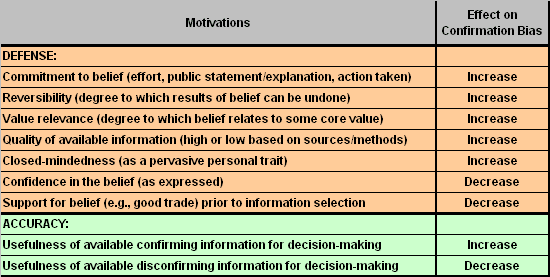
The authors observe that: “Selecting congenial [confirming] information can facilitate feeling validated about one’s view or even maintaining stable views of the world but may reduce accuracy and flexibility.”
In summary, evidence from many studies indicates that confirmation bias is substantial, with defensiveness outweighing desire for accuracy in driving a preference for confirming over disconfirming information. Individual investors may want to counteract this bias by doubling efforts to consider information in conflict with their beliefs.
Confirmation bias arguably inhibits incorporation of new information by both individual investors and by financial markets. Enforced peer/editorial reviews should mitigate confirmation bias in research and reporting to the extent that peers/editors hold diverse views and to the extent that there are incentives for accuracy (versus, for example, popularity or sales).
