
Who wins and who loses among equity investors, and why? In the December 2008 version of their paper entitled “Who Win and Who Lose Among Individual Investors?”, Kingsley Fong, David Gallagher and Adrian Lee compare the trading performances of three investor groups, those trading through: (1) institutional brokers; (2) discount retail brokers; and, (3) non-discount retail brokers. They define discount brokers as those offering trading services but no in-house research. They compare performances of these groups based on raw and risk-adjusted trading returns at the close on the trade date and at horizons of 1, 10, 25, 140 and 254 trading days. Using detailed intraday trading records for the Australian stock market spanning February 19, 1990 to December 1, 2005, they conclude that:
- From 1995 to 2005, discount (non-discount) brokers gained (lost) share of trading from 0.02% (14.4%) to 7.25% (10.0%) of turnover.
- The share of trading attributable to individual investors (retail brokers) relates inversely to firm capitalization, such that individuals account for about half of dollar volume in trading of smaller capitalization stocks.
- On average, individual investors (see the chart below):
- Incur a significant intraday trading loss to institutional investors, disproportionately due to the poor performance of discount broker clients.
- Extract a positive return from institutional investors during the first month after trades, attributable to the good performance of non-discount broker clients behaving as near-term (limit order) liquidity providers.
- Revert to losing to institutional investors more than a month after trades, attributable to the poor performance of discount broker clients getting untended limit orders picked off.
- The two main sources of underperformance for discount broker clients are:
- Aggressive (market order) and uninformed intraday trading, with the greatest losses derived from trading at the market open.
- Having passive (limit) orders picked off over time by other groups of traders who are monitoring the market more closely.
- Discount broker clients could apparently improve trading performance by: (1) trading at the close rather than the open; and, (2) placing longer-term limit orders further from the market price.
- Results are consistent across calendar years and firm size.
The following chart, constructed from data in the paper, compares the raw net cumulative trading performances over various holding periods of investors who trade through institutional, discount retail and non-discount retail brokers during 1995-2005. Net trading performance is the difference in returns from buys and sells measured from the trade date to the close on the same date and the closes 1, 10 ,25, 140 and 254 trading days later. Overall individual trading performance (combining discount and non-discount retail broker clients on a value-weighted basis) is the inverse of the institutional trading performance. Results show that institutional investors win at very short term and long horizons, non-discount broker clients win at the one-month horizon and discount broker clients generally lose to the other two groups.
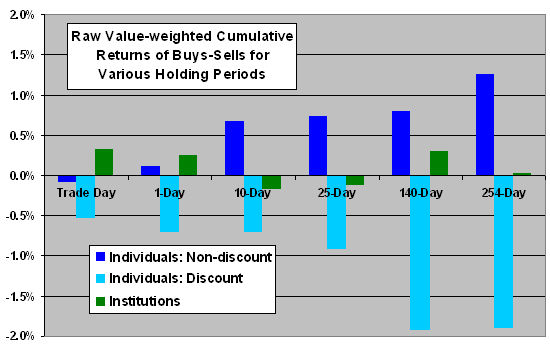
In summary, evidence indicates that discount retail broker clients lose money on average to both non-discount retail broker clients and institutional investors, while non-discount brokerage clients have some success trading against institutions.
Frequently Asked Questions
What is a discount retail broker and how does it differ from a non-discount broker?
A discount retail broker offers trading services but no in-house research, while a non-discount retail broker provides fuller service. In the study of Australian equities, discount brokers' share of trading grew from 0.02% to 7.25% of turnover over 1995-2005, while non-discount brokers' share fell from 14.4% to 10.0%.
Do individual investors lose money trading against institutional investors?
Individual investors lose to institutional investors overall, but the result depends on the type of broker and the horizon. In Australian equity data from 1995-2005, discount broker clients generally lost to both other groups, while non-discount broker clients gained at the one-month horizon. Institutions won at very short-term and long horizons, and overall individual performance was the inverse of institutional performance.
How is trading performance measured when comparing institutional and retail investors?
Trading performance is measured as the net difference in returns between buys and sells, from the trade date to the close on the same day and to the closes 1, 10, 25, 140 and 254 trading days later. The study used raw and risk-adjusted returns from detailed intraday trading records for the Australian stock market, spanning February 19, 1990 to December 1, 2005. Investors were grouped by whether they traded through institutional, discount retail or non-discount retail brokers.
Why do non-discount broker clients outperform discount broker clients in the short term?
Non-discount broker clients outperformed in the first month after trades because they acted as near-term liquidity providers using limit orders. Discount broker clients instead traded aggressively with uninformed market orders, with the largest losses at the market open, and had untended limit orders picked off over time. Beyond a month, individual investors as a whole reverted to losing to institutions, attributed to the discount clients' poor performance.
What mistakes cause retail investors to underperform, and can they be avoided?
Discount broker clients underperform mainly through aggressive, uninformed market-order trading, especially at the open, and through passive limit orders being picked off by more closely monitoring traders. The study suggests they could improve by trading at the close rather than the open and placing longer-term limit orders further from the market price. These findings come from Australian equities data for 1995-2005, and the results were consistent across calendar years and firm size.