
What kinds of returns do options traders actually achieve? In their January 2009 paper entitled “Investor Trading Behavior and Performances: Evidence from Taiwan Stock Index Options”, Bing Han, Yi-Tsung Lee and Yu-Jane Liu examine trading behavior and net returns for all traders of Taiwan stock index options. Using the complete record of transactions, orders and quotes for Taiwan stock index options during 2002-2005 (involving 238,303 individual investors, 1,076 domestic institutions, 50 foreign institutions and 29 market makers), they conclude that:
- Individual investors comprise the least successful group of index option traders. They take mostly long positions in calls and puts with time to maturity less than a month, and the average trade duration is under 5 days. Their average net return per trade is -3.4%. About 27% of individual option traders achieve overall positive net returns.
- Foreign institutions comprise the most successful group of index option traders. Their average net return per trade is an impressive 14.3%. Even so, only 46% of foreign institutional traders achieve overall positive net returns.
- For all investor groups, the average returns for long put positions are significantly lower than those for short put positions. In fact, the average realized returns from selling index puts are positive for all investor groups.
- For all investor groups except market makers, the average returns for long call positions are significantly lower than those for short call positions.
- Returns for all four types of trades vary considerably with past market return. The average return from buying (selling) calls after the market has risen the previous month is significantly smaller (larger) than that after a down month. Similarly, buying (selling) puts after a down month is money-losing (profitable) for all investor groups.
- Option trades initiated via market orders or aggressive limit orders have higher returns than those initiated with timid limit orders, perhaps because more informed traders tend to be more aggressive.
- The disposition effect (holding losing positions longer than winning positions) degrades index option trading performance. For all investor groups, investors with the most pronounced disposition effects achieve the lowest returns.
- Individual investor trading performance improves with experience and sophistication (as indicated by more frequent trading, larger trades, multiple open positions, trading of both index futures and index options, and complex trading strategies such as straddles).
The following table, constructed from data in the paper, summarizes the frequencies and dollar-weighted average returns of Taiwan stock index option trades by type over the entire four-year sample period for the least informed group (individual investors) and most informed group (foreign institutions). The table shows that individual investors are on average successful only with short puts, while foreign institutions are on average successful with all four types of trades.
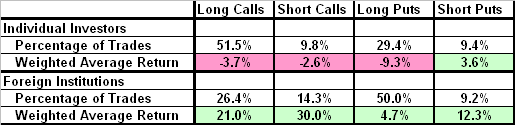
In summary, evidence suggests that individual index option traders tend to transfer wealth to institutional traders and market makers, but they can improve their probability of success by: (1) focusing on the short side of index options; (2) trading against trend; and, (3) practicing/learning.
Frequently Asked Questions
What is a Taiwan stock index option and who trades it?
A Taiwan stock index option is a derivative contract whose value depends on the level of a Taiwan stock index, traded as calls and puts. In the 2002-2005 data studied, participants included 238,303 individual investors, 1,076 domestic institutions, 50 foreign institutions and 29 market makers.
Do individual investors make money trading index options?
Individual investors mostly lose money trading index options. In Taiwan during 2002-2005, their average net return per trade was -3.4%, and only about 27% achieved overall positive net returns. Foreign institutions averaged 14.3% per trade, though only 46% of them were profitable overall.
How is index option trading performance measured across different investor groups?
Index option trading performance was measured using the complete record of transactions, orders and quotes for Taiwan stock index options during 2002-2005. Researchers computed average net return per trade and the share of traders with positive overall net returns for individuals, domestic institutions, foreign institutions and market makers. They also split returns by trade type (long/short calls and puts), past market return, order aggressiveness, disposition effect and investor experience.
Is selling index options more profitable than buying them?
Selling index options generally outperformed buying them in the Taiwan study. Average returns on long puts were significantly lower than on short puts for all investor groups, and realized returns from selling puts were positive for every group. Long calls also earned significantly less than short calls for all groups except market makers, and individual investors were profitable on average only with short puts.
What are the limitations of using Taiwan index option trading results to guide investing decisions?
The findings come from Taiwan index options during 2002-2005, so they may not generalize to other markets or periods. Even the most successful group, foreign institutions, saw only 46% of traders profitable overall, and the explanation that aggressive orders signal more informed traders is only suggested as a possibility ('perhaps'). The study shows average returns by group, not guaranteed outcomes for any individual using strategies like short selling, trading against trend or gaining experience.