
Is gold a prototypical hedge (based on average uncorrelated or negatively correlated behavior) and safe haven (based on uncorrelated or negatively correlated behavior during a market crash)? Two recent papers address this question. In the February 2009 update of their paper entitled “Is Gold a Hedge or a Safe Haven? An Analysis of Stocks, Bonds and Gold”, Dirk Baur and Brian Lucey examine the hedging/haven behavior of gold for stocks and bonds during normal market conditions and during extreme market events. In their September 2009 paper entitled “Is Gold a Safe Haven? International Evidence”, Dirk Baur and Thomas McDermott investigate whether gold represents a safe haven with respect to stocks of major emerging and developing countries. These studies conclude that:
“Is Gold a Hedge or a Safe Haven? An Analysis of Stocks, Bonds and Gold” examines whether gold acts as: (1) a hedge with returns that are on average uncorrelated or negatively correlated with those of stocks and bonds; and/or, (2) a haven that does not follow stock and bond values downward when they crash. Using daily MSCI stock and long-term bond indexes and daily spot gold prices from the end of November 1995 through November 2005 (ten years), the authors conclude that:
- Gold has a lower mean return than stocks and bonds over the sample period, with a volatility comparable to that of stocks.
- The long-run correlation of returns for U.S. stocks and gold is modestly negative, while the correlation of returns for U.S. bonds and gold is slightly positive. (See the table below.)
- Gold is therefore a hedge for U.S. stocks in that gold on average provides positive returns when stock returns are negative.
- Gold acts as a safe haven for U.S. stocks after extreme negative market shocks but only for about 15 trading days after crash onset. As stocks recover after a crash, gold resumes its hedging role and its returns turn negative. Stock-gold portfolios that purchase gold after a crashed market stabilizes underperform.
- Gold is neither a hedge nor a safe haven for U.S. bonds.
- Results are generally similar for the UK, but not for Germany.
- Results are not clearly consistent across subsamples, suggesting that stocks-bonds-gold relationships may vary with market conditions.
The following table, excerpted from the paper, shows the correlations of returns for U.S. stocks, U.S. bonds and gold for the entire 1995-2005 sample period.
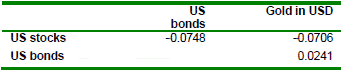
In summary, gold is both a hedge and a (short-lived) safe haven for U.S. stocks, but not for bonds.
“Is Gold a Safe Haven? International Evidence” investigates the correlations between gold returns and stock market returns in 13 countries over the past three decades. Using daily, weekly and monthly return data for the stock markets of the seven largest developed countries (G7), the largest emerging markets (BRIC), Australia and Switzerland and spot gold prices from the beginning of March 1979 to the beginning of March 2009, the authors conclude that:
- Over the entire sample period, the average daily/weekly/monthly returns of the world stock index are higher than those of gold, and gold returns have higher standard deviations than stock returns.
- Investment demand for gold has soared with introduction of gold-related Exchange-Traded Funds, thereby explaining the recent dramatic increase in gold price.
- Gold is both a hedge and a safe haven for the U.S. and major European stock markets, but not for Australia, Canada, Japan or BRIC countries. The safe haven effect is strongest for daily and weekly returns under very extreme market conditions in U.S. and European markets.
- Rising uncertainty (world stock index volatility) generally causes investors to seek out gold, but under conditions of extreme volatility gold co-moves with stock markets.
- With respect to specific events, gold was:
- A strong safe haven for most developed markets during the peak of the recent financial crisis.
- A strong safe haven for U.S. and Canadian markets during the 1987 stock market crash.
- Not clearly a safe haven for any stock market during the 1997 Asian crisis.
The following chart, taken from the paper, shows the rolling 250-trading day correlation between U.S. stock market returns and gold returns (in U.S. dollars) based on daily data. Patterns are qualitatively similar for stock market returns in other countries. Since the correlation is sometimes positive and sometimes negative, gold is not always a hedge for stocks.
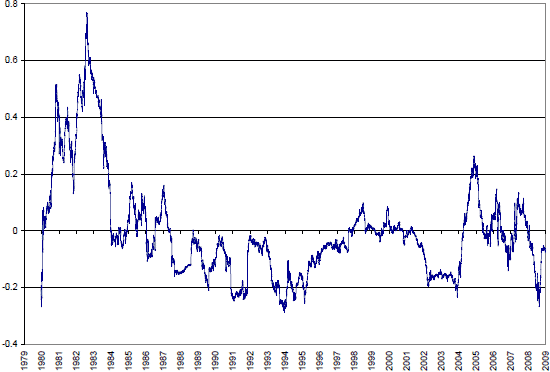
In summary, gold is generally a hedge and safe haven for stocks in developed markets, but not in emerging markets.
Frequently Asked Questions
What is the difference between a hedge and a safe haven in investing?
A hedge is an asset whose returns are, on average, uncorrelated or negatively correlated with another asset such as stocks or bonds. A safe haven is an asset that is uncorrelated or negatively correlated with that other asset specifically during a market crash. Gold is the asset tested for both roles in the underlying studies.
Is gold a safe haven for stocks during market crashes?
Gold is a safe haven for U.S. and major European stocks, but not for Australian, Canadian, Japanese or BRIC stocks, and not for bonds. In the U.S. sample (1995-2005), the safe haven effect lasted only about 15 trading days after a crash began. The effect was strongest for daily and weekly returns under very extreme market conditions.
How do researchers test whether gold is a hedge or safe haven?
Researchers compare gold returns with stock and bond returns using correlations of daily (and in one study weekly and monthly) data. A hedge is identified by average uncorrelated or negative correlation over the full sample, and a safe haven by such behavior during extreme market declines. One study used MSCI stock and long-term bond indexes with spot gold from 1995 to 2005, and another used 13 countries' stock markets with spot gold from 1979 to 2009.
How does gold's role differ for developed market stocks versus emerging market stocks and bonds?
Gold is both a hedge and a safe haven for U.S. and major European stocks, but it is neither for bonds, nor for Australia, Canada, Japan or BRIC stocks. U.S. stock-gold correlation was modestly negative and U.S. bond-gold correlation slightly positive over 1995-2005. Results were generally similar for the UK but not for Germany in the bond-and-stock study.
Why isn't gold always a reliable hedge or safe haven for stocks?
Gold's correlation with stocks is sometimes positive and sometimes negative over time, so it is not always a hedge. Its safe haven effect is short-lived (about 15 trading days in the U.S. sample), and under extreme volatility gold can co-move with stock markets. Results were also not clearly consistent across subsamples, and gold was not clearly a safe haven for any stock market during the 1997 Asian crisis.