
Fed Model proponents argue that there is an equilibrium relationship between the earnings yield of a stock index and the 10-year government bond yield. When the earnings yield is below (above) the 10-year government bond yield, the stock market is overvalued (undervalued). In their August 2005 working paper entitled “An International Analysis of Earnings, Stock Prices and Bond Yields”, Alain Durré and Pierre Giot assess the relationships among stock index prices, earnings and long-term government bond yields for 13 countries (Australia, Austria, Belgium, Canada, Denmark, France, Germany, Italy, Japan, Switzerland, The Netherlands, United Kingdom and the United States) over a 30 year period. Using current earnings for total market indexes over the period 1973-2003, they conclude that:
- A long term relationship among stock indexes, earnings and long-term government bond yields does exist for many countries.
- However, the long term government bond yield does not determine an “equilibrium” stock market valuation. This finding supports past studies that stress valuation ratios (such as the price/earnings ratio) in forecasting long-run stock market performance. It does not support market pundits who assert that low interest rates should produce low earnings yields and therefore high stock prices. (See chart below.)
- Any stock market forecasting exercise based on stock prices and earnings (with or without consideration of interest rates) is unlikely to be financially significant on a short-term (e.g., quarterly) basis.
- Changes in bond yields do impact short term stock market returns, consistent with arbitrage effects and/or impacts of margin interest fluctuations.
The following chart, adapted from the paper, compares the actual U.S. total stock market behavior with fair value calculations based on earnings and interest rates, and on earnings only.
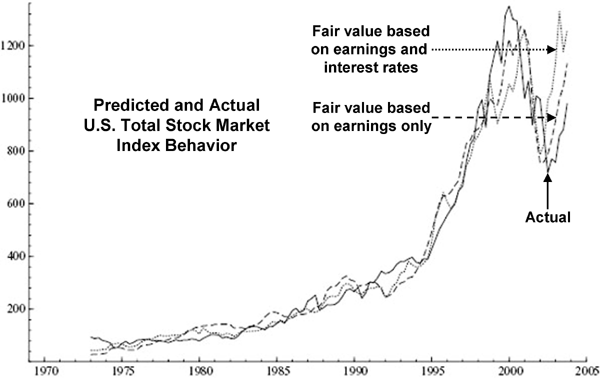
In summary, while changes in bond yields have short-term effects on stock prices, valuation ratios better forecast long-term stock market behavior.