
Does media coverage of hedge funds indicate their values as investments? In their July 2010 paper entitled “Media and Investment Management”, Gideon Ozik and Ronnie Sadka investigate the level and investment implications of media bias by applying textual analysis to titles of articles from three types of news coverage about equity hedge funds (General newspapers, Specialized investment magazines, and Corporate communications). They frame their investigation by hypothesizing three aspects of bias: reporting style, editorial selection and content. Using the Google News archive to collect approximately 67,000 news articles from about 3,600 unique media sources on a sample of 774 long/short U.S. equity hedge funds over the period 1999-–2008, they find that:
- When multiple sources cover a hedge fund at the same time, sentiment is most positive in
Corporate coverage and least positive in General coverage (reporting style bias). - When coverage is exclusive within a given month, this difference in source sentiment is about twice as large (editorial selection bias).
- There appears to be a content bias in that, on average, funds covered exclusively by Corporate (General) media produce a positive (negative) return over the following year (see the chart below).
- These biases generally persist after controlling for hedge fund characteristics such as past returns and assets under management.
- Based on fund flow analysis, investors appear not to exploit media coverage as a sentiment indicator.
The following chart, constructed from data in the paper, summarizes average (equally weighted) monthly returns for groups of hedge funds formed each month based on exclusive coverage by each of the three media types the prior month. Returns by media type are similar whether measured simply in excess of the risk-free rate or adjusted for multiple risk factors common to long/short U.S. equity hedge funds.
Exclusive Corporate (General) media coverage tends to precede positive (negative) returns, with exclusive Specialized media coverage falling in between.
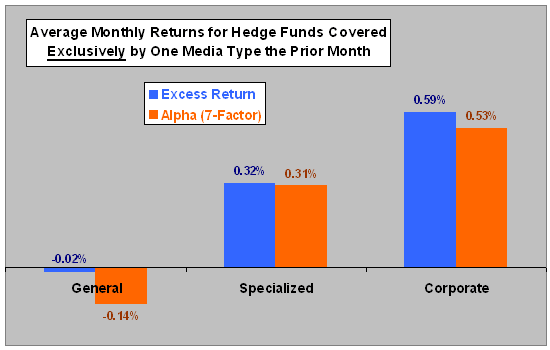
In summary, evidence indicates that hedge fund investors may be able to gain an edge by limiting consideration to funds with recent corporate releases but no other recent media coverage.
However, fund trading restrictions would likely limit systematic exploitation of media bias.
Frequently Asked Questions
What is media bias in hedge fund coverage?
Media bias in hedge fund coverage is the systematic difference in how news sources portray hedge funds, measured by the sentiment of article titles. The study frames it as three aspects: reporting style, editorial selection, and content. It examined General newspapers, Specialized investment magazines, and Corporate communications covering 774 long/short U.S. equity hedge funds from 1999 to 2008.
Does media coverage of a hedge fund predict its future returns?
Media coverage of a hedge fund is associated with subsequent returns, depending on the source. Funds covered exclusively by Corporate media tended to produce positive returns over the following year, while those covered exclusively by General media tended to produce negative returns, with Specialized media in between. These patterns generally persisted after controlling for past returns and assets under management, and the finding is descriptive rather than a trading test.
How is media sentiment about hedge funds measured and tested?
Media sentiment about hedge funds was measured by applying textual analysis to the titles of about 67,000 articles from roughly 3,600 unique sources, collected from the Google News archive for 1999-2008. Articles were grouped into General, Specialized, and Corporate coverage. Hedge funds were then grouped each month by exclusive coverage type in the prior month, and their average equally weighted monthly returns were compared, both in excess of the risk-free rate and adjusted for multiple risk factors.
How does sentiment differ between corporate press releases and general newspaper coverage of hedge funds?
Sentiment about hedge funds is most positive in Corporate coverage and least positive in General newspaper coverage, with Specialized investment magazines in between. When multiple sources cover a fund at the same time, this gap reflects reporting style bias. When coverage is exclusive within a month, the gap is about twice as large, reflecting editorial selection bias.
Can investors profit from hedge fund media bias, and what are the limitations?
Investors may gain an edge by limiting consideration to hedge funds with recent corporate releases but no other recent media coverage, but systematic exploitation of media bias is likely limited by fund trading restrictions. The study is descriptive rather than a trading test, covers only 774 long/short U.S. equity hedge funds over 1999-2008, and found that investors' fund flows did not appear to use media coverage as a sentiment indicator.