
How active are active traders? What are the odds that an active trader will make a profit? How are winners different from losers? In their recent paper entitled “The Profitability of Active Stock Traders”, Ryan Garvey and Anthony Murphy examine the outcomes for a large group of active traders over a three-month period. Using data for over 400,000 trades by 1,386 day traders from a direct access broker in the U.S. over the period March 8, 2000 through June 13, 2000 (68 trading days), they find that:
- Trading involved mostly large-capitalization Nasdaq stocks.
- Traders are most active in the morning and least active at midday, with 80% of all positions closed out intraday. Most trades are via limit orders.
- About 55% of all round-trip trades and about 50% of the 1,386 day traders make a profit after commissions. Some traders consistently make large net profits.
- All traders have trouble making a profit when market makers are involved in the transactions. Profitable trading goes through ECNs.
- The characteristics of profitable and unprofitable traders are very similar, including time of day, exchange used and stocks traded. The data is insufficient to distinguish clearly between luck and skill, although there is consistency of winners and losers across different stocks.
- Results suggest that relatively skilled day traders take money from relatively unskilled day traders in a zero-sum game.
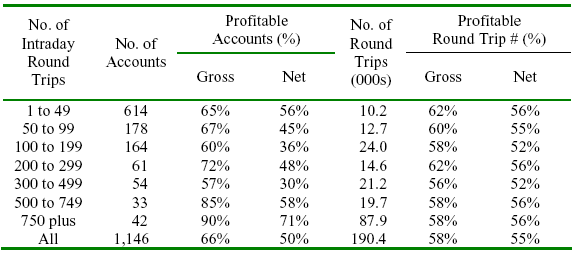
The following table, taken from the paper, shows the percentage of trading accounts and round-trip trades that were profitable before (gross) and after (net) commission. It ranks accounts by number of intraday round-trip trades conducted over the sample period (1,146 of the 1,386 accounts in the dataset engaged in at least one intraday round-trip). The data thinly suggests that the most and least active accounts tend to be the most profitable.
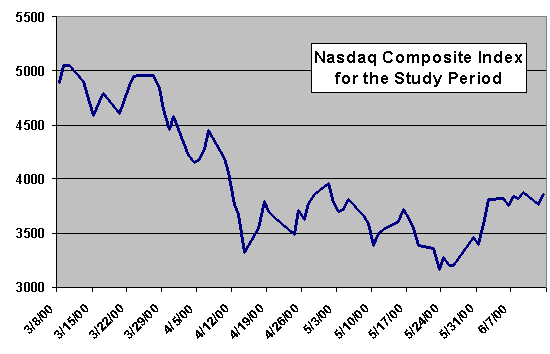
For context, the following chart shows the behavior of the Nasdaq Composite Index during the three-month period of the study, which included a sickening drop of nearly 40%. The traders in this group must have engaged in considerable short selling to achieve the level of success recorded. It would be interesting to measure the performance of the same group during the immediately preceding three months when the index rose dramatically. Were they adaptively trading long during that prior run-up, or losing big trying to call a top?
In summary, this evidence suggests that the average day trader breaks even and that the most active traders may be the most successful.
Frequently Asked Questions
What is a day trader and how is active stock trading different from investing?
A day trader is an active trader who opens and closes stock positions within the same day, aiming to profit from short-term price moves rather than long-term holdings. In the study of 1,386 day traders at a U.S. direct access broker (March 8 to June 13, 2000), about 80% of all positions were closed out intraday. Trading was mostly in large-capitalization Nasdaq stocks, largely via limit orders.
Do day traders actually make money after commissions?
Day traders as a group roughly break even after commissions. In the study of 1,386 day traders and over 400,000 trades from March to June 2000, about 50% of traders and about 55% of round-trip trades were profitable net of commissions. Some traders consistently made large net profits, and the most active traders may have been the most successful, though the data only thinly supports this.
How is day trader profitability measured and tested?
Day trader profitability in the study was measured using direct access broker data covering over 400,000 trades by 1,386 traders over 68 trading days (March 8 to June 13, 2000). Profitability was assessed as the percentage of accounts and round-trip trades that were profitable before (gross) and after (net) commissions. Accounts were ranked by number of intraday round-trip trades, with 1,146 of the 1,386 accounts making at least one intraday round-trip.
Is day trading a zero-sum game where skilled traders profit from unskilled traders?
Day trading appears to be a zero-sum game in which relatively skilled traders take money from relatively unskilled traders, according to the study's results. Profitable and unprofitable traders looked very similar in time of day traded, exchange used and stocks traded. All traders had trouble profiting when market makers were involved in transactions, while profitable trading went through ECNs.
What are the limitations of studies on day trader profitability?
The day trader profitability study has limitations because its data is insufficient to clearly distinguish luck from skill, although winners and losers were consistent across different stocks. The sample covers only about three months (March 8 to June 13, 2000), a period when the Nasdaq Composite fell nearly 40%, so results may reflect that market environment and likely heavy short selling. The evidence for the most active traders being most profitable is described as thin.