
Are the performances of individual hedge funds exploitably predictable? In the July 2010 version of their paper entitled “Hedge Fund Predictability Under the Magnifying Glass: The Economic Value of Forecasting Individual Fund Returns”, Doron Avramov, Laurent Barras and Robert Kosowski investigate whether investors can exploit the predictability of individual hedge fund returns. They consider four potential predictors: (1) the default spread (between Moody’s BAA and AAA rated bonds); (2) the broad stock market dividend yield; (3) the implied volatility of the S&P 500 Index (VIX); and, (4) the monthly net aggregate flow into the hedge fund industry. Using monthly values of these predictors, commonly used hedge fund risk factors and returns for 7,991 individual hedge funds in ten distinct categories over the period 1994-2008, they find that:
- For a 1994-2007 in-sample analysis (i.e, using all the data at once), the four selected predictors significantly predict future returns of 60.5% of hedge funds (ranging from from 31.1% of managed futures funds to 83.7% of convertible arbitrage funds). A likely interpretation is that predictability derives from persistent skill(s) related to specific economic conditions.
- An out-of-sample test that selects the top tenth of funds as an investment portfolio each year based on a rolling three-year window of historical data during 1994-2007 (with 1997 therefore the first portfolio year) indicates that:
- Using only past returns to rank funds generates an attractive seven-factor annual alpha of 5.8%, an information ratio of 2.4 and a Sharpe ratio of 1.8.
- Strategies that add one of the four predictors to help predict returns underperform this past performance strategy on a risk-adjusted basis, apparently because predictability is asymmetrical with respect to a predictor being above or below its mean (e.g., more funds react predictably when a predictor is above than below its mean).
- A multi-predictor strategy that adds all predictors simultaneously (multiple regression) yields the worst performance.
- A strategy that combines individual predictor forecasts by averaging their predictive powers (t-statistics) enhances the past performance strategy, generating a seven-factor annual alpha of 7.0%, an information ratio of 2.7 and a Sharpe ratio of 1.9. This combination strategy also offers low tail risk, low exposure to common risk factors, low liquidity risk, the second lowest turnover and good diversification across hedge fund categories.
- The performance enhancement of the combination strategy persists after including data for 2008 (which introduces dramatic deviation of all four predictors from their historical means), offering a seven-factor annual alpha of 6.0% versus 4.1% for the past performance strategy.
The following chart, taken from the paper, compares the cumulative values of $1.00 initial investments in the past performance strategy and the combination strategy from January 1997 through December 2007, thereby quantifying the incremental value of applying the four predictors by averaging.
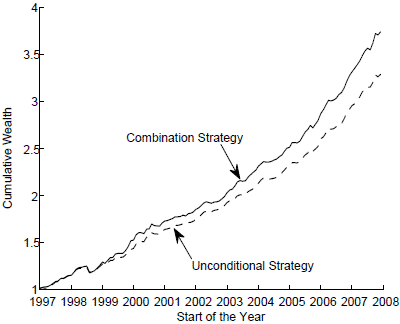
In summary, evidence indicates that large (diversified) hedge fund investors may be able to exploit multiple predictive factors by averaging their predictive powers to enhance returns derived from selecting recent past winners.
Frequently Asked Questions
What is hedge fund return predictability and what predictors are used to forecast it?
Hedge fund return predictability is the ability to forecast an individual fund's future returns using economic variables, which likely reflects persistent manager skill tied to specific economic conditions. The study examines four predictors: the default spread (Moody's BAA minus AAA), the stock market dividend yield, the VIX (implied S&P 500 volatility), and monthly net aggregate flows into the hedge fund industry.
Can economic predictors improve hedge fund selection beyond just picking recent top performers?
Economic predictors can improve hedge fund selection, but only when their forecasts are combined by averaging. A strategy averaging the predictors' t-statistics produced a seven-factor annual alpha of 7.0% versus 5.8% for ranking on past returns alone, with information ratios of 2.7 versus 2.4 (top-decile portfolios, 1997-2007). Adding a single predictor underperformed past returns on a risk-adjusted basis.
How is a hedge fund selection strategy tested out-of-sample using a rolling window?
The out-of-sample test selects the top tenth of hedge funds each year as an investment portfolio, using a rolling three-year window of historical data from 1994-2007, so 1997 is the first portfolio year. The data cover 7,991 individual hedge funds in ten categories, and performance is judged by seven-factor alpha, information ratio and Sharpe ratio. The combination strategy averages the predictive powers (t-statistics) of the four individual predictor forecasts.
Is averaging several predictors better than putting them all in one multiple regression for picking hedge funds?
Averaging predictors' forecasts performed better than a multiple regression that includes all four predictors simultaneously, which yielded the worst performance of all strategies tested. Averaging t-statistics produced a 7.0% seven-factor annual alpha, beating the 5.8% from past returns alone. The combination strategy also showed low tail risk, low liquidity risk, low exposure to common risk factors, the second lowest turnover and good diversification across fund categories.
What are the limitations of using economic predictors to select hedge funds?
Predictability is asymmetrical, since more funds react predictably when a predictor is above its mean than below it, which is why single-predictor strategies underperformed past-performance ranking. Extreme conditions also weaken results: including 2008, when all four predictors deviated dramatically from their means, the combination strategy's alpha fell to 6.0% (versus 4.1% for past performance). The article suggests the approach suits large, diversified hedge fund investors and that predictability varies widely by category, from 31.1% of managed futures funds to 83.7% of convertible arbitrage funds.