
We have selected for retrospective review a few all-time “best selling” research papers of the past few years from the General Financial Markets category of the Social Science Research Network (SSRN). Here we summarize the March 2004 update of the paper entitled “Company Valuation Methods: The Most Common Errors in Valuations” (download count over 6,000) by Pablo Fernandez. In this paper, the author describes the four most widely used company valuation methods: (1) balance sheet-based; (2) income statement-based; (3) goodwill-based; and, (4) cash flow discounting-based. He also illustrates a break-up value calculation and summarizes the valuation errors he has most commonly encountered. He states that:
- Balance sheet-based methods estimate a company’s value by determining the value of its assets (book value, adjusted book value, liquidation value, replacement value). This view is static, ignoring potential company opportunities and problems. In general, book value does not match market value.
- Income statement-based methods estimate a company’s value as a multiple of its earnings, dividends, sales or EBITDA.
- Goodwill-based (mixed) methods estimate a company’s value by first valuing its assets and then adding a quantity related to future earnings, goodwill. Goodwill represents an advantage over competitors (for example, brand power). There is no consensus on how to calculate goodwill.
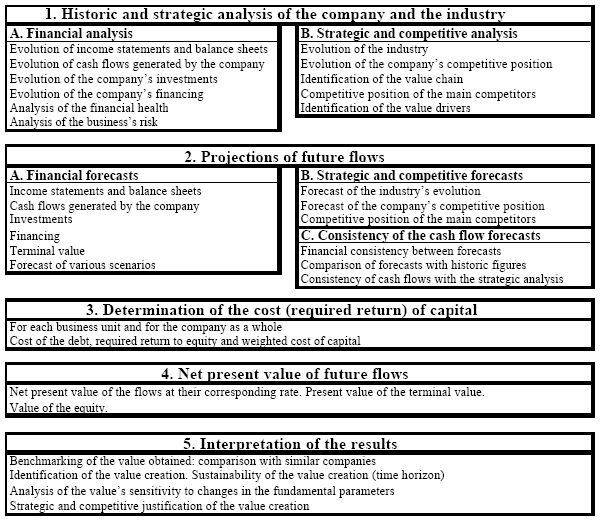
- Cash flow discounting-based methods (see first chart below) estimate a company’s value by forecasting its future cash flow and then discounting the flow based on its risk. The approach is conceptually like cash budgeting. Determining the discount rate is critical. Because they are the only conceptually correct valuation methods, cash flow discounting models are the most widely used.
The following chart, taken from the paper, shows the steps in valuation via cash flow discounting. It illustrates the complexities and uncertainties that analysts and investors face in guesstimating whether a company’s stock is overvalued or undervalued. Few investors have the resources to attempt the process — hence the broad investor reliance on gurus and on simple fundamental and technical indicators, and the advantage of company insiders.
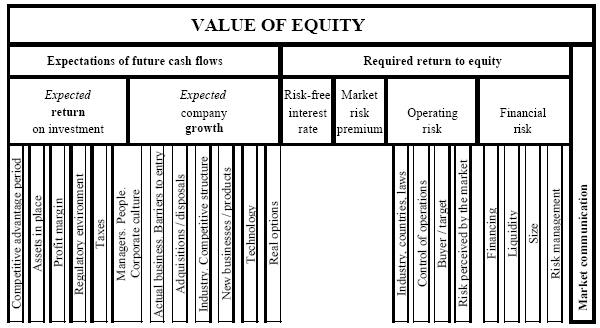
In summary, the value of a company’s equity depends on its future cash flows (derived from the company’s growth rate and return on investment) and on the required return on equity (derived from the risk-free rate and the company’s operating and financial risks). The following chart decomposes these value drivers. Investors who are stock pickers should understand how the companies they choose stand with respect to these drivers.
Frequently Asked Questions
What is company valuation and what are the main methods used to value a business?
Company valuation is the process of estimating what a business is worth, and Pablo Fernandez's 2004 paper identifies four widely used methods: balance sheet-based, income statement-based, goodwill-based (mixed), and cash flow discounting-based. Each estimates value differently, using assets, earnings multiples, assets plus goodwill, or discounted future cash flows.
Is discounted cash flow the most correct way to value a company?
Fernandez argues in his 2004 paper that cash flow discounting methods are the only conceptually correct company valuation approach, which is why they are the most widely used. This is a theoretical argument rather than an empirical test, and it depends on forecasting future cash flows and choosing a risk-appropriate discount rate.
How does cash flow discounting work to estimate a company's equity value?
Cash flow discounting estimates a company's value by forecasting its future cash flows and discounting them based on risk, similar to cash budgeting. Equity value depends on future cash flows, derived from the company's growth rate and return on investment, and on the required return on equity, derived from the risk-free rate and the company's operating and financial risks. Determining the discount rate is critical.
How does book value differ from market value in company valuation?
Book value, the basis of balance sheet-based valuation, generally does not match a company's market value. Balance sheet methods give a static view of assets (book, adjusted book, liquidation or replacement value) and ignore the company's opportunities and problems, whereas cash flow discounting incorporates expected future cash flows.
What are the limitations and difficulties of valuing a company with discounted cash flows or goodwill methods?
Cash flow discounting requires complex, uncertain forecasts and a critical discount rate choice, so few investors have the resources to do it well, leading many to rely on gurus or simple fundamental and technical indicators and giving company insiders an advantage. Goodwill-based methods have no consensus on how to calculate goodwill, the value of competitive advantages such as brand power.