
Should long-term investors view their retirement portfolios more like houses than savings plans? In other words, should they start out with considerable leverage and draw the leverage down gradually over time? In their October 2010 paper entitled “Diversification Across Time”, Ian Ayres and Barry Nalebuff investigate the effects of initially implementing and then gradually phasing out leverage for long-term (retirement) equity investment. This strategy exploits the large present value of investments made early in life, while protecting accumulated wealth from equity market volatility late in life. Tests limit initial leverage to 200%. Using return data for U.S. stocks and margin interest rate estimates over the period 1871 through 2009, they conclude that:
- Over the entire sample period, U.S. equities generated an annualized nominal return of 8.83%, while the comparable cost of margin was 5.01%. The 3.82% difference drives the benefits of leverage early in life.
- For example, by more evenly spreading exposure to equities over time, a portfolio with 200% initial allocation to stocks produces on average the same terminal value as one with a constant 75% allocation to stocks, but realizes a 21% smaller annual standard deviation .
- In general, derivative markets have made it inexpensive to apply 200% leverage. Alternative sources of reasonably low effective margin interest rates include:
- Margin loans from aggressive brokers.
- Leveraged index funds.
- Stock index futures.
- Deep-in-the-money, long-range call options on stock indexes (perhaps the most cost-effective approach).
- The strategy is generally robust to moderate reductions in the the spread between equity return and margin interest rate, and has little margin call risk.
- The strategy also outperforms constant equity exposure for UK and Japanese stock indexes.
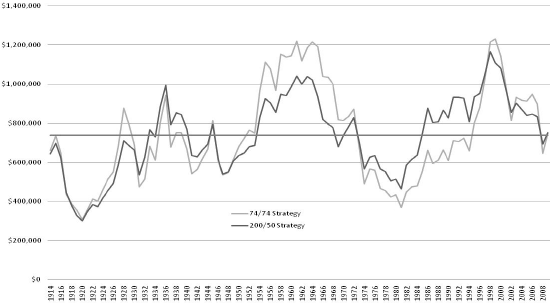
The following chart, taken from the paper, plots the terminal values for 96 cohorts of investors after a 44-year investing lifetime (with uniform income profile) starting in 1871 and ending in 2009 based on two comparable strategies:
- The 200/50 strategy initially invests 200% of liquid savings (4% of income annually) in the stock market and ramps this percentage down to 50% as retirement approaches.
- The 74/74 strategy invests a constant 74% of liquid savings in the stock market, producing the same average terminal value as the 200/50 strategy (same effective stock market exposure).
The 200/50 strategy lowers volatility relative to the 74/74 strategy, essentially channeling the incremental benefits of better diversification across time to risk reduction. Other calculations demonstrate that the 200/50 strategy also outperforms a 90/50 strategy.
The authors note that the study “ignores the impact of human capital or housing investments on the optimal retirement investment.” As noted by a reader, to the extent that an investor’s labor income and home equity correlate with stock market returns, the investor should include these implicit dependencies on stock market performance in estimating stock market leverage.
In summary, evidence from a range of tests indicates that diversifying stock investments over time by using leverage when young offers a return/risk advantage at retirement over both a constant allocation and a declining but initially unleveraged allocation.
Other than the margin interest rate for leverage, the authors do not address costs of portfolio formation and maintenance. For example, index mutual funds and exchange-traded funds charge fees and incur trading costs that make them underperform their benchmark indexes. Moreover, such funds are not available for much of the sample period. Alternatively, investors creating their own index portfolios, whether from stocks or derivatives (available only late in the sample period), incur trading frictions via broker fees and bid-ask spreads. Realistic costs of portfolio formation and maintenance may materially dent the advantage of the early leverage strategy.
Frequently Asked Questions
What is a leveraged lifecycle investing strategy for retirement?
A leveraged lifecycle investing strategy starts a long-term retirement portfolio with borrowed money to hold more than 100% in stocks, then gradually reduces leverage as retirement approaches. In the Ayres and Nalebuff study, initial equity exposure was capped at 200% of liquid savings and ramped down to 50%. The goal is to exploit the large present value of early-life investments while protecting accumulated wealth from stock market volatility late in life.
Does using leverage when young improve retirement outcomes compared with a constant stock allocation?
Using leverage when young improved the return/risk profile at retirement in Ayres and Nalebuff's tests of U.S. data from 1871 through 2009. A 200% initial stock allocation declining to 50% matched the average terminal value of a constant 74% allocation while cutting annual standard deviation by 21%. The strategy also outperformed a 90/50 declining allocation without initial leverage and beat constant exposure for UK and Japanese stock indexes.
How is a 200/50 leveraged lifecycle stock strategy tested against a constant allocation?
The 200/50 strategy was tested by simulating 96 cohorts of investors, each investing for 44 years with a uniform income profile, starting in 1871 and ending in 2009. Each investor saved 4% of income annually, initially invested 200% of liquid savings in stocks, and ramped exposure down to 50% near retirement. Results were compared with a constant 74% allocation chosen to produce the same average terminal value, using an 8.83% annualized equity return and a 5.01% margin cost.
How can investors get 200% stock exposure, and which method is most cost-effective?
Investors can reach 200% stock exposure through margin loans from aggressive brokers, leveraged index funds, stock index futures, or deep-in-the-money, long-range call options on stock indexes. The article suggests the call options approach is perhaps the most cost-effective. Derivative markets have made applying 200% leverage inexpensive, and the strategy's benefit depends on the 3.82% gap between the 8.83% equity return and the 5.01% margin cost.
What are the limitations and risks of leveraging stock investments early in life?
The Ayres and Nalebuff study ignores human capital and housing investments, which may correlate with stock market returns and should affect optimal leverage. It also does not address portfolio formation and maintenance costs beyond margin interest, such as fund fees, trading frictions, broker fees and bid-ask spreads. Realistic costs may materially dent the advantage, and index funds and derivatives were unavailable for much of the 1871-2009 sample.