
Are high-yield government bonds good bets? In his January 2016 paper entitled “Finding Yield in A 2% World”, Mebane Faber applies a simple value metric to global government bonds. He specifies a value portfolio as the equally weighted third (Top 33%) of 30 government bonds with the highest nominal yields, reformed/rebalanced monthly. He considers two benchmarks: (1) an equally weighted portfolio of all 30 bonds (Equal Weight); and, (2) a GDP-weighted index of 10-year government bonds of 17 non-U.S. developed countries (Foreign 10-year). He also considers performance of U.S. government Treasury bills (T-bills), 10-year notes and 30-year bonds. Using monthly total returns for the specified bonds in U.S. dollars during 1950 through 2012, he finds that:
- Long-term gross performance increases systematically with nominal yield, with gross annual Sharpe ratios ranging from 0.13 for the bottom fourth of yields to 0.57 for the top fourth.
- On a gross basis over the entire sample period, the Top 33% portfolio (see the table below):
- Beats bond portfolio benchmarks by at least 2% per year.
- Does not have an extraordinarily high maximum drawdown.
- Is potentially diversifying, with low monthly return correlations with U.S. Treasury notes and bonds (-.06 to 0.16), and with the S&P 500 Index (0.28) and gold (0.31).
- The Top 33% portfolio beats the other bond portfolios in most decades.
- Current yield for the Top 33% portfolio is about 7%, compared to 3.6% for an equally weighted portfolio of bonds for all 30 countries.
The following table, excerpted from the paper, compares gross performance statistics for the Top 33% portfolio to those for various benchmarks. Results indicate that Top 33% gross performance is generally attractive and effectively diversifies U.S. Treasuries.
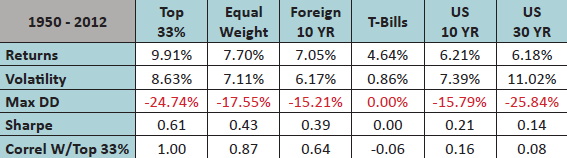
In summary, evidence indicates that apparently risky high-yield government bonds are potentially attractive yield-boosters and diversifiers of U.S. Treasury notes and bonds.
Cautions regarding findings include:
- Results do not account for trading frictions for monthly portfolio reformation/rebalancing. These frictions would reduce performance and may differ across the portfolios presented. In mitigation, the author reports that results are similar for annual reformation/rebalancing.
- Investors may not have efficient access to Top 33% bonds, and would bear management and administrative fees for access through a fund or funds that maintain a rolling portfolio of these bonds.
- Per the paper, short-term currency exchange rate variations “can have major impact on returns.” In other words, investors should view high-yield government bonds as a long-term allocation.
- As noted in the paper, the Top 33% portfolio involves some ostensibly unstable countries, but historical data indicate that volatility/drawdowns are not extreme.
Frequently Asked Questions
What is a high-yield government bond value strategy?
A high-yield government bond value strategy buys the government bonds with the highest nominal yields among a global set of countries and rebalances regularly. In Mebane Faber's January 2016 paper, the value portfolio is the equally weighted top third (Top 33%) of 30 government bonds by nominal yield, reformed monthly.
Do high-yield government bonds outperform other government bonds?
Yes, high-yield government bonds outperformed on a gross basis in Faber's 1950-2012 sample. The Top 33% portfolio beat bond benchmarks by at least 2% per year (about 9.6% versus 7.4% annually for the equally weighted 30-country portfolio) and beat the other bond portfolios in most decades. Gross Sharpe ratios rose with yield, from 0.13 for the bottom fourth to 0.57 for the top fourth.
How is a high-yield government bond portfolio constructed and tested?
The portfolio ranks 30 government bonds by nominal yield each month, holds the equally weighted top third, and rebalances monthly. Faber tested it using monthly total returns in U.S. dollars from 1950 through 2012, comparing it with an equally weighted portfolio of all 30 bonds, a GDP-weighted index of 10-year bonds from 17 non-U.S. developed countries, and U.S. T-bills, 10-year notes and 30-year bonds.
Do high-yield government bonds diversify U.S. Treasuries and stocks?
High-yield government bonds in the Top 33% portfolio appear potentially diversifying, with low monthly return correlations to U.S. Treasury notes and bonds (-0.06 to 0.16). Correlations were also modest with the S&P 500 Index (0.28) and gold (0.31). The portfolio's yield was about 7% versus 3.6% for the equally weighted 30-country bond portfolio.
What are the risks and limitations of investing in high-yield government bonds?
The Top 33% results are gross figures that exclude trading frictions from monthly rebalancing, though the author reports similar results with annual rebalancing. Investors may lack efficient access to these bonds and would bear fund fees, and short-term currency swings can heavily affect returns, so the strategy suits a long-term allocation. The portfolio also includes ostensibly unstable countries, although historical volatility and drawdowns were not extreme.