
What part of the day offers the best stock returns? Does this sweet spot vary by day of the week, time of the month or calendar month? In their July 2007 paper entitled “Return Differences between Trading and Non-trading Hours: Like Night and Day”, Michael Cliff, Michael Cooper and Huseyin Gulen use transaction-level data to decompose returns for individual stocks and exchange-traded funds (ETF) into four time intervals: Night (4:00 PM to 9:30 AM), AM (9:30 AM to 10:30 AM), Mid-day (10:30 AM to 3:00 PM), and PM (3:00 PM – 4:00 PM). Using intraday price data for the period 1993-2006, they conclude that:
- Over the last decade, overnight returns are strongly positive, and daytime returns are close to zero and sometimes negative. Specifically, during 1993-2006, average overnight returns for the individual S&P 500 stocks range (depending on the averaging method) from 0.028% to 0.048%, and average daytime returns range from -0.028% to 0.002%.
- This overnight/daytime effect holds for individual stocks, equity indexes, futures contracts on equity indexes and ETFs. It is robust across exchanges, with the average overnight-minus-daytime return spread 0.18% for QQQQ, 0.061% for DIA and 0.068% for SPY. (See the table below.)
- Average overnight returns are consistently higher than daytime returns across days of the week, days of the month and months of the year. Average overnight (daytime) returns for the S&P 500 index are positive (negative or close to zero) for all five days of the week. Overnight returns are strongly positive from Friday close to Monday open, reversing results from older research. For example, the average return from Friday close to Monday open for the individual S&P 500 stocks is 0.042%.
- High opening prices that decline in the first hour of trading drive much of the effect. For example, the average return for the individual S&P 500 stocks during the first hour of trading ranges (depending on averaging method) from -0.012% to -0.036%.
- The overnight/daytime effect is not due to portfolio risk (the standard deviation of overnight returns is consistently less than the standard deviation of daytime returns). Nor do timing of earnings announcements, the growth of ECNs or decimalization explain the anomaly.
The following table, taken from the paper, lists the average return (in basis points) for 14 high-volume ETFs during the four intraday periods defined above. It shows that average overnight returns consistently beat average daytime returns for all 14 ETFs. In fact, average daytime returns are negative for 12 of 14 ETFs. The table also shows that the first hour of trading is the least profitable of the four periods.
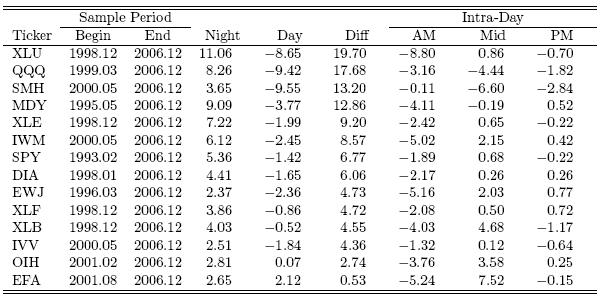
The paper offers similar tables summarizing the overnight/daytime effect by day of the week, by day around the turn of the month, by calendar month and by year for 1993 through 2006.
In summary, both individual stocks and broad funds have, on average, appreciated overnight and stalled or declined during the trading day over the past 14 years. The first hour of trading may be the worst hour.
Frequently Asked Questions
What is the overnight return effect in stocks?
The overnight return effect is the pattern in which stocks earn most of their gains between the close (4:00 PM) and the next open (9:30 AM) rather than during regular trading hours. In a study of 1993-2006 data, average overnight returns for individual S&P 500 stocks ranged from 0.028% to 0.048%, while average daytime returns ranged from -0.028% to 0.002%.
Do overnight returns beat daytime returns in the stock market?
Overnight returns beat daytime returns in a 1993-2006 study of individual stocks, equity indexes, index futures and ETFs. The overnight-minus-daytime spread averaged 0.18% for QQQQ, 0.061% for DIA and 0.068% for SPY. Overnight returns exceeded daytime returns across days of the week, days of the month and months of the year, and daytime returns were negative for 12 of 14 high-volume ETFs.
How are overnight and intraday stock returns measured and separated?
Researchers used transaction-level intraday price data for 1993-2006 to split each trading day's returns for individual stocks and ETFs into four intervals. These are Night (4:00 PM to 9:30 AM), AM (9:30 to 10:30 AM), Mid-day (10:30 AM to 3:00 PM) and PM (3:00 to 4:00 PM). Average returns were then compared across intervals, using different averaging methods, and by day of week, turn of the month, calendar month and year.
Is the overnight return premium just compensation for taking more risk than daytime trading?
The overnight return premium is not explained by higher risk, since the standard deviation of overnight returns was consistently lower than that of daytime returns in the 1993-2006 study. Timing of earnings announcements, the growth of ECNs and decimalization also did not explain it. The study also found overnight returns strongly positive from Friday close to Monday open, averaging 0.042% for S&P 500 stocks, which reverses results from older research.
What are the limitations of a buy-at-the-close, sell-at-the-open strategy?
The article reports average return differences from 1993-2006 and does not assess whether a buy-at-close, sell-at-open strategy would remain profitable after costs. The effects are small, with average overnight returns of 0.028% to 0.048% for S&P 500 stocks, and the article does not address trading costs or whether the pattern persists beyond the sample. Much of the effect comes from high opening prices that decline in the first hour, when average returns ranged from -0.012% to -0.036%.