
“Intraday U.S. Stock Market Behavior” examines behavior of the S&P 500 Index at 15-minute intervals over the trading day during each of 2007 (bullish year) and 2008 (bearish year), finding slight tendencies for market weakness during mid-afternoon and market volatility at the beginning and the end of the trading day. Does recent data confirm these findings? To investigate, we calculate average cumulative returns and standard deviations of returns for both the S&P 500 Index and SPDR S&P 500 (SPY) measured at 5-minute intervals during the trading day over the last six months. Using 5-minute levels/prices for the S&P 500 Index and for SPY during 9:30-16:00 over the period August 2012 through September 2014, we find that:
Data is missing or incomplete for 10 trading days, and the market closes at 13:00 on six others, so we exclude part or all of these days.
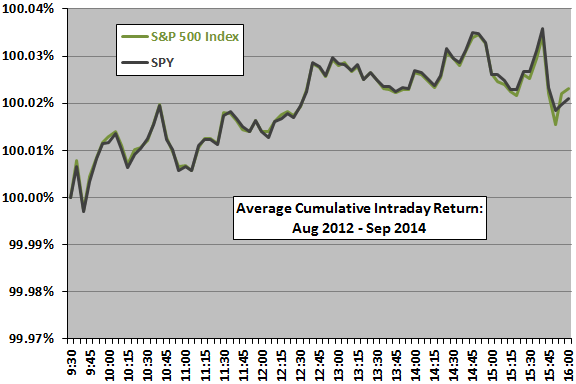
The following chart shows average cumulative returns measured at 5-minute intervals during the trading day for the S&P 500 Index and SPY over the entire sample period. Results indicate a mid-day transition higher, but variations are modest. Results do not confirm the mid-afternoon dip observed in 2007-2008 data. Tracking error for SPY relative to the index is very slight.
Is this pattern stable within the sample?
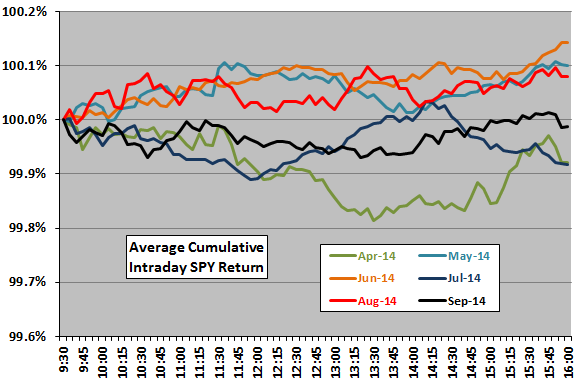
The next chart shows average cumulative returns measured at 5-minute intervals during the trading day for SPY during the last six calendar months (about 20 observations per month). Results indicate that there is no stable intraday pattern.
Do days of the week exhibit distinct patterns?
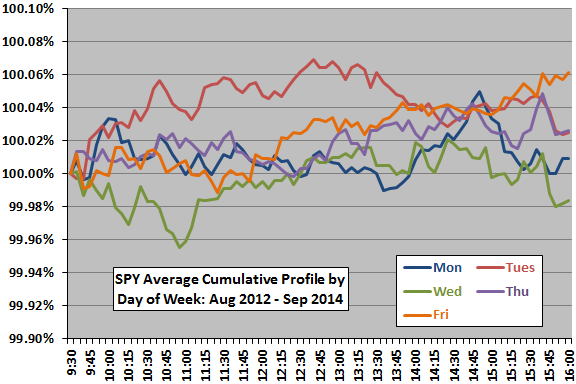
The next chart shows average cumulative returns measured at 5-minute intervals during the trading day for SPY during the days of the week over the recent sample period (about 90 observations each). Results indicate that Tuesday and Wednesday may be different from the other days.
What about intraday volatility patterns?
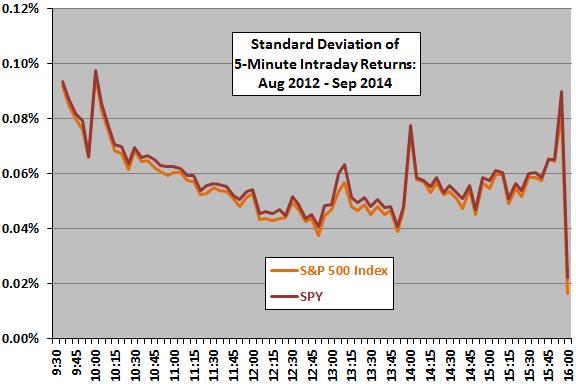
The final chart shows standard deviations of 5-minute returns across trading days for the S&P 500 Index and SPY over the entire sample period. Confirming results from 2007-2008 data, returns tend to be more variable at the beginning and end of the trading day. Again, differences between the S&P 500 Index and SPY are slight.
In summary, evidence from simple tests support little belief that U.S. stock market returns exhibit reliable intraday patterns (perhaps weak Mondays and Wednesdays), but does support belief that the market tends to be more volatile at the beginning and end of the trading session than in the middle.
Cautions regarding findings include:
- Monthly subsamples are small for reliable inference.
- Any wildness in high-frequency returns undermines use of conventional statistics.
Frequently Asked Questions
What is an intraday return pattern in the stock market?
An intraday return pattern is a systematic tendency for stock market returns or volatility to vary by time of day, such as weakness in mid-afternoon or larger swings at the open and close. The article examines these patterns for the S&P 500 Index and SPDR S&P 500 (SPY) using average cumulative returns and standard deviations of returns at 5-minute intervals during the 9:30-16:00 trading session.
Do S&P 500 returns follow a reliable pattern during the trading day?
S&P 500 returns do not show a reliable intraday pattern in data from August 2012 through September 2014. Results show a modest mid-day transition higher but no stable pattern across the last six months, and the mid-afternoon dip seen in 2007-2008 is not confirmed. Tuesday and Wednesday may differ from other days, but the evidence supports little belief in dependable intraday return patterns.
How do you measure intraday stock market patterns using 5-minute data?
Intraday patterns are measured by calculating average cumulative returns and standard deviations of returns at 5-minute intervals between 9:30 and 16:00 for the S&P 500 Index and SPY. The article uses data from August 2012 through September 2014, compares the full sample to monthly subsamples (about 20 observations per month) and day-of-week subsamples (about 90 observations each), and excludes 10 days with missing data and six days with a 13:00 close.
Does the SPY ETF behave differently from the S&P 500 Index during the trading day?
The SPY ETF behaves almost identically to the S&P 500 Index during the trading day. Tracking error for SPY relative to the index is very slight in average cumulative returns, and differences in the standard deviations of 5-minute returns between the two are also slight. Both show greater return variability at the beginning and end of the session.
What are the limitations of studying intraday stock market patterns with simple statistics?
Studies of intraday stock market patterns with simple statistics face limits on reliability, since the monthly subsamples (about 20 observations per month) are too small for reliable inference. Any wildness in high-frequency returns also undermines the use of conventional statistics. The article's tests are simple and descriptive, so its findings on weak days of the week should be treated cautiously.