
Has increasing use of gold as a portfolio diversifier changed the response of its price to crises? In their August 2012 paper entitled “The Destruction of a Safe Haven Asset?”, Dirk Baur and Kristoffer Glover examine the potential of investor behavior to extinguish the safe haven property of gold. Specifically, they consider how widespread inclusion of gold as a diversifier in investment portfolios affects gold price behavior in times of crisis. Based on theoretical conjecture and price data for gold during major financial market crises, they conclude that:
- Broader and deeper exposure to gold in investment portfolios over recent years undermines the safe haven behavior of gold via:
- Portfolio rebalancing after equity market crises (selling gold and buying stocks).
- Liquidation of positions in all risky assets, including gold, due to elevated risk aversion after portfolio shocks.
- Liquidation of assets, including gold, to obtain needed cash during financial crises.
- Concentration of liquidation in gold due to the disposition effect (preferring to sell winners rather than losers).
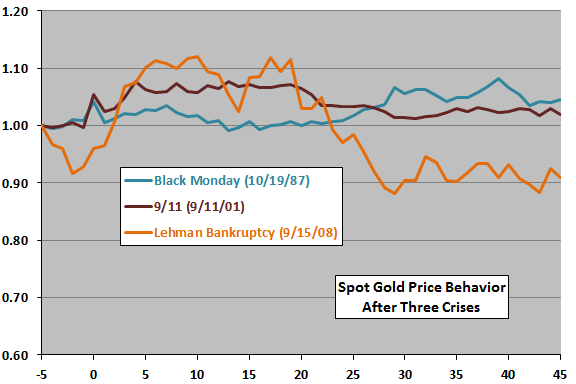
- With respect to the October 1987 stock market crash, the September 2001 terrorist attacks and the 2008 subprime crisis/Lehman bankruptcy (see charts below):
- Gold acts as an immediate safe haven, with responses arguably increasing over time.
- During the 2008 crisis, a substantial drop in gold price follows a strong safe haven response, perhaps due to portfolio margin calls or rebalancing.
The following chart, constructed from daily spot gold prices (normalized to 1.00 at outset), shows gold price evolutions from 5 trading days before (-5) to 45 trading days after (45) three major financial market crises. Results suggest that the initial safe haven reaction to crises is growing over time (perhaps a consequence of wider investor access to gold proxies), but that the safeness of the haven is increasingly transient (as argued in the paper).
The next chart compares the evolutions of spot gold price and the S&P 500 Index based on daily data (both series normalized to 1.00 at the outset) after the 2008 subprime crisis/Lehman bankruptcy. Depending on the date selected as the onset of the crisis, the safe haven effect for gold lasts from roughly one week to one month.
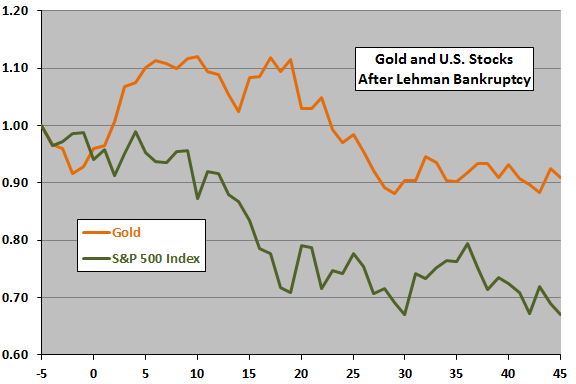
In summary, evidence suggests that the safe haven effect for gold is increasingly transient, quickly giving way to typical post-crisis asset behavior.
Cautions regarding findings include:
- Crises are rare, with incomparable aspects, undermining confidence in empirical confirmation of arguments.
- The difficulty of assigning a specific start date to the 2008 financial crisis (with the Lehman bankruptcy one in a series of shocks) undermines the finding in the paper that the safe haven reaction to this crisis is dramatically compressed compared to reactions to prior crises.
Frequently Asked Questions
What is a safe haven asset and how is it different from a diversifier in investing?
A safe haven asset is an investment that holds or increases in value during financial market crises, whereas a diversifier is held in a portfolio to reduce overall risk in normal conditions. The article examines gold in both roles, arguing that widespread use of gold as a portfolio diversifier can undermine its behavior as a safe haven during crises.
Does gold still work as a safe haven during stock market crises?
Gold still acts as an immediate safe haven during crises, but the safe haven effect appears increasingly transient. Around the October 1987 crash, the September 2001 terrorist attacks and the 2008 subprime crisis/Lehman bankruptcy, the initial gold response seems to grow over time, yet it quickly gives way to typical post-crisis asset behavior. For 2008, the effect lasts roughly one week to one month depending on the assumed crisis start date.
How do researchers test whether gold behaves as a safe haven after a market crash?
Researchers in this study combined theoretical conjecture with an event-study-style comparison of daily spot gold prices, normalized to 1.00 at the outset, from 5 trading days before to 45 trading days after three major crises. They also compared gold with the S&P 500 Index after the 2008 subprime crisis/Lehman bankruptcy. The crises examined were the October 1987 crash, the September 2001 attacks and the 2008 crisis.
Why might gold prices fall after an initial spike during a financial crisis?
Gold prices may fall after an initial crisis spike because broader portfolio exposure to gold triggers selling pressure through several channels. These include portfolio rebalancing into stocks after equity crises, liquidation of all risky assets due to higher risk aversion, liquidation to raise cash, and the disposition effect (preferring to sell winners). In 2008, a substantial gold price drop followed a strong safe haven response, perhaps due to margin calls or rebalancing.
What are the limitations of the evidence that gold's safe haven role is weakening?
The evidence for a weakening gold safe haven role is limited because crises are rare and have incomparable aspects, which undermines confidence in empirical confirmation. It is also difficult to assign a specific start date to the 2008 financial crisis, since the Lehman bankruptcy was one in a series of shocks. This weakens the finding that the 2008 safe haven reaction was dramatically compressed compared to prior crises.