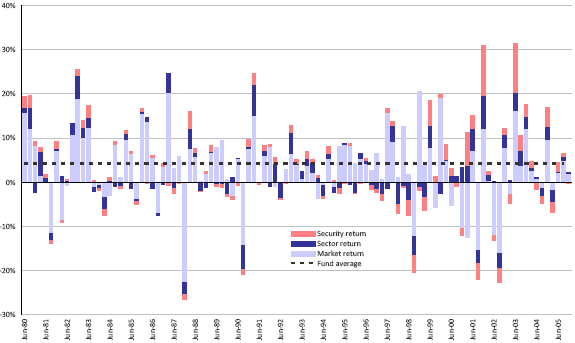
Stock picking contributed more than sector allocation to average equal-weighted quarterly fund returns before fees (0.52% vs 0.36%; 3,350 U.S. equity mutual funds, 1980-2005; 113,614 fund-quarters; sector-neutral benchmarks; descriptive).
Do expert investors outperform more by being in the right sectors (top-down economic analysis) or by picking the right stocks (bottom-up firm analysis)? In their November 2008 paper entitled “Impact of Sector Versus Security Choice on Equity Portfolios”, Jason Hall and Ben McVicar investigate the relative impact on equity mutual fund returns of industry sector allocation versus individual stock picks. They perform this investigation by constructing sector-neutral and stocks-within-sector-neutral benchmarks. Using data for 3,350 U.S. equity mutual funds over the period 1980-2005 (113,614 fund-quarter observations), they conclude that:
The equally weighted (fund value weighted) average quarterly fund return before fees over the entire sample period is 4.21% (4.26%), beating the average quarterly market return by 0.88% (0.93%).
On an equally weighted (fund value weighted) basis, sector allocation contributes an average 0.36% (0.38%) to raw market outperformance, while individual stock picking contributes 0.52% (0.55%).
The average contributions to fund returns from market-sectors-stocks across the entire sample period are therefore 79%-9%-12%.
The above-market average performance of sampled mutual funds comes with increased volatility, with a quarterly return standard deviation of 10.82% compared to 8.15% for the market. Part of the excess volatility comes from sector allocation and stock picking, with the former disproportionately greater than the latter. The rest of the abnormal volatility comes from exposure to size and book-to-market factors.
On a risk-adjusted basis, the sampled mutual funds do not beat the market.
The following chart, taken from the paper, decomposes equally weighted average fund returns by quarter for 1980-2005. The relative contributions of the market, sector allocation and stock (“security”) picking to quarterly return vary considerably across quarters.
In summary, among a broad sample of actively managed mutual funds, stock picking makes a greater contribution to returns than sector allocation. The average contributions to fund returns from market-sectors-stocks are 79%-9%-12%.
Developed Country Stock ETF Momentum? Premium"Developed Country Stock Index Momentum?" summarizes a short paper finding that MSCI developed country stock market indexes may exhibit exploitable momentum since 1970. However, indexes do…
Combining Quality and Momentum ETFs PremiumA subscriber asked about the performance of a 50-50 combination of a basket of momentum stock exchange-traded funds (ETF) and a basket of quality…
Are Equity Momentum ETFs Working? PremiumAre stock and sector momentum strategies, as implemented by exchange-traded funds (ETF), attractive? To investigate, we consider nine momentum-oriented equity ETFs, all currently available,…
Treasuries ETFs Momentum Strategy Update/Extension PremiumMonthly top-1 momentum rotation among seven Treasury ETFs (BIL, SHY, VTIP, IEI, IEF, TIP, TLT) beat the equal-weighted seven-ETF mix on CAGR in 9…
Doing Momentum with Style (ETFs) PremiumTop 1 style ETF momentum (monthly hold of the best 6-month performer among six iShares Russell value/growth ETFs) had the highest gross terminal value…