
A subscriber suggested testing the diversification power of SPDR Barclays International Real Estate (RWX) as a distinct asset class. To check, we add RWX to the following mix of asset class proxies (the same used in “Simple Asset Class ETF Momentum Strategy”):
PowerShares DB Commodity Index Tracking (DBC)
iShares MSCI Emerging Markets Index (EEM)
iShares MSCI EAFE Index (EFA)
SPDR Gold Shares (GLD)
iShares Russell 1000 Index (IWB)
iShares Russell 2000 Index (IWM)
SPDR Dow Jones REIT (RWR)
iShares Barclays 20+ Year Treasury Bond (TLT)
3-month Treasury bills (Cash)
First, per the findings of “Asset Class Diversification Effectiveness Factors”, we measure the average monthly return for RWX and the average pairwise correlation of RWX monthly returns with the monthly returns of the above assets. Then, we compare cumulative returns and basic monthly return statistics for equally weighted (EW), monthly rebalanced portfolios with and without RWX. We ignore rebalancing frictions, which would be about the same for the alternative portfolios. Using adjusted monthly returns for RWX and the above nine asset class proxies from April 2007 (first return available for RWX) through April 2013 (73 monthly returns), we find that:
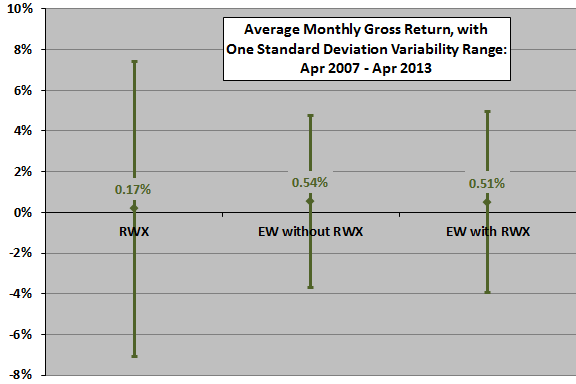
The following chart summarizes average monthly returns with variability ranges of one standard deviation for RWX and the EW portfolios without and with RWX over the available sample period. During this time, RWX generates a poor average return with high volatility. Adding RWX to the diversified EW portfolio reduces return and slightly elevates volatility. The ratio of average return to standard deviation (return per unit of risk) is 0.13 (0.11) without (with) a RWX position.
The average pairwise correlation of RWX monthly returns with those of the other assets is a relatively high 0.53 over the available sample period. Highest correlations are with equities and RWR.
Per “Asset Class Diversification Effectiveness Factors,” the poor average return (high average pairwise correlation) of RWX indicates a poor (poor) contribution with respect to portfolio diversification.
Sample size is not large in terms of number of months or variety of market conditions.
What is the net effect on cumulative portfolio performance?
The next chart compares cumulative values of EW portfolios without and with RWX in the mix over the available sample period. Adding RWX slightly depresses cumulative return over the sample period.
Again, sample size is not large.
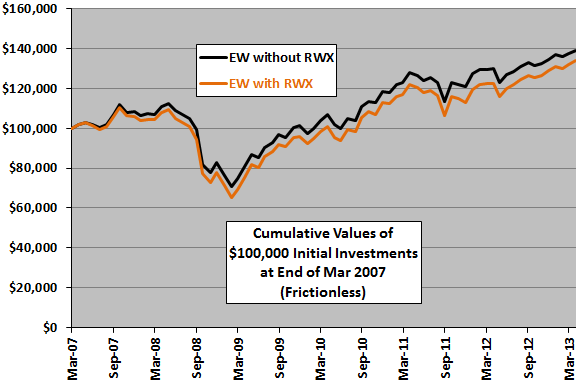
In summary, evidence from simple tests over the available sample period does not support belief that adding a proxy for international real estate to a diversified portfolio improves overall performance.
Cautions regarding findings include:
- As noted, the sample period is not long in terms of market conditions.
- Including the trading frictions associated with monthly rebalancing would depress performance of both portfolios, depending mostly on portfolio size.
Frequently Asked Questions
What is RWX and what asset class does it represent?
RWX is the SPDR Barclays International Real Estate ETF, used as a proxy for international real estate as a distinct asset class. In the article's tests it was evaluated as a potential diversifier alongside nine other asset class proxies, including commodities, emerging market equities, gold, REITs, Treasury bonds and cash.
Does adding international real estate (RWX) to a diversified portfolio improve performance?
Adding RWX did not improve performance of an equally weighted, monthly rebalanced diversified portfolio from April 2007 to April 2013. The ratio of average return to standard deviation fell from 0.13 without RWX to 0.11 with it, and cumulative return was slightly depressed. The evidence does not support the belief that international real estate improves overall portfolio performance, though the sample is short.
How do you test whether an asset like RWX is a good portfolio diversifier?
The test measured RWX's average monthly return and its average pairwise correlation with nine other asset class proxies, then compared cumulative returns and monthly return statistics for equally weighted, monthly rebalanced portfolios with and without RWX. It used 73 adjusted monthly returns from April 2007 through April 2013 and ignored rebalancing frictions. A good diversifier is expected to have a high average return and low average correlation with the other assets.
How is RWX correlated with U.S. REITs and equities compared with other asset classes?
RWX had a relatively high average pairwise correlation of 0.53 with the other nine asset class proxies from April 2007 to April 2013. Its highest correlations were with equities and with the U.S. REIT proxy RWR. This high correlation, combined with RWX's poor average return and high volatility, indicates a poor contribution to diversification.
What are the limitations of the RWX diversification test results?
The RWX test results rest on a small sample of only 73 monthly returns (April 2007 to April 2013), which does not cover a wide variety of market conditions. The results also ignore trading frictions from monthly rebalancing, which would lower performance of both portfolios depending mostly on portfolio size. The conclusions should therefore be treated as simple, preliminary evidence.