
Is the book-to-market ratio (B/M) the most efficient way to identify value stocks? In their October 2009 paper entitled “The Enterprise Multiple Factor and the Value Premium”, Tim Loughran and Jay Wellman investigate the Enterprise Multiple (EM), calculated as (equity value + debt value + preferred stock – cash)/ EBITDA, as a replacement for B/M in defining value. Using common stock prices and accounting data for a broad sample of non-financial firms (with outliers suppressed) over the period 1963 through 2008, they conclude that:
- EM generates an annual value premium of 5.8% per year over the entire sample period (compared to 4.8% for B/M during 1926-2004).
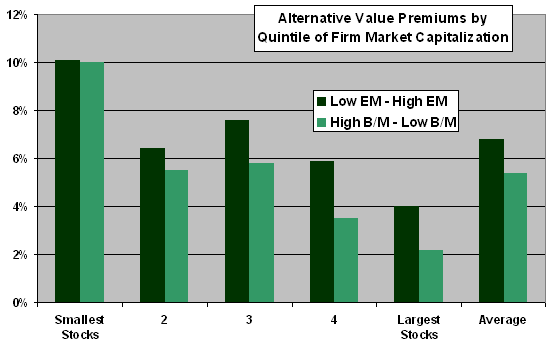
- EM captures more premium than B/M for all five quintiles of firm size and is much less dependent on small stocks for its overall premium (see chart below).
- In the top three quintiles of firm size (accounting for about 94% of total market capitalization), EM is a highly significant measure of relative value, while B/M is not.
- EM remains highly significant after controlling for the January effect and after removing low-priced (<$5) stocks.
- EM outperforms Tobin’s q as a predictor of stock returns.
- Evidence from the UK and Japan confirms that EM is a highly significant measure of relative value.
The following chart, constructed from data in the paper, compares value premiums derived from the Enterprise Multiple (EM) and the book-to-market ratio (B/M) by quintile of firm size over the entire sample period and the entire sample of stocks. The value premium for each size quintile is the average annual return (July through June) for the 20% of stocks with the lowest (highest) EM (B/M) minus the average annual return of the 20% of stocks with the highest (lowest) EM (B/M). Results show that the EM-based value premium is: (1) consistently higher across the size quintiles; and, (2) overall less driven by the smallest stocks.
In summary, investors may be able to exploit the value premium more efficiently and completely by defining it using the Enterprise Multiple rather than the book-to-market ratio.
