Industry momentum via sector ETFs generated 5% annual abnormal returns before trading frictions but profits disappeared after accounting for bid-ask spreads and transaction costs (Jul 2000–Nov 2007; long-short strategy).
Industries arguably follow multi-month cycles of outperformance and underperformance. Can investors use industry/sector Exchange Traded Funds (ETF) to capture abnormal returns from industry momentum? In their June 2008 paper entitled “Can Exchange Traded Funds Be Used to Exploit Industry Momentum?”, Laurens Swinkels and Liam Tjong-A-Tjoe analyze the profitability of industry momentum strategies based on two sets of industry/sector ETFs. Using monthly ETF return data for the period July 2000 through November 2007, they conclude that:
Over the long run (1926-2007), medium-term industry momentum strategies that are self-financing (long-short) generate abnormal returns of about 0.4%-0.5% per month before trading frictions.
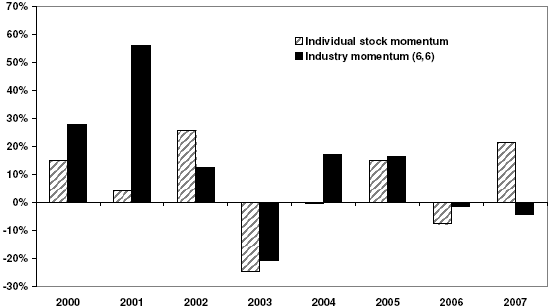
Momentum effects have not disappeared since 2000 (see the chart below), with industry momentum generating abnormal returns (before trading frictions) of about 5% per year during 2000 to 2007.
A rolling momentum strategy that invests one sixth of the portfolio each month long (short) the sector ETF with the highest (lowest) past six-month return and holds each position for six months generates an abnormal return of 0.37% via iShares sector ETFs and 0.59% via Select Sector SPDRs, before trading frictions, over the period July 2000 through November 2007.
Estimated bid-ask spreads, broker commissions and short-selling costs make these abnormal returns disappear for nearly all combinations of ranking and holding periods ranging from three months to 12 months.
The following chart, taken from the paper, shows the annual momentum returns during 2000-2007 for:
The 10 industries defined in the data library of Kenneth French based on six-month ranking and six-month holding (6,6) periods.
The chart indicates that momentum effects have not disappeared in recent years.
In summary, after accounting for trading frictions, medium-term long-short industry momentum strategies implemented via sector/industry ETFs do not offer abnormal returns.
Note that the sample period of a little over seven years is quite short for this kind of analysis.
Developed Country Stock ETF Momentum? Premium"Developed Country Stock Index Momentum?" summarizes a short paper finding that MSCI developed country stock market indexes may exhibit exploitable momentum since 1970. However, indexes do…
Combining Quality and Momentum ETFs PremiumA subscriber asked about the performance of a 50-50 combination of a basket of momentum stock exchange-traded funds (ETF) and a basket of quality…
Are Equity Momentum ETFs Working? PremiumAre stock and sector momentum strategies, as implemented by exchange-traded funds (ETF), attractive? To investigate, we consider nine momentum-oriented equity ETFs, all currently available,…
Treasuries ETFs Momentum Strategy Update/Extension PremiumMonthly top-1 momentum rotation among seven Treasury ETFs (BIL, SHY, VTIP, IEI, IEF, TIP, TLT) beat the equal-weighted seven-ETF mix on CAGR in 9…
Doing Momentum with Style (ETFs) PremiumTop 1 style ETF momentum (monthly hold of the best 6-month performer among six iShares Russell value/growth ETFs) had the highest gross terminal value…