
Are short sellers and expert equity analysts generally in synch or out of synch? What does it mean when short sellers and analysts disagree? In their September 2008 paper entitled “Trading Against the Prophets: Using Short Interest to Profit from Analyst Recommendations”, Michael Drake, Lynn Rees and Edward Swanson investigate whether investors/traders can earn abnormal returns by trading on information provided by expert sell-side analysts (recommendations and recommendation changes) and short sellers (short interest). In their tests, they rebalance portfolios quarterly, hold for six months and adjust returns for firm size. Using a large sample of quarterly return, short interest and analyst recommendation data for the period 1994-2006 period, they conclude that:
- A hedge strategy that is long (short) the 20% of stocks with the highest (lowest) average analyst recommendation, rebalanced quarterly during 1994-2006, has an average six-month return of -3.3%. The subperiod 1999-2003, with an average return of -7.8%, drives this negative result. Average returns are insignificant for the subperiods 1994-1998 and 2004-2006.
- A hedge strategy that is long (short) the 20% of stocks with the most positive (negative) average change in analyst recommendation, rebalanced quarterly during 1994-2006, has an average six-month return of +2.3% (but insignificant during the 2004-2006 subperiod).
- A hedge strategy that is long (short) the 20% of stocks with the lowest (highest) short interest, rebalanced quarterly during 1994-2006, has an average six-month return of +4.3% (positive in each sub-period but statistically reliable only for 2004-2006).
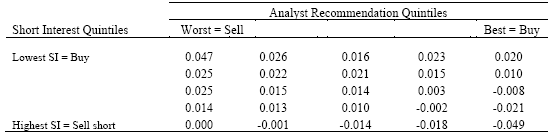
- Investors can boost abnormal returns by combining analyst recommendations and short interest (double-sorting first on the former and then on the latter), with the largest returns occurring when short sellers disagree with analyst recommendations. (See the table below.)
- A hedge strategy that is long (short) the 4% of stocks with the lowest (highest) average analyst recommendation and the lowest (highest) short interest, rebalanced quarterly during 1994-2006, has an average six-month return of +9.6%. The return for this strategy is statistically reliable in all three subperiods, ranging from +6.1% in 1994-1998 to +15.6% in 1999-2003. Most of the value of high short interest as a signal of poor future returns occurs when analyst recommendations are positive.
- A hedge strategy that is long (short) the 4% of stocks with the most positive (negative) average change in analyst recommendation and the lowest (highest) short interest, rebalanced quarterly during 1994-2006, has an average six-month return of +7.9%. The return for this strategy is also statistically reliable in all three subperiods, ranging from +5.9% in 1994-1998 to +10.8% in 1999-2003.
The following table, excerpted from the paper, summarizes average six-month, size-adjusted returns for 25 portfolios formed by double sorting first on average analyst recommendation and then on short interest each quarter during 1994-2006. The most profitable strategy is to use short interest as a signal for when to trade against, rather than with, the average analyst recommendation. The resulting six-month abnormal return of 9.6% is about equally balanced between +4.7% for the long side (lowest average analyst recommendation and lowest short interest) and +4.9% for the short side (highest average analyst recommendation and highest short interest).
The above results apparently do not account for any trading frictions.
In summary, investors/traders may be able to earn significant abnormal returns by following the lead of short sellers when the short sellers disagree with expert equity analysts (short sellers know best).