
Do new mutual funds bring fresh alpha to the marketplace, outperforming until the market catches up and extinguishes it? In their August 2008 paper entitled “Performance and Characteristics of Mutual Fund Starts”, Aymen Karoui and Iwan Meier examine the performance and portfolio characteristics of U.S. equity mutual funds launched during 1991-2005. Using monthly return, quarterly holdings and fund characteristics/fee data for 1,374 U.S. domestic equity mutual funds and 828 fund starts over this period, they conclude that:
- On average, new mutual funds outperform older funds over the first 12 months and 36 months after launch by 0.05% and 0.12% per month, respectively. However, the number of new funds that outperform older funds shrinks substantially after one to three years.
- There is evidence of short-term persistence among top performing new funds, but a substantial fraction of new funds drop from the top 10% to the bottom 10% of mutual fund performance over years 4-9.
- Returns of new funds have on average a higher standard deviation and a higher risk unexplained by exposure to market, size, book-to-market and momentum factors than do older funds.
- Portfolios of new funds are typically less diversified in terms of number of stocks and industries than older funds. They also tend to invest in smaller capitalization and less liquid stocks than do older funds.
- The superior initial performance and risk taking behavior of new mutual funds are consistent with beliefs that: (1) large (older) funds suffer
diseconomies of scale; (2) younger fund managers work harder/smarter; (3) mutual fund companies give favorable treatment to new funds via cost/opportunity allocations; and/or, (4) there is an incubation bias (a sort of data mining bias) in returns for new funds. Accuracy of the first three of these four beliefs would benefit investors in new funds.
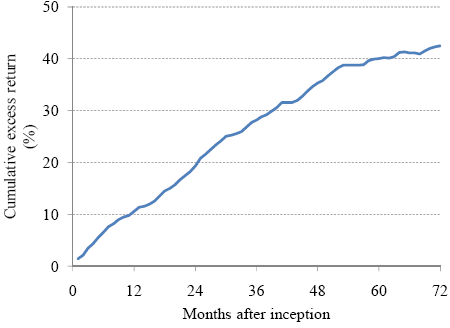
The following chart, taken from the paper, shows the cumulative average (equally weighted) excess return for 828 new mutual funds over the first 72 months of life during 1991-2005. This return, calculated as fund returns net of management fees minus the one-month T-bill yield, begins to flatten after four years.
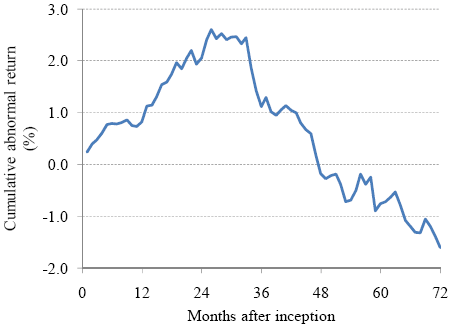
The next chart, also from the paper, shows the cumulative average (equally weighted) abnormal return for 828 new mutual funds over the first 72 months of life during 1991-2005. Abnormal fund returns are net fund returns minus expected fund returns based on a four-factor (market, size, book-to-market and momentum) model. The cumulative average abnormal return peaks after about two years and degrades thereafter.
In summary, new mutual funds appear to enjoy initial outperformance by taking on innovative risk.
Frequently Asked Questions
What is a mutual fund start, and how is a new fund different from an older fund?
A mutual fund start is a newly launched mutual fund, which this research compares with older, established funds. In the study of 828 U.S. domestic equity fund starts during 1991-2005, new funds had different performance and portfolio characteristics from older funds, including higher return volatility and less diversified holdings.
Do new mutual funds outperform older mutual funds?
New mutual funds outperform older funds on average early in life, but the advantage fades. In a study of 828 fund starts during 1991-2005, new funds beat older funds by 0.05% per month over the first 12 months and 0.12% per month over the first 36 months after launch. The number of outperforming new funds shrinks substantially after one to three years, and cumulative abnormal return peaks after about two years.
How is the performance of new mutual funds measured against older funds?
New fund performance is measured using monthly returns net of management fees, with excess return calculated as fund return minus the one-month T-bill yield. Abnormal return is net fund return minus the expected return from a four-factor model covering market, size, book-to-market and momentum. The study used monthly returns, quarterly holdings and fee data for 1,374 U.S. domestic equity funds, including 828 fund starts, launched during 1991-2005.
Why might new mutual funds outperform larger, older funds?
New mutual funds' early outperformance is consistent with four explanations: older, larger funds suffer diseconomies of scale; younger managers work harder or smarter; fund companies give new funds favorable cost or opportunity allocations; and incubation bias, a type of data mining bias, inflates new fund returns. These are beliefs the findings are consistent with, not proven causes. Accuracy of the first three would benefit investors in new funds.
What are the risks and drawbacks of investing in new mutual funds for their early outperformance?
New mutual funds' early outperformance does not last and comes with higher risk. Their returns have a higher standard deviation and more risk unexplained by market, size, book-to-market and momentum factors than older funds, and their portfolios are less diversified and tilt toward smaller, less liquid stocks. Short-term persistence exists among top new funds, but a substantial fraction fall from the top 10% to the bottom 10% of performance over years 4-9, and incubation bias may inflate the early returns.