
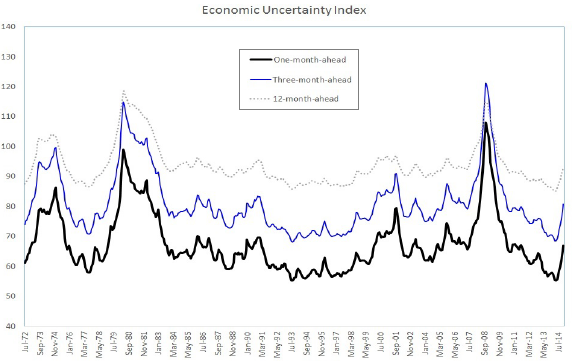
Do specific stocks react differently to economic uncertainty? In their December 2016 paper entitled “Is Economic Uncertainty Priced in the Cross-Section of Stock Returns?”, Turan Bali, Stephen Brown and Yi Tang investigate the role of economic uncertainty in the cross-sectional pricing of individual stocks. They measure economic uncertainty monthly as an aggregation of the volatilities of the unpredictable components of a large number of economic indicators (see the chart below). They then calculate each stock’s sensitivity to economic uncertainty by regressing next-month returns versus economic uncertainty over rolling 60-month windows. Finally, sort stocks into tenths (deciles) by economic uncertainty regression betas and measure economic uncertainty factor returns as the difference in next-month average returns of stocks in extreme deciles. They test robustness via multiple factor models of stock returns and many control variables. Using monthly economic uncertain index data, monthly returns for a broad sample of U.S. stocks and monthly values of control variables during July 1972 through December 2014, they find that:
- Over the sample period, the equal-weighted (value-weighted) decile of stocks with the lowest uncertainty betas outperform the equal-weighted (value-weighted) decile with the highest uncertainty betas by monthly gross average 0.51% (0.40%).
- Across several conventional factor models of stock returns, monthly gross equal-weighted (value-weighted) alphas are about the same as (larger than) the unadjusted extreme decile return premium.
- Stocks with low (high) economic uncertainty betas tend to be small, illiquid, value stocks with low volatility, low market beta and low investment (big, liquid, growth stocks with high volatility, high market beta and high investment).
- The economic uncertainty factor premium is significant:
- After restricting the sample to S&P 500 stocks or to the 1,000 biggest and most liquid stocks.
- After controlling one-by-one and simultaneously for a large set of known stock return predictors.
- For eight of 10 industry stock subsamples (notably not for utilities).
- Economic uncertainty beta predicts cross-sectional variation in stock returns up to 11 months later.
The following chart, taken from the paper, depicts one-month, three-month and 12-month ahead
economic uncertainty indexes (multiplied by 100). These indexes are aggregations of volatilities of the unpredictable components of economic variables encompassing: real output and income; employment and hours; real retail, manufacturing and trade sales; consumer spending; housing starts, inventories and inventory sales ratios; orders and unfilled orders; compensation and labor costs; capacity utilization; price indexes; bond and stock market indexes; and, foreign exchange measures. The three economic uncertainty indexes are highly correlated and are generally high during bad states of the economy.
In summary, evidence indicates that stocks with low sensitivity to economic uncertainty outperform those with high sensitivity on a gross basis.
Cautions regarding findings include:
- Returns and alphas are gross, not net. Accounting for monthly economic uncertainty factor portfolio reformation and shorting costs would reduce premium magnitude.
- Monthly reformation of the long side of the factor portfolio may be costly because it tends to hold small, illiquid stocks.
- Shorting costs may be material because the short side tends to hold volatile stocks.
- Economic data are generally available only with lags and are subject to short-term and long-term revisions. Use of as-revised (rather than as-released) historical data therefore incorporates look-ahead bias.
- Cross-sectional stock return factors based on U.S. data arguably involve aggregate/cumulative snooping bias as addressed in “Taming the Factor Zoo”, thereby overstating statistical significance.
- Data acquisition/processing burdens are substantial and beyond the reach of most investors. Delegating the work to a manager would involve fees.
The economic uncertainty factor explored above may have some connection to the “Bear Market Expectation Risk Factor”.
Frequently Asked Questions
What is an economic uncertainty beta for a stock?
An economic uncertainty beta measures how sensitive a stock's returns are to changes in an index of economic uncertainty. The index aggregates the volatilities of the unpredictable components of many economic indicators, including output, employment, sales, prices, bond and stock market indexes, and foreign exchange measures. Stocks with high betas are more exposed to uncertainty, while stocks with low betas are less exposed.
Do stocks with low economic uncertainty betas outperform stocks with high betas?
Yes, stocks with low economic uncertainty betas outperformed those with high betas on a gross basis during July 1972 to December 2014. The lowest-beta decile beat the highest-beta decile by an average 0.51% per month equal-weighted and 0.40% value-weighted. The premium held after controlling for known return predictors, in S&P 500 and 1,000 largest-stock subsamples, and in eight of 10 industries (not utilities), and beta predicted returns up to 11 months ahead.
How is the economic uncertainty factor return calculated from individual stocks?
Economic uncertainty is measured monthly by aggregating the volatilities of the unpredictable components of many economic indicators. Each stock's beta comes from regressing its next-month returns on economic uncertainty over rolling 60-month windows. Stocks are then sorted into deciles by beta, and the factor return is the difference in next-month average returns between the extreme deciles. The authors tested robustness with multiple factor models and many control variables.
What kinds of stocks have low versus high sensitivity to economic uncertainty, and is this the same as value or low-volatility investing?
Low economic uncertainty beta stocks tend to be small, illiquid value stocks with low volatility, low market beta and low investment, while high-beta stocks tend to be big, liquid growth stocks with high volatility, high market beta and high investment. The factor therefore overlaps with known characteristics, but the premium persisted after controlling one-by-one and simultaneously for a large set of known return predictors. Across several conventional factor models, equal-weighted alphas were about the same as the raw premium and value-weighted alphas were larger.
What are the limitations of an economic uncertainty factor strategy?
The reported economic uncertainty factor returns and alphas are gross, so monthly portfolio reformation and shorting costs would reduce the premium. The long side tends to hold small, illiquid stocks that are costly to trade, and the short side tends to hold volatile stocks that may be costly to short. Other caveats include look-ahead bias from using as-revised rather than as-released economic data, possible data-snooping bias that overstates statistical significance, and substantial data-processing burdens.