
Are some types of cars attractive alternative investments? In their September 2018 paper entitled “My Kingdom for a Horse (or a Classic Car)”, Dries Laurs and Luc Renneboog investigate price determinants and investment performance of classic cars from veteran cars (built 1888-1907) through modern classics (1975-1990). They estimate returns and risks for several classic car price indexes via a hedonic price methodology that accounts for physical attributes (such as engine displacement), condition, rarity, uniqueness and provenance. They then compare results to those for financial and other real asset classes. Using a sample of 29,002 global auction sales with hedonic model inputs, plus U.S. inflation data and price series for other asset classes, during 1998 through 2017, they find that:
- The total value of classic cars worldwide is about $120 billion.
- The auction segment of the classic cars market trades about $1.3 billion per year (private sales may be a multiple of this amount). Nationalities of cars sold are mostly American (52%), British (17%), German (12%) and Italian (17%). Ferrari dominates the top of the market.
- The hedonic model explains about 70% of variation in classic car prices, confirming model usefulness.
- Average annual gross nominal (real) returns for classic cars over the sample period are:
- 5.6% (3.4%) overall.
- 5.3% (3.2%), with annual volatility 15.6%, for 2,488 auction sales of Classic Car Club of America classics (American or foreign built, produced between 1915 and 1948).
- 6.3% (4.1%), with annual volatility 15.2%, for 911 auction sales of Hagerty’s Affordable Classics.
- 12.5% (10.0%), with annual volatility 22.6%, for 833 auction sales of Hagerty’s Blue Chip Classics.
- 11.3% (8.9%), 7.0% (4.7%), 6.3% (4.0%) and 4.5% (2.3%), respectively, for Italian, German, British and American classics.
- 13.8% (11.3%), 9.4% (7.0%) and 7.0% (4.7%), respectively, for Ferrari, Porsche and Mercedes-Benz classics.
- Regarding gross annual Sharpe ratio of classic cars versus those of other asset classes over the sample period (see the chart below):
- Classic cars overall have a higher Sharpe ratio (0.35) than the S&P 500 Index (0.21), the MSCI World Index (0.16) and art (0.07). But, adding dividends would boost Sharpe ratios for the equity indexes to about 0.30.
- Classic cars have a lower Sharpe ratio than global government bonds (0.40) and gold (0.40).
- Correlations between classic car returns and those of other asset classes are generally low, indicating diversification benefits within a portfolio of other classes.
- Because owning and trading classic cars are costly, net average annual returns are likely 25%-50% lower than above. Specifically:
- Auction houses typically charge buyers and sellers roughly a combined 25% of sales price, encouraging long holding periods.
- The market is illiquid, such that a forced sale may mean a considerable discount.
- Classic cars require: storage in a controlled environment with security, restoration (when acquired in less than pristine condition), regular maintenance, insurance and taxes.
- However, in most countries, there are no capital gain taxes on classic car transactions.
The following chart, taken from the paper, compares nominal gross cumulative performance of the classic car index to those of several financial asset indexes over the sample period (all normalized to 100 at the start). Average annual gross nominal returns are in parenthesis in the legend.
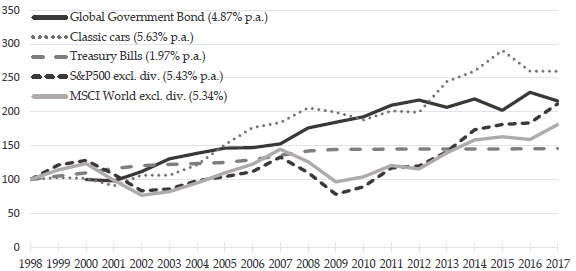
In summary, evidence indicates that owning premium classic cars over a very long holding period may be an attractive alternative investment.
Cautions regarding findings include:
- As noted, owning and trading classic cars are very costly compared to owning financial assets.
- As noted, the classic car market is illiquid, such that forced selling is problematic.
- Most investors do not have the capital to consider a selection of premium classic cars as part of a diversified investment portfolio.
Frequently Asked Questions
What is a classic car as an alternative investment?
A classic car as an alternative investment is a collectible vehicle, ranging from veteran cars built 1888-1907 to modern classics from 1975-1990, held for price appreciation rather than ordinary use. Its value depends on physical attributes such as engine displacement, plus condition, rarity, uniqueness and provenance. The worldwide classic car market is valued at about $120 billion, with roughly $1.3 billion traded per year at auction.
Do classic cars deliver good investment returns?
Classic cars delivered average annual gross returns of 5.6% nominal (3.4% real) over 1998-2017, and the evidence suggests that owning premium classic cars over a very long holding period may be attractive. Returns varied widely: Hagerty Blue Chip Classics earned 12.5% nominal and Ferraris 13.8%, while American classics earned 4.5%. Net returns are likely 25%-50% lower than these gross figures because of costs.
How are classic car investment returns measured using a hedonic price model?
A hedonic price model measures classic car returns by estimating how much of each auction price is explained by attributes such as engine displacement, condition, rarity, uniqueness and provenance, so that price indexes reflect market movement rather than differences in the cars sold. The study applied it to 29,002 global auction sales from 1998 through 2017. The model explains about 70% of the variation in classic car prices.
How do classic cars compare to stocks, bonds, gold and art on risk-adjusted returns?
Classic cars had a gross Sharpe ratio of 0.35 over 1998-2017, higher than the S&P 500 (0.21), MSCI World (0.16) and art (0.07), but lower than global government bonds and gold (both 0.40). Adding dividends would lift the equity indexes' Sharpe ratios to about 0.30. Classic car returns also had generally low correlations with other asset classes, indicating potential diversification benefits.
What are the risks and costs of investing in classic cars?
Investing in classic cars is costly and illiquid, so net returns are likely 25%-50% lower than reported gross returns. Auction houses charge buyers and sellers a combined roughly 25% of the sale price, a forced sale may require a considerable discount, and owners pay for storage, restoration, maintenance, insurance and taxes. Most investors also lack the capital to hold a diversified selection of premium classic cars, though most countries levy no capital gains tax on these transactions.