
How should investors assess whether the market is fairly valuing cryptocurrencies such as Bitcoin? In his March 2019 paper entitled “Bitcoin Spreads Like a Virus”, Timothy Peterson offers a way to value Bitcoin based on Metcalf’s Law (network economics) and a Gompertz function (often used to describe biological activity). The former model estimates fair price based on number of active users, and the latter model estimates the growth rate of active users. Using findings from prior research plus daily Bitcoin price and active account data from coinmetrics.io and blockchain.info during July 2010 through February 2019, he finds that:
- The value of any currency depends primarily on its acceptance and use. The fair price of Bitcoin therefore varies with the number of active Bitcoin accounts.
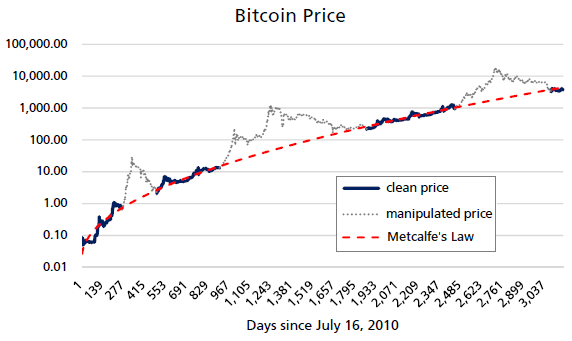
- Calibrating Metcalfe’s Law to the number of Bitcoin active accounts accurately estimates the fair price of Bitcoin over time, except during intervals of blatant manipulation (see the first chart below).
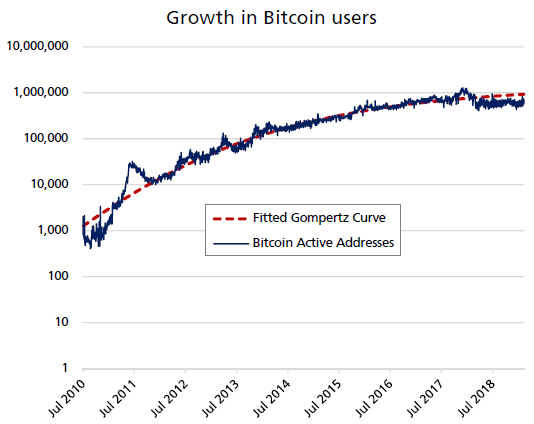
- Calibrating a Gompertz function to the number of active Bitcoin accounts accurately describes growth in number of accounts over time (see the second chart below).
The following chart, extracted from the paper, models Bitcoin price history in days from the start of the sample period according to Metcalfe’s Law based on the known number of active accounts. The fit ignores three local peaks in price strongly suspected to come from price manipulation.
The next chart, also from the paper, models the number of active Bitcoin accounts using a Gompertz function over the full sample period. Investors could use such a model to estimate the future number of accounts and then apply Metcalfe’s Law as in the preceding chart to estimate the future fair price of Bitcoin.
In summary, modeling suggests that investors can estimate a fair price for Bitcoin by combining the value of its network (Metcalfe’s Law) with “biological” growth in its active accounts (Gompertz function).
Cautions regarding findings include:
- As noted, analyses ignore parts of the Bitcoin price series deemed driven by manipulation.
- The above curves are fitted in-sample. An investor operating in real time would not know all the information used to calibrate associated models. The paper offers no analyses of the usefulness of the models in predicting Bitcoin price.
Frequently Asked Questions
What is Metcalfe's Law and how does it apply to Bitcoin?
Metcalfe's Law is a network-economics principle holding that a network's value depends on its number of users. Applied to Bitcoin, it implies the fair price varies with the number of active Bitcoin accounts, since a currency's value depends primarily on its acceptance and use.
Can Metcalfe's Law accurately estimate the fair price of Bitcoin?
Metcalfe's Law, calibrated to the number of active Bitcoin accounts, accurately estimates Bitcoin's fair price over time in Timothy Peterson's analysis of July 2010 through February 2019 data. The fit holds except during intervals of blatant manipulation, and it is an in-sample result. The paper does not test whether the model predicts future Bitcoin prices.
How does a Gompertz function model the growth of Bitcoin users?
A Gompertz function, often used to describe biological activity, is calibrated to the number of active Bitcoin accounts to describe account growth over time. In Peterson's study, using coinmetrics.io and blockchain.info data from July 2010 to February 2019, it accurately fit account growth over the full sample. Investors could use it to project future account numbers and then apply Metcalfe's Law to estimate a future fair price.
How do Metcalfe's Law and a Gompertz function differ when valuing Bitcoin?
In Peterson's approach, Metcalfe's Law and the Gompertz function play different roles: Metcalfe's Law estimates Bitcoin's fair price from the number of active users, while the Gompertz function estimates the growth rate of those active users. They are combined, with the Gompertz projection of accounts feeding into the Metcalfe's Law price estimate, to value Bitcoin's network with 'biological' growth.
What are the limitations of using Metcalfe's Law to value Bitcoin?
The Metcalfe's Law valuation of Bitcoin in Peterson's paper ignores price periods deemed driven by manipulation, including three local price peaks. The curves are fitted in-sample, so an investor in real time would not know all the information used to calibrate the models. The paper also offers no analysis of whether the models are useful for predicting Bitcoin price.