In their October 2005 paper entitled “The January Effect”, Mark Haug and Mark Hirschey examine the persistence of the January effect (abnormally high rates of return during the month of January). Using broad samples of value-weighted and equally-weighted returns spanning 1802-2004 for large-capitalization stocks and 1927-2004 for small-capitalization stocks, theyconcludethat:
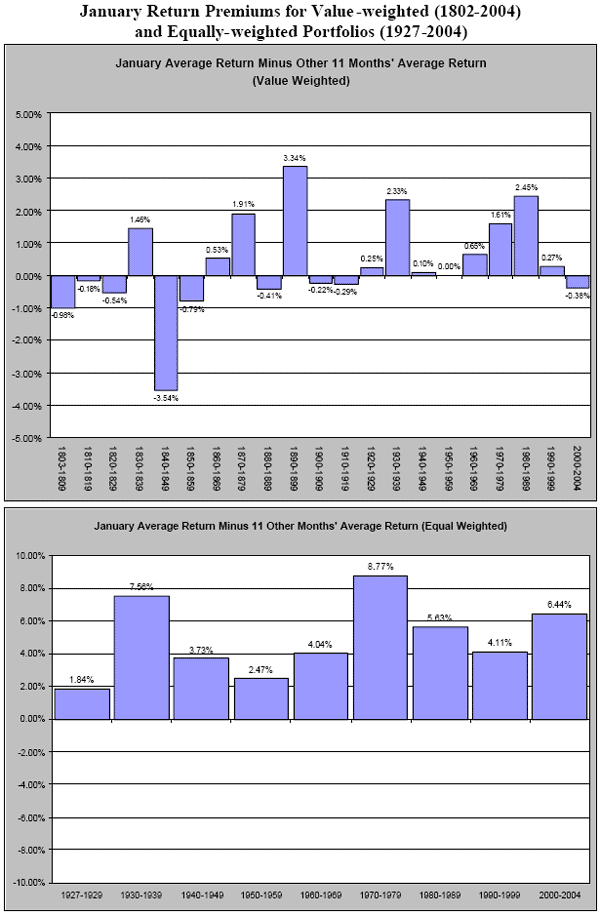
There is little evidence of a January effect for large-capitalization stocks during 1802-2004.
In contrast, the January effect in small-capitalization stock returns is remarkably consistent over time.
Abnormally high January returns derive from both firm size (small is better) and book-to-market (value is better) factors. Firm size, however, is the dominant factor.
The January effect is a momentum reversal phenomenon, with highest returns for small firms with negative annual returns in the prior period.
The 1986 Tax Reform Act did not significantly affect the January effect for small-capitalization stocks.
The January effect continues to challenge to the Efficient Market Hypothesis.
The following charts, extracted from the paper, depict January performance relative to the average performance of other months by decade for a portfolio dominated by large-capitalization stocks over 1802-2004 (top chart) and a portfolio dominated by small-capitalization stocks over 1927-2004 (bottom chart). In the top chart, the relative performance in January appears to be random. In the bottom chart, January consistently outperforms the average of other months in all decades.
In summary, history still favors small-capitalizationvalue stocks in January.
Asset Class ETF Seasonalities? PremiumAverage monthly returns for nine asset class ETFs (SPY, IWM, EFA, EEM, TLT, LQD, VNQ, GLD, DBC) are mostly positive in April, July, November…
Style Performance by Calendar Month PremiumStyle ETFs show modest monthly return differences versus SPY, with value outperforming growth in Mar/Apr/Dec and growth leading in Oct/Nov (Aug 2001–Oct 2021; 20-year…
Sector Performance by Calendar Month PremiumAverage returns and return dispersion across nine Select Sector SPDR ETFs (XLB, XLE, XLF, XLI, XLK, XLP, XLU, XLV, XLY) differ somewhat by calendar…
“Sell in May” Over the Long Run Premium"Sell in May" stocks underperformed November-April stocks (CAGR not specified vs buy-and-hold benchmark; Apr 1871–Apr 2021; seasonal timing with 1% trading costs; S&P Composite…
Stock Market Continuation and Reversal Months? PremiumCalendar-month correlations between S&P 500 and Russell 2000 monthly returns and prior 3-, 6- and 12-month returns show unstable continuation/reversal patterns across subperiods and…