
Do the billions of dollars of annual mutual fund advertising work to attract investors? If so, are the appeals rational or emotional? Does the advertising connect investors with the right funds? In his July 2006 paper entitled “Advertising and Portfolio Choice”, Henrik Cronqvist examines how mutual fund industry advertising affects investor choices and returns. Focusing on the effects of 50,000 multimedia advertisements by 454 funds on 4.4 million workers during the year 2000 launch of a new pension system in Sweden, he finds that:
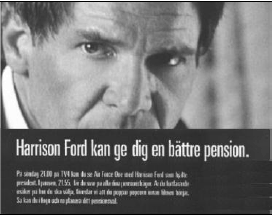
“Harrison Ford can give you a better pension.”
- Only a small fraction of fund advertising appeals to investor rationality (with information about fund fees). [The author does not regard past performance information as an appeal to rationality, citing prior research that challenges the persistence of fund outperformance.]
- Funds that advertise heavily do not subsequently outperform other funds.
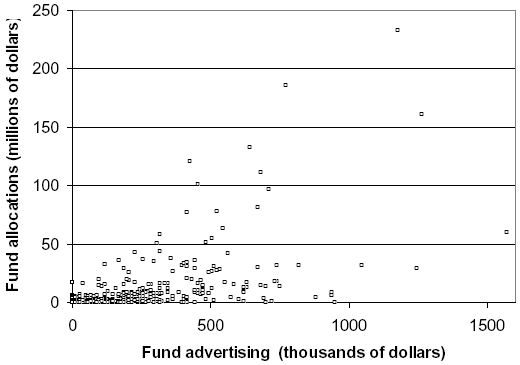
- Advertising expenditures show a significant 54% correlation with investor choices (see scatterplot below). Its effect is at least as large as those of fund size, media attention and past performance, but probably not as large as that of home bias.
- Advertising steers investors towards portfolios with higher fees and more risk (higher exposure to equities, more active management, more “hot” sectors and more home bias). Coinciding with the height of the Internet bubble, much of the performance advertising encountered in this study focuses on technology funds.
The following scatterplot, taken from the paper, shows the relationship between investor fund allocations and fund advertising during the 2000 launch of the new Swedish pension system. The results indicate that advertising does tend to attract money to mutual funds.
In summary, investors should generally ignore advertising in choosing mutual funds; they should consciously control their fund search methodologies to achieve rational decisions.
Frequently Asked Questions
What is mutual fund advertising and how does it influence investor portfolio choice?
Mutual fund advertising is the marketing fund companies use to attract investor money, and it influences portfolio choice by steering investors toward the advertised funds. In a study of 50,000 multimedia advertisements by 454 funds during the 2000 launch of Sweden's new pension system, only a small fraction of ads appealed to investor rationality (such as information about fees). The author does not count past performance information as a rational appeal.
Do heavily advertised mutual funds outperform other funds?
Heavily advertised mutual funds do not subsequently outperform other funds, according to the Swedish study of 454 funds. Despite this, advertising expenditures show a significant 54% correlation with investor fund choices, indicating that advertising does attract money to funds. The findings are descriptive rather than evidence that advertising leads investors to better funds.
How is the effect of fund advertising on investor choices measured?
The effect of fund advertising on investor choices was measured by relating each fund's advertising expenditures to the allocations of 4.4 million Swedish workers during the 2000 launch of a new pension system. The study covered 50,000 multimedia advertisements by 454 funds and found a 54% correlation between advertising and investor choices. Advertising's effect was compared against other factors, including fund size, media attention, past performance and home bias.
Is mutual fund advertising a bigger driver of investor choices than past performance or home bias?
Mutual fund advertising has an effect on investor choices at least as large as fund size, media attention and past performance, but probably not as large as home bias. This comes from the study of Swedish investors during the 2000 pension system launch. Advertising also steered investors toward portfolios with higher fees and more risk, including greater equity exposure, more active management, more "hot" sectors and more home bias.
What are the risks and limitations of choosing mutual funds based on advertising?
Choosing mutual funds based on advertising is risky because advertising steers investors toward higher-fee, riskier portfolios without delivering subsequent outperformance. The study's evidence comes from one setting, the 2000 Swedish pension launch, which coincided with the Internet bubble, so much of the performance advertising focused on technology funds. The article concludes that investors should generally ignore advertising and consciously control their fund search methods to make rational decisions.