
Do the returns of iPath S&P 500 VIX Short-term Futures ETN (VXX) and VelocityShares Daily Inverse VIX Short-term ETN (XIV) vary systematically across days of the week? To investigate, we look at daily close-to-open, open-to-close and close-to-close returns for both. Using daily split-adjusted opening and closing prices for VXX during February 2009 through July 2017 and for XIV during December 2010 through July 2017, we find that:
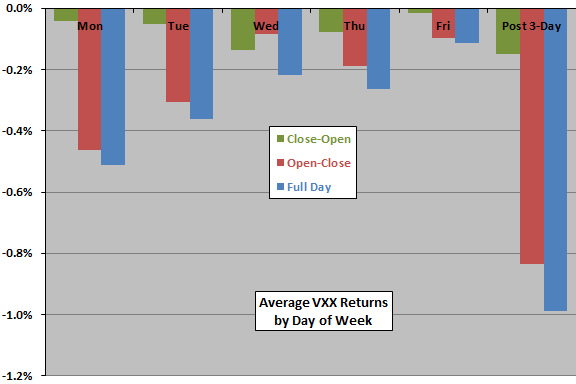
The following chart summarizes average daily returns for VXX by day of the week and for the day after 3-day weekends (Post 3-Day) over the available sample period. There are at least 402 observations for each day, but only 59 observations for Post 3-day. Notable points are:
- Average returns are uniformly negative and mostly decrease in magnitude across the week, with Monday and Tuesday most negative.
- Open-to-close mostly drives full-day average returns.
- Average returns are particularly negative after 3-day weekends.
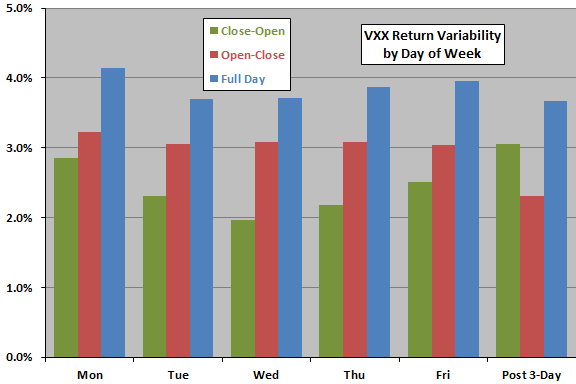
For additional insight, we look at VXX return variability (standard deviation of returns) by day of the week.
The next chart summarizes variability of daily VXX returns by day of the week and for the day after 3-day weekends over the available sample period. Notable points are:
- Monday returns are a little more variable than those for other days.
- There is no variability penalty for the particularly negative Post 3-Day average returns.
What about XIV?
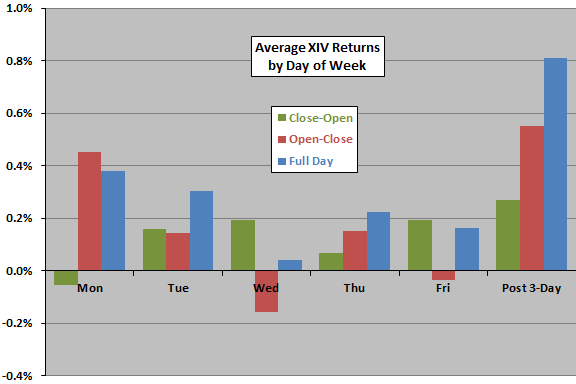
The next chart summarizes average daily returns for XIV by day of the week and for the day after 3-day weekends over the available sample period. There are at least 314 observations for each day, but only 46 observations for Post 3-day. Notable points are:
- The average return pattern is roughly a mirror image of that for VXX, but not all returns are positive.
- Average returns mostly decrease in magnitude across the week, with Monday and Tuesday average returns largest.
- Average returns are particularly positive after 3-day weekends.
For additional insight, we look at XIV return variability across the week.
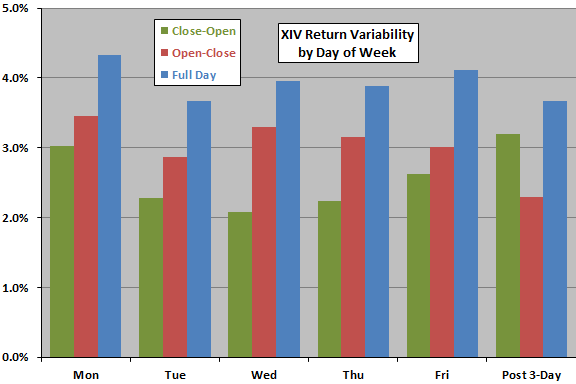
The final chart summarizes average variability of daily XIV returns by day of the week and for the day after 3-day weekends over the available sample period. Notable points are:
- Monday returns are again a little more variable than those for other days.
- Again, there is no variability penalty for the particularly positive Post 3-Day average returns.
In summary, evidence from available data suggests average daily returns for VXX (XIV) are all negative (mostly positive) and mostly decrease in magnitude across the week. VXX (XIV) returns after 3-day weekends are particularly negative (positive).
Cautions regarding findings include:
- Sample periods are not long in terms of variety of market conditions, and average return differences across days of the week may therefore not be reliable.
- VXX and XIV return distributions may be wild, confounding the predictive power of average and standard deviation statistics.
- Trading any findings involves frictions that would reduce returns.
Frequently Asked Questions
What are VXX and XIV, and how do these VIX exchange-traded notes work?
VXX (iPath S&P 500 VIX Short-term Futures ETN) is an exchange-traded note that tracks short-term VIX futures, while XIV (VelocityShares Daily Inverse VIX Short-term ETN) is its inverse counterpart. The article studies both as instruments whose returns can be broken into close-to-open, open-to-close and close-to-close components. VXX data cover February 2009 through July 2017 and XIV data cover December 2010 through July 2017.
Do VXX and XIV returns differ systematically by day of the week?
VXX average daily returns are negative on every day of the week and are most negative on Monday and Tuesday, while XIV shows a roughly mirror-image pattern with mostly positive returns that are largest early in the week. Returns for both are particularly extreme after 3-day weekends (more negative for VXX, more positive for XIV). These findings come from VXX data for February 2009 through July 2017 and XIV data for December 2010 through July 2017, with at least 402 and 314 observations per day respectively.
How are day-of-the-week returns for VXX and XIV measured and compared?
The analysis uses daily split-adjusted opening and closing prices to compute close-to-open, open-to-close and close-to-close returns for each day of the week, plus the day after 3-day weekends. It also measures return variability using the standard deviation of daily returns by day. Samples include at least 402 observations per day for VXX (only 59 for post-3-day-weekend) and at least 314 for XIV (only 46 for post-3-day-weekend).
Is the XIV day-of-the-week return pattern the opposite of VXX, and does most of the return come from overnight or intraday trading?
The XIV average return pattern is roughly a mirror image of VXX, but not all XIV returns are positive. For VXX, open-to-close (intraday) returns mostly drive full-day average returns rather than close-to-open (overnight) returns. Both products show the largest-magnitude average returns on Monday and Tuesday, with magnitudes mostly decreasing across the week.
How reliable are day-of-the-week return patterns in VXX and XIV for trading?
The patterns may not be reliable because the sample periods are short relative to the variety of market conditions, so average return differences across weekdays may not persist. VXX and XIV return distributions may also be wild, which can undermine the predictive power of average and standard deviation statistics. In addition, trading frictions would reduce any returns from exploiting the findings, and the post-3-day-weekend results rest on only 59 (VXX) and 46 (XIV) observations.