
Can systematic, contrarian sports betting usefully diversify conventional investments? In their June 2016 paper entitled “Sports Betting As a New Asset Class: Can a Sports Trader Beat Hedge Fund Managers from 2010-2016?”, Lovjit Thukral and Pedro Vergel investigate whether a specific sports betting strategy outperforms and diversifies the Credit Suisse Hedge Fund Index and the S&P 500 Index. The strategy hypothesizes that horse racing favorites are consistently overrated by betting 1% of a hypothetical portfolio against the top four (lowest odds) horses in each regulated race in the UK. Using historical data from Betfair Exchange for 57,000 horse races and contemporaneous annual returns for the Credit Suisse Hedge Fund Index and the S&P 500 Total Return Index during January 2010 through early January 2016, they find that:
- The betting strategy is competitive with the Credit Suisse Hedge Fund Index and the S&P 500 Total Return Index based on gross cumulative performance (see the chart below) and gross annual Sharpe ratio (1.12, versus 1.11 and 0.69, respectively).
- Strategy returns are uncorrelated to those of hedge funds and the U.S. stock market.
The following chart, taken from the paper, tracks the normalized gross performances of the horse race betting strategy specified above, the Credit Suisse Hedge Fund Index and the S&P 500 Total Return Index over the sample period. The betting strategy generally outperforms, but does exhibit stock market-like volatility.
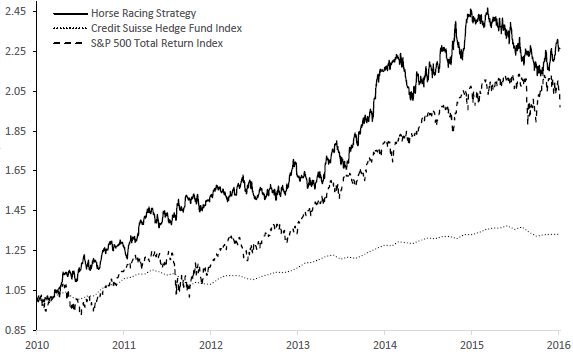
In summary, evidence suggests that systematically betting against horse racing favorites provides attractive gross returns, uncorrelated to those of hedge funds and U.S. equities.
Cautions regarding findings include:
- The sample period is very short for assessment of annual performance.
- As noted in the paper, the capacity of the specified strategy may be limited, with large bets or many small bets materially moving the odds.
- As noted in the paper, results are gross, not net. The authors state that: “…in our experience commissions are quite small and do not materially affect our returns.”
- Results may not apply to other sports betting due to either different levels of market efficiency or unavailability of contrarian bets.
- There may be snooping bias in specification of the top four horses, thereby overstating expectations.
Frequently Asked Questions
What does it mean to treat sports betting as an asset class?
Treating sports betting as an asset class means evaluating a systematic betting strategy like an investment, comparing its returns, risk, and correlations with conventional holdings such as hedge funds and stocks. In the Thukral and Vergel study, a contrarian horse racing strategy was tested as a possible diversifier against the Credit Suisse Hedge Fund Index and the S&P 500 Total Return Index.
Does betting against horse racing favorites produce better returns than the stock market?
Betting against horse racing favorites outperformed the S&P 500 on a gross basis from January 2010 to early January 2016, with a gross annual Sharpe ratio of 1.12 versus 0.69 for the S&P 500 Total Return Index and 1.11 for the Credit Suisse Hedge Fund Index. Strategy returns were uncorrelated to both hedge funds and U.S. stocks, though volatility was similar to the stock market and the results are gross of costs.
How is a contrarian horse racing betting strategy tested against hedge funds and stocks?
The contrarian horse racing strategy was tested by betting 1% of a hypothetical portfolio against the top four lowest-odds horses in each regulated UK race, using Betfair Exchange data for 57,000 races. Its gross cumulative performance, annual Sharpe ratio, and correlations were then compared with the Credit Suisse Hedge Fund Index and the S&P 500 Total Return Index over January 2010 through early January 2016.
Can sports betting diversify a portfolio of hedge funds and stocks?
Sports betting using a contrarian horse racing strategy showed returns uncorrelated to hedge funds and U.S. equities during 2010-2016, suggesting potential diversification benefits. However, the strategy exhibited stock market-like volatility, and findings may not apply to other sports because of different market efficiency levels or a lack of contrarian bets.
What are the limitations of backtested horse racing betting strategies?
The contrarian horse racing betting strategy has several caveats: the roughly six-year sample is very short for judging annual performance, and results are gross rather than net of commissions. Strategy capacity may be limited because large or numerous bets can move the odds, and choosing the top four horses may reflect data snooping bias that overstates expectations.