
Is sentiment a useful trading indicator? In their December 2006 paper entitled “On the Predictive Power of Sentiment: Why Institutional Investors Are Worth Their Pay”, Bernhard Zwergel and Christian Klein measure the forecasting abilities of institutional and private investors and test out of sample a related trading strategy. Their source data comes from the sentix weekly sentiment survey, asking as many as 700 investors (25% institutional and 75% private investors) about the future one-month (short term) and six-month (medium term) directions of ten stock markets. Using this data for six of these markets over the period 2/23/01-2/2/06, they conclude that:
- Institutional investors are generally more bullish than private investors, and private investors are more pessimistic about the short term than the intermediate term (see table below).
- For both types of investors, short-term sentiment (unlike stock returns) is roughly twice as variable as medium-term sentiment, suggesting that investors overreact to news.
- Institutional investors exhibit some forecasting ability for the medium term, but not the short term. Their short-term forecasts relate positively to recent past returns (they follow the trend), but they seem to use other information for medium-term forecasts. The less they their forecasts relate to past prices, the better their predictions.
- Private exhibit no forecasting ability for either short or medium horizons. In fact, some evidence indicates that their sentiment is a contrarian indicator. Both their short-term and medium-term forecasts relate positively to returns over the past week and month.
- Institutional investors are better at forecasting their home stock market than foreign stock markets, tending to anchor on recent past returns for the latter. Private investors have less differentiated opinion across markets than do institutional investors
- The sentiment of institutional investors has some value for out-of-sample trading, especially for their home market.
The following table, taken from the paper, shows that institutional investors (Is) are on average across all markets more optimistic about future returns than private investors (Ps). In fact, private investors are typically a bit negative for the short term. The table also shows that both categories are generally more optimistic for the medium term than the short term.
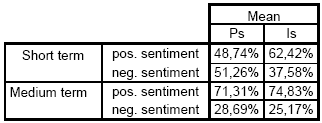
In summary, the sentiment of institutional (private) investors probably has some (no) value in predicting stock market returns over a six-month horizon.