
Market volatility tends to rise as returns fall. Does adding a proxy for short-term U.S. equity market volatility to a diversified portfolio improve its performance? To check, we add iPath S&P 500 VIX Short Term Futures (VXX) to the following mix of asset class proxies (the same used in “Simple Asset Class ETF Momentum Strategy”):
PowerShares DB Commodity Index Tracking (DBC)
iShares MSCI Emerging Markets Index (EEM)
iShares MSCI EAFE Index (EFA)
SPDR Gold Shares (GLD)
iShares Russell 1000 Index (IWB)
iShares Russell 2000 Index (IWM)
SPDR Dow Jones REIT (RWR)
iShares Barclays 20+ Year Treasury Bond (TLT)
3-month Treasury bills (Cash)
First, per the findings of “Asset Class Diversification Effectiveness Factors”, we measure the average monthly return for VXX and the average pairwise correlation of VXX monthly returns with the monthly returns of the above assets. Then, we compare cumulative returns and basic monthly return statistics for equally weighted (EW), monthly rebalanced portfolios with and without VXX. We ignore rebalancing frictions, which would be about the same for the alternative portfolios. Using adjusted monthly returns for VXX and the above nine asset class proxies from February 2009 (first return available for VXX) through April 2013 (only 51 monthly returns), we find that:
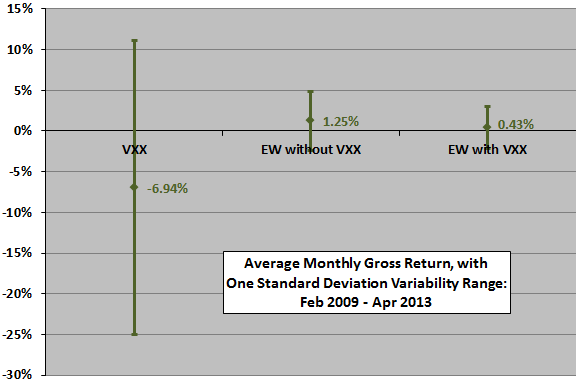
The following chart summarizes average monthly returns with variability ranges of one standard deviation for VXX and the EW portfolios without and with VXX over the available sample period. During this time, VXX generates a very negative average return with very high volatility. Adding VXX to the diversified EW portfolio reduces both return and volatility. The ratio of average return to standard deviation (return per unit of risk) is 0.34 (0.17) without (with) a VXX position.
The average pairwise correlation of VXX monthly returns with those of the other assets is a very low -0.34 over the available sample period. The low correlation derives from negative pairwise relationships with equity assets, RWR and DBC.
Per “Asset Class Diversification Effectiveness Factors,” the poor average return (low average pairwise correlation) of VXX indicates a bad (good) contribution with respect to portfolio diversification.
Sample size is small in terms of number of months, and especially, variety of market conditions.
What is the net result of these opposing effects?
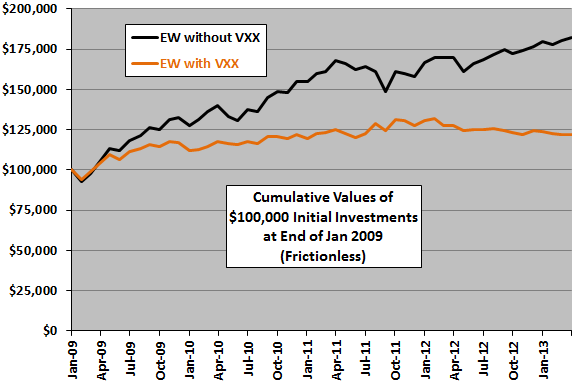
The next chart compares cumulative values of EW portfolios without and with VXX in the mix over the available sample period. Adding VXX does dampen return volatility, but loses based on terminal value over most recent intervals.
Again, sample size is small.
In summary, evidence from simple tests over a short available sample period does not support belief that adding a proxy for short-term U.S. equity market volatility to a diversified portfolio improves overall performance.
It may be that VXX volatility is such a drag on returns that a VXX position represents more a costly hedge than a diversifier.
Cautions regarding findings include:
- As noted, the sample period is very short in terms of market conditions (no bear markets). Stock market volatility has mostly trended down over the sample period. If VXX were available during 2008, findings might be different. In other words, over the long term, VXX may prove a more effective diversifier than found above.
- Including the trading frictions associated with monthly rebalancing would depress performance of both portfolios, depending mostly on portfolio size.
See also “Diversifying with Equity Volatility Exposure?”, “Feasibility of Diversifying Equities with Volatility Futures” and “Hedging Crashes: Volatility Futures vs. Index Puts”.
Frequently Asked Questions
What is VXX and how is it used as a proxy for stock market volatility?
VXX (iPath S&P 500 VIX Short Term Futures) is an exchange-traded note that serves as a proxy for short-term U.S. equity market volatility. In the article's tests, it was added to a diversified portfolio to see whether exposure to volatility, which tends to rise when stock returns fall, would improve overall performance.
Does adding VXX to a diversified portfolio improve performance?
Adding VXX to a diversified portfolio did not improve performance in the article's tests. Over February 2009 to April 2013, it reduced both return and volatility in an equal-weighted, monthly rebalanced nine-asset portfolio, and cut the return-to-risk ratio from 0.34 to 0.17. The sample is short, so the evidence does not support the belief that VXX improves overall performance.
How do you test whether VXX is a good portfolio diversifier?
The test measures VXX's average monthly return and its average pairwise correlation with monthly returns of nine asset class proxies (commodities, emerging markets, EAFE stocks, gold, Russell 1000, Russell 2000, REITs, long-term Treasuries and cash). It then compares cumulative returns and monthly return statistics for equal-weighted, monthly rebalanced portfolios with and without VXX. The sample covers 51 monthly returns from February 2009 to April 2013, and rebalancing frictions are ignored.
Is VXX a diversifier or just a costly hedge against stock market declines?
VXX appears to act more as a costly hedge than a diversifier in the article's tests. Its average pairwise correlation with the other assets was a very low -0.34, which is good for diversification, but its very negative average return with very high volatility is bad. Adding it dampened portfolio return volatility but lost on terminal value over most recent intervals.
What are the limitations of testing VXX as a portfolio diversifier over 2009 to 2013?
The main limitation is a very short sample of only 51 monthly returns with no bear markets, during which stock market volatility mostly trended down. Results might differ had VXX been available during 2008, and VXX may prove a more effective diversifier over the long term. Trading frictions from monthly rebalancing were also ignored and would depress performance of both portfolios.