
A reader offered the following observation and question: “For many market observers, the 200-day moving average is the point of being in or out of the market. Does being above or below the 200-day moving average make a material difference with respect to missing the the best/worst 10, 20 or 100 days?” To check, we return to the data set for our “Trend Implications of Big Up and Down Days”, which identifies the 40 biggest up days (daily return > 3.50%) and the 40 biggest down days (daily return < -3.09%) for the S&P 500 index during January 1950 through November 2007. Calculating the 200-day moving average (MA) at the close for each day just before these 80 biggest up/down days, we find that:
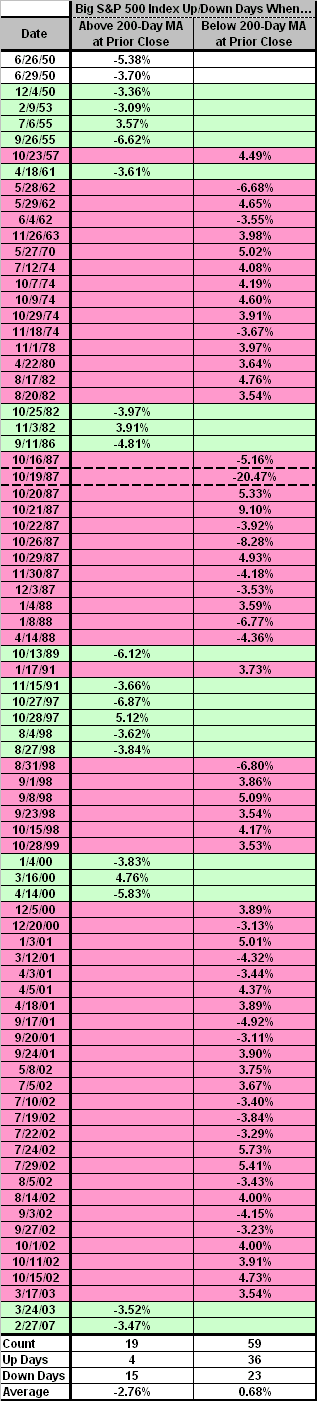
The following table organizes the 40 biggest up days and 40 biggest down days for the S&P 500 index since 1950 according to whether the index is above (left column with rows shaded light green) or below (right column with rows shaded pink) its 200-day MA at the prior day’s close. Note that:
There is not enough data to calculate the 200-day MA for the first two dates.
Of the 78 dates tested, 19 (24%) occur when the index is above its 200-day MA at the prior close. For these 19 instances, 4 are up days and 15 are down days, and the average return is -2.76%.
Of the 78 dates tested, 59 (76%) occur when the index is below its 200-day MA at the prior close. For these 59 instances, 36 are up days and 23 are down days, and the average return is +0.68%. This group includes 10/19/87, the worst of all days in the sample. Without 10/19/87, the average return for the remaining 58 instances is +1.04%.
It appears that a strategy of staying in (out of) the market while the S&P 500 index is above (below) its 200-day MA results in missing most of the extremely high volatility days, but it may not be good for net investing outcome. In this sample, the strategy catches just 10% of the big up days while missing only 57.5% of the big down days.
In summary, an investor who enters (exits) the market when the S&P 500 index crosses above (below) its 200-day moving average may miss most of the extremely high volatility days but will probably not enhance cumulative return by missing them.
More generally, results support a belief that extreme stock market volatility most often (but not always) follows substantial declines and sometimes signals market bottoms.
