
Assisted by a reader in discovering strategy details, we analyze here the “Common Sense” stock market timing strategy developed by James Stewart. He often refers to this strategy in his “Common Sense” columns in SmartMoney.com. The essential mechanism of this strategy is to move some funds from stocks to cash (cash to stocks) when the stock market is relatively high (low), defining high and low based on percentage changes from prior buy and sell dates. The strategy focuses on the NASDAQ Composite Index as a proxy for equities. Using comments from James Stewart’s columns to construct the strategy and daily NASDAQ Composite Index closing levels and 13-week Treasury bill (T-bill) yields over the period 2/5/71 through 5/8/09, we find that:
Defining descriptions of the Common Sense strategy come from two articles, an October 3, 2000 article entitled “Why I’m Buying Now” and a November 7, 2000 article entitled “Value or Growth? Who Cares?”, as follows:
“My formula is simple: I begin selling at intervals of 25% gains, approximately 5% of my assets each time. I will have reached a full cash position at a 75% gain. The target numbers based on the Oct. 12 NASDAQ close are 3844, 4613 and 5382.”
“If you sell 5% of your portfolio at intervals when the market registers gains of 25%, 50% and 75%, you will end up with more than the 10% cash that I indicated was my target. Specifically, you end up with 14.26%. But rallies in which the market rises 75% are unusual. Since the average rally is closer to 50%, I will have raised 9.75% cash in the more typical rally, and more than that when the market gains more than 75%.”
“Except in the rare incidents of a selling climax, I would never commit all my cash at once. Let’s hypothesize that the market continues to decline. If I spent 20% of my cash, as I did last week, I force myself to wait for a further 5% decline, and then allow myself to invest 20% of what remains. So I never completely run out of cash. Should the market drop 30% (a pretty severe correction by historical measures), most of my cash will have been committed. Obviously, you can adjust these figures to whatever level of risk makes you comfortable. The important thing is to have a disciplined approach. Otherwise, your emotions will run away with you and with your chance for superior returns.”
This description is not completely clear and consistent. It is clear that sequential gain or loss thresholds are increments calculated on a fixed date based on a set number of points rather than a floating percentage change. The description also indicates an intent or expectation that the percentage of funds in cash will be low compared to the percentage of funds in stocks. Based on the description, we establish the following rules for testing the Common Sense strategy:
- Each time action changes from sell to buy (buy to sell), calculate a new set of sell (buy) targets, but continue using the previous set of sequential buy (sell) targets.
- Establish buy (sell) targets on a fixed number of points that represent 10% (25%) increments based on the level of the NASDAQ Composite Index at the time of calculation for each set of buy (sell) targets.
- Start with 5% in cash and 95% in the NASDAQ Composite Index on 2/5/71 (arbitrary but in accord with the intended low percentage in cash).
- Move 20% of cash to stocks upon hitting a buy target, based on daily closes.
- Move 5% of the value of stocks to cash upon hitting a sell target, based on daily closes.
- Assume round-trip trading frictions (fee plus bid-ask spread) of 0.1% of assets (could be high or low depending on account size).
- Assume the cash portion of Common Sense strategy funds earns contemporaneous T-bill returns.
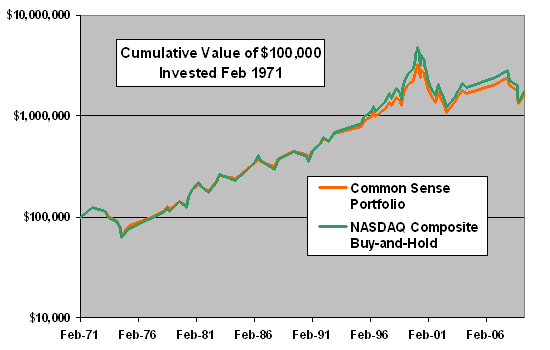
Over the entire sample period, these Common Sense strategy rules generate 81 buy/sell signals, an average of about two per year. As shown on the following chart (log scale), based on cumulative returns from initial investments of $100,000 at the close on 2/5/71, the Common Sense strategy generally tracks or modestly underperforms buying and holding the index (terminal values $1,630,730 versus $1,763,560). As of the 81 trading dates, the Common Sense strategy beats buy-and-hold 31% of the time, but it has not been ahead of buy-and-hold since 1992.
The average return between trades is 4.5% (5.0%) for the Common Sense strategy, with volatility (standard deviation) 14.1% (17.1%), so the strategy does modestly reduce volatility (because of the cash holding). The cash holding peaks at greater than a third of Common Sense strategy funds in early 2000.
The performance of the Common Sense strategy is sensitive to assumptions/parameter settings as follows:
- Performance systematically but only modestly improves as the movement of cash to stocks per buy signal increases above 20%.
- Performance systematically and fairly rapidly degrades as the allocation of stocks to cash per sell signal increases above 5%.
- Performance of course degrades with an increase in trading frictions.
- Performance of course degrades with imposition of any capital gain taxes.
In other words, the percentages used to shift between cash and stocks are probably more meaningful for outcome than “whatever level of risk makes you comfortable.” For no settings of the per-buy and per-sell transfers of funds between cash and stocks does the terminal value of the Common Sense strategy match or beat buy-and-hold for 2/5/71 through 5/8/09. However, because of a NASDAQ Composite Index crash early in the sample period (1974), it is possible for the Common Sense strategy to beat buy-and-hold by starting mostly in cash rather than stocks. The opposite profitability responses to increasing cash-to-stocks and stocks-to-cash percentages may reflect a tendency of stocks to fall more quickly than they rise.
The Common Sense strategy appears to misplay, at least for the stocks-to-cash actions, the forces of momentum and reversion in the stock market. These actions appear to bet on reversion over time frames when momentum tends to dominate reversion. Said differently, the system appears to sell too early on average. Much academic research points to two ways to exploit the momentum-reversion cycle: (1) intermediate-term trend following, (2) long-term value investing. The Common Sense strategy appears to try to exploit value at a mostly intermediate-term horizon.
In summary, the Common Sense buy-low/sell-high strategy appears not to be an effective asset allocation approach because it is somewhat out of phase with momentum and value return horizons.
For comparability with the methodology used in Guru Grades, we also collect a sample of James Stewart’s U.S. stock market outlooks and assign subjective binary (right or wrong) grades to each forecast. The table below summarizes these forecasts and shows the performance of the S&P 500 Index over the 5, 21, 63 and 254 trading days after the publication date for each item. Red plus (minus) signs to the right of specific items indicate those that the market has subsequently proven right (wrong). Forecast sample is moderate, as is therefore confidence in the measurement of her accuracy.
See Guru Grades for a snapshot of the accuracies of various experts in predicting the behavior of the U.S. stock market, including links to detailed individual evaluations.
| S&P 500 Index | ||||||
| Date | Comments from: James Stewart via SmartMoney.com | 5-Day Return | 21-Day Return | 63-Day Return | 254-Day Return | |
| 4/7/09 | The Nasdaq Composite pierced my selling threshold…, giving me the chance to raise some cash. …Now I have some additional cash to deploy when the inevitable correction arrives. | 4.5% | 11.3% | 8.0% | – | |
| 3/10/09 | …this is a great opportunity to buy… | 8.1% | 14.7% | 30.5% | + | |
| 2/24/09 | You don’t want to sell now. …the risks of being underexposed to stocks now strikes me as especially acute. | -9.9% | 5.3% | 14.7% | + | |
| 11/25/08 | …the Nasdaq Composite fell well below my latest buying target…. This marks the fifth consecutive 10% decline since I began buying in January… On Friday I did more buying… | 1.6% | 1.8% | -12.2% | – | |
| 10/7/08 | The important thing is to take advantage of opportunities now. …Back in the bleak years of 2000-02, …purchases made when things looked their worst ended up being the most profitable. | 0.2% | -4.4% | -6.2% | – | |
| 9/16/08 | Despite Monday’s 500-plus point rout, we have not yet reached another of the Common Sense buying thresholds, which is to buy on 10% dips (the next would be 2025 on the Nasdaq)… | -2.1% | -25.2% | -27.5% | – | |
| 7/1/08 | …you have another opportunity. The prices of many stocks have been slashed in recent weeks, including many I’ve recommended this year. The Common Sense approach is to buy lower. One reason it has worked over the years is that’s exactly when most people want to sell. | -3.1% | -1.4% | -13.9% | -30.1% | – |
| 1/29/08 | …this isn’t the time for hand-wringing over the declining value of your portfolio. It’s time to identify some bargains and do some buying. | -1.9% | 0.4% | 2.1% | -39.4% | – |
| 1/22/08 | This is the first time since 2002 that back-to-back buying opportunities have presented themselves: successive 10% declines without an interim selling opportunity. …sudden drops like these represent opportunities for patient investors. …Instead of fretting over the decline in your net worth, think opportunistically about all those bargains… | 4.0% | 2.4% | 5.9% | -36.5% | + |
| 1/8/08 | The U.S. stock market will fall in the first half of 2008, recover in the second half, and end with modest gains. … the Nasdaq…dropped below the latest Common Sense buying threshold of 2575…in early December… If you missed that brief opportunity…, this is your chance. | -0.7% | -3.8% | -1.8% | -36.0% | – |
| 12/4/07 | Last August, I predicted investors would get another chance, and they did. I’ll make a similar prediction now. | 1.0% | -3.5% | -8.8% | -40.1% | + |
| 11/20/07 | …a 10% decline from the high of 2860 on the Nasdaq reached on Halloween is 2575, which is my new buying target. That’s when the holiday shopping season will really begin (at least for stocks)… | 2.0% | 1.4% | -6.7% | -44.4% | – |
| 10/23/07 | …there are times to be cautious. With so many unknowns lurking within the financial system, this strikes me as one of them. | 0.8% | -6.8% | -11.9% | -42.3% | + |
| 8/21/07 | Market Selloff Is Buying Opportunity… And so I launched my buying campaign… | -1.0% | 4.9% | 0.8% | -10.7% | + |
| 6/12/07 | …the big news from Gross is that…he’s gone from being pessimistic about the global economy…to cautiously optimistic…his arguments make sense to me. They strike me as a reason to buy stocks, not bail out. | 2.7% | 3.7% | -2.8% | -8.9% | + |
| 4/24/07 | Nasdaq Hits the Common Sense Selling Target | 0.4% | 2.8% | 4.1% | -5.6% | – |
| 2/27/07 | …the Nasdaq Composite crossed my selling target of 2515 last week. …So it was time to take some profits… If you missed it, there’s no reason to panic. …The Nasdaq will cross the 2515 threshold again… | -0.3% | 1.3% | 8.3% | -4.9% | + |
| 2/20/07 | …if you’re really itching to do something, it’s OK to take some profits. …But if you’ve waited this long, why not wait a little longer? For those of you with cash to deploy who are eager to buy, I counsel patience…there’s a high degree of probability that there will be a buying opportunity this year. | -4.2% | -1.7% | 4.3% | -7.3% | + |
| 1/9/07 | The stock market will have a positive, if unspectacular year, gaining about 7% to 8%. | 1.3% | 2.6% | 2.6% | -0.8% | + |
| 10/17/06 | …some modest profit-taking is in order. | 1.0% | 2.4% | 4.6% | 10.4% | – |
| 8/8/06 | …you probably have a month or two to adapt to this new environment. But plan to have your investments in place before this uncertainty about the economy is resolved. By then, profit opportunities will already have been realized. | 1.1% | 1.8% | 7.3% | 14.3% | + |
| 8/1/06 | …this bull market is aging rapidly, and…the period of correction which began in April may not have run its course. | 0.0% | 2.6% | 8.4% | 15.5% | – |
| 7/18/06 | …this remains a buying opportunity. | 2.6% | 4.7% | 10.4% | 24.6% | + |
| 6/20/06 | …it’s not too late to add to your stock portfolio. | -0.1% | 0.7% | 6.5% | 20.8% | + |
| 6/13/06 | It’s time to buy. | 1.3% | 1.5% | 6.2% | 25.1% | + |
| 6/6/06 | …the market decline may well reach the next…buying target of 2138 on the Nasdaq, and sooner rather than later. | -3.2% | 0.8% | 3.7% | 19.4% | + |
| 5/23/06 | …last week’s market turmoil had the feel of a significant turning point… | 1.1% | -0.9% | 3.3% | 20.8% | + |
| 5/16/06 | …I’m keeping my powder dry. | -2.7% | -2.8% | -1.8% | 18.0% | + |
| 5/10/06 | …the stock market moved into a selling range… | -4.0% | -5.3% | -3.9% | 13.5% | + |
| 4/25/06 | …be raising some cash, if you haven’t already. | 0.9% | -3.3% | -3.1% | 13.9% | + |
| 4/18/06 | Now that the Nasdaq has risen 25% from its interim low of last April, it’s time to recalibrate. The next buying opportunity will be at 2138, a 10% decline, and the next selling opportunity will be at 2969, a further 25% gain. …if you missed this opportunity and the Nasdaq again hits 2365, you can still sell. …we’ll be at a buying opportunity before we reach the next selling threshold. | -0.5% | -2.9% | -5.6% | 13.3% | + |
| 3/21/06 | Selling now would be premature… | -0.3% | 1.1% | -4.4% | 10.8% | + |
| 2/21/06 | I’m not saying reduce your overall exposure to equities, but rather to maintain or add to cash positions. | -0.2% | 1.7% | -1.2% | 13.0% | + |
| 1/10/06 | U.S. stocks look like relative bargains. | -0.9% | -2.0% | 0.5% | 11.0% | – |
| 9/27/05 | No sector is going to revive until there’s a significant correction in oil prices. | -0.1% | -2.0% | 4.4% | 9.9% | – |
| 9/6/05 | …those investors betting on continued economic disruption had better take their profits quickly… | -0.2% | -3.0% | 2.6% | 5.3% | – |
| 4/26/05 | …if for some reason you missed my buy signal of last week, it’s not too late. | 0.8% | 3.3% | 6.7% | 13.8% | + |
| 4/19/05 | …it’s the perfect time to buy. | -0.1% | 2.8% | 5.9% | 13.7% | + |
| 4/5/05 | …it’s time to think about buying stocks. | 0.5% | -0.5% | 1.1% | 10.8% | – |
| 3/8/05 | …it’s more appropriate at the moment to be fearful than greedy… | -1.8% | -2.3% | -1.8% | 5.1% | + |
| 1/25/05 | …I’m inclined to wait. | 1.8% | 2.7% | -0.5% | 9.9% | – |
| 11/23/04 | …if you haven’t acted to take advantage of the recent market euphoria, it’s not too late. | 1.2% | 2.8% | 1.2% | 7.8% | – |
| 11/16/04 | …I sensed a mood of euphoria in the markets this past week…often good times to sell stocks. | 0.1% | 2.4% | 3.0% | 5.7% | – |
| 8/10/04 | …a buying opportunity seems imminent…when the Nasdaq hits 1750… | 0.2% | 3.6% | 8.1% | 14.7% | + |
| 5/11/04 | …all kinds of opportunities are suddenly appearing… If you missed my last buying target of 1950 on the Nasdaq, stocks are even cheaper now. But I’ve already done some buying, so I’m waiting until my next buying target, which is 1750 on the Nasdaq… | -0.4% | 3.7% | -1.5% | 5.3% | + |
| 4/27/04 | …be alert for any buying opportunities, especially if the market tumbles on the day the Fed raises rates. | -1.6% | -2.0% | -3.8% | 1.6% | – |
| 3/16/04 | Corrections are healthy. I urge you to take advantage of this one. | -1.5% | 1.6% | 1.9% | 7.1% | + |
| 3/2/04 | Even if there is a near-term correction, I expect stocks to be up by year’s end… | -0.7% | -2.0% | -2.5% | 6.4% | + |
| 2/24/04 | …I plan to be patient about putting my cash to work… | 0.9% | -4.2% | -4.0% | 6.3% | + |
| 1/20/04 | …I feel comfortable reducing my exposure to the market a little more than at previous thresholds. | 0.5% | 0.7% | -0.3% | 2.6% | + |
| 12/16/03 | …the market is vulnerable. | 1.9% | 6.0% | 4.5% | 11.1% | – |
| 12/9/03 | I haven’t been able to give you a solid buy signal since last March, which is now nearly nine months in the past. Nor can I now. …the stock market probably will go higher before we get a real correction… | 1.4% | 5.8% | 6.0% | 13.1% | – |
| 11/25/03 | …those of you who still want to generate some cash might want to consider selling some covered calls into this market strength. The market has the frothy tone… | 1.0% | 4.0% | 8.6% | 11.4% | – |
| 11/4/03 | …a stock-market rally that sent the Nasdaq soaring through my new selling threshold of 1950. In investing, there are times to reflect, and there are times to act. This is one of the latter. …Now I feel well-positioned for any pullbacks. | -0.6% | 1.6% | 7.0% | 10.6% | – |
| 10/28/03 | I remain cautious, which is just as well, since my model doesn’t call for any buying or selling at this juncture. | 0.6% | 1.1% | 7.8% | 8.0% | – |
| 10/21/03 | …if you’re in the mood to raise some cash, there’s no reason to let a few points stop you. We’re already in the ballpark. | 0.1% | -0.3% | 9.7% | 4.7% | + |
| 9/23/03 | …hold off [buying]… | -3.2% | 0.1% | 5.8% | 7.2% | + |
| 7/15/03 | …the Nasdaq has shot up so fast that it hit and then surpassed my latest selling target… So instead of plowing the proceeds of my latest cash-raising strategies right back into the market, I’ll wait for a pullback. | -1.2% | -1.6% | 3.8% | 10.0% | + |
| 7/1/03 | …I’m waiting for the market to pull back to another of my buy signals… | 2.0% | 0.8% | 2.5% | 13.6% | – |
| 5/6/03 | …the market has already risen a healthy amount, making this an attractive time to lock in some gains by selling high. | 0.8% | 6.0% | 5.2% | 17.6% | – |
| 4/29/03 | …the market’s recent run-up has made me cautious about buying stocks. …If you have modest expectations, I think there will still be some more gains before it’s time to sell. My advice is to be patient: There are always good buying opportunities eventually. | 1.8% | 3.5% | 8.6% | 20.6% | – |
| 4/8/03 | …if I had significant cash on hand, I would feel comfortable allocating some of it to equities now. | 1.4% | 4.8% | 14.8% | 30.4% | + |
| 3/18/03 | I’m entirely comfortable on the sidelines for the time being. | 1.0% | 1.6% | 16.7% | 28.1% | – |
| 3/11/03 | This is when the rest of us, the long-term investors, need to be most disciplined and stay the course. | 8.2% | 8.2% | 21.9% | 39.9% | + |
| 2/11/03 | …resist panic selling…take the long view. | 1.9% | 0.3% | 14.0% | 38.2% | + |
| 2/6/03 | …this is a time to buy stocks or options… This time I decided to venture into selling puts as well as buying calls. | -2.5% | -3.7% | 10.9% | 36.7% | – |
| 12/10/02 | The last time I was buying…everything was so depressed that I recommending buying index funds rather than trying to pick individual stocks. That’s still not a bad idea… | -0.2% | 2.6% | -11.1% | 18.8% | + |
| 11/5/02 | …time for me to raise some cash. | -3.5% | -1.0% | -7.8% | 15.1% | + |
| 10/1/02 | …it’s a good time to buy… | -5.8% | 5.0% | 3.7% | 21.5% | + |
| 9/24/02 | …so many good stocks are down that there are a multitude of options. This might be a time to consider buying index futures… | 3.5% | 9.4% | 9.3% | 21.7% | + |
| 8/22/02 | I’ve had to shift from thinking of stocks to buy to thinking of stocks to sell…it could happen soon. | -4.7% | -13.4% | -6.9% | 3.5% | + |
| 8/6/02 | …sentiment was so negative that I felt compelled to buy. This doesn’t mean, however, that I’m convinced the market is going to take off any time soon. | 2.9% | 2.3% | 4.8% | 13.7% | + |
| 7/23/02 | …I’m not rushing into the market. I also see no reason to act boldly. | 13.2% | 19.0% | 10.9% | 25.2% | – |
| 7/9/02 | The market isn’t at a level at the moment where I’m buying myself… | -5.4% | -8.0% | -16.0% | 4.8% | + |
| 6/25/02 | …you don’t have to wait. …there are plenty of stocks that look to me like bargains. | -2.9% | -14.1% | -14.6% | 0.0% | – |
| 6/11/02 | …I missed the opportunity to buy the last time… But last week’s dismal market action…gave me plenty of time. There are so many “bargains” I hardly knew where to begin… | 2.3% | -8.5% | -10.9% | -2.5% | – |
| 5/28/02 | …we may soon be seeing some vitality in the markets. | -3.2% | -9.4% | -12.4% | -10.3% | – |
| 5/21/02 | …this isn’t the time to be selling anything, tech or otherwise…stocks are still low. | -1.1% | -6.8% | -12.0% | -13.6% | – |
| 5/7/02 | …the more irrational the recent decline — driven by fear rather than reason — the better. It turns more stocks into bargains and stands to make the eventual gains that much better. | 4.6% | -1.9% | -20.5% | -11.1% | – |
| 4/30/02 | …I’m getting ready to buy. Did I say “buy”? Yes. …There’s a time to reap and a time to sow, and this is still the latter. | -2.5% | -1.6% | -16.5% | -13.6% | – |
| 4/9/02 | …the time to be selling…is when the broad market is hitting new highs, not in the midst of a month-long slump. | 0.9% | -2.6% | -12.6% | -22.0% | – |
| 3/5/02 | I wouldn’t let a few points stand in the way if you’re sitting on excess cash you’d like to put to work. | 1.7% | -1.7% | -9.2% | -27.7% | – |
| 2/12/02 | …ignoring the gloom and dire forecasts, I was in the market deploying some of my cash. | -0.9% | 4.1% | -3.0% | -24.6% | + |
| 2/5/02 | …I’ll be comfortable putting some cash to work in this current negative environment. | 1.6% | 6.2% | -3.4% | -23.9% | + |
| 1/22/02 | Now is not the time to be selling calls or shares…dust off your wish list, and stay tuned. | -1.7% | -3.4% | -1.0% | -23.0% | – |
| 1/2/02 | At the moment my stock-market model is neutral; I’m in neither a buying nor selling mode. | 0.0% | -2.8% | -2.5% | -19.5% | – |
| 11/27/01 | I see little risk in being out of the market for the next month. | -0.4% | 0.7% | -3.4% | -18.5% | + |
| 11/13/01 | The mood last week definitely felt frothy. I found several tempting opportunities for selling call options… | 0.3% | -1.7% | -1.8% | -20.1% | + |
| 11/6/01 | Right now, in my view, isn’t the time to invest that cash. | 1.8% | 4.3% | -3.2% | -20.0% | – |
| 10/30/01 | …it’s time to look again at the buy side of the equation. | 5.6% | 7.6% | 5.1% | -15.0% | + |
| 9/18/01 | On Monday I was in the market buying shares. | -2.0% | 4.3% | 8.7% | -18.1% | + |
| 9/4/01 | …the odds favor investing in stocks. | -8.3% | -6.7% | 3.0% | -21.7% | – |
| 8/28/01 | I’m “selling” real-estate equity and plan to buy bargain stocks… | -2.6% | -7.7% | -1.9% | -23.0% | – |
| 8/21/01 | …stocks should logically remain above their previous lows. | 0.4% | -13.0% | -0.6% | -20.7% | – |
| 8/14/01 | … the odds are that the glass is half-full. | -2.5% | -14.4% | -3.7% | -18.9% | – |
| 8/7/01 | Telecom remains the single most undervalued sector in the market, in my view, and such widespread buying opportunities don’t come around that often. | -1.5% | -8.1% | -7.1% | -22.8% | – |
| 7/31/01 | I was in the market buying stocks last week. | -0.6% | -5.2% | -10.5% | -25.2% | – |
| 5/1/01 | Investors will likely be anticipating stronger earnings at least through December, which should give the market an upward bias until then. | -0.4% | -0.8% | -4.9% | -15.3% | – |
| 4/24/01 | I forced myself to raise some cash. | 4.7% | 6.6% | -1.5% | -10.3% | – |
| 4/17/01 | I’m in the rather pleasant position…of being neither a buyer nor a seller. | 1.5% | 7.8% | 0.9% | -8.4% | – |
| 3/21/01 | …I remain a buyer of stocks. | 2.8% | 10.8% | 8.1% | 2.2% | + |
| 3/6/01 | I’m feeling pretty optimistic. …According to the reversion theory, that means a rally should be in the offing. | -4.5% | -12.0% | 1.1% | -8.0% | – |
| 2/27/01 | …I stepped in with my latest buying program. | -0.3% | -8.3% | 1.6% | -8.0% | – |
| 2/20/01 | I urge long-term investors with cash available to continue to take advantage of these periods of market weakness. | -1.6% | -12.3% | 1.0% | -13.5% | – |
| 2/13/01 | …I’m easing into a buying mood again | -4.8% | -11.0% | -5.3% | -17.4% | – |
| 2/6/01 | …the odds favor being fully invested, or close to it. | -2.5% | -6.5% | -6.6% | -17.4% | – |
| 1/30/01 | … this as a sell signal. | -1.6% | -9.6% | -9.0% | -21.4% | + |
| 1/23/01 | …uncertainty suggests to me that opportunities persist. | 1.0% | -7.9% | -10.0% | -16.9% | – |
| 1/9/01 | …this represents an opportunity for investors. | 2.2% | 2.4% | -12.5% | -12.4% | + |
| 12/26/00 | …we may look back at December 2000 as a time of incredible bargains in the stock market. | 2.5% | 3.0% | -10.1% | -10.8% | + |
| 11/14/00 | For now, I’m content to hold my positions… | -2.6% | -3.0% | -4.8% | -16.8% | – |
| 10/10/00 | …this kind of pessimism puts me in the mood to buy stocks… | -2.7% | 1.6% | -6.2% | -23.0% | – |
| 10/3/00 | My view of the market has turned from cautious to positive. | -2.8% | -0.4% | -10.0% | -23.1% | – |
| 9/5/00 | …a stable interest-rate environment, relatively weak consumer demand and a continuing slowdown in basic industry will lead to modest overall gains… | -1.7% | -4.8% | -12.7% | -28.0% | – |
| 6/28/00 | When the cycle turns — and it may have done so this week — the event will prove to be great news for stocks… | 0.1% | -2.4% | -1.9% | -15.0% | – |
