
Conventional wisdom says that both short sellers and corporate insiders are typically better informed than most traders. However, much short selling comes from programmed (uninformed) hedging, and much insider trading is pre-planned diversification of concentrated positions by firm executives. Is there a way to overlay the activities of these two groups to isolate truly informed trading? In their July 2007 draft paper entitled “Shorts and Insiders”, Amiyatosh Purnanandam and Nejat Seyhun investigate the combined power of unusual levels of short interest and unusual insider trading to predict stock returns. They test for “unusual” short interest and insider trading by subtracting the historical mean from the current value and dividing this difference by the historical standard deviation on a firm-by-firm basis. Using monthly short interest, insider trading and stock return data for all NYSE/AMEX-listed firms during 9/91-12/03, they find that:
- The one third of firms with the unusually highest (lowest) levels of short interest, rebalanced monthly, earn an average monthly equal-weighted return of -0.29% (0.49%) after adjusting for market return, size, book-to-market and momentum.
- When insider trading is unusually negative, the one third of stocks with unusually highest short interest earn an average risk-adjusted monthly return of -0.49% (-0.45%) on an equal-weighted (value-weighted) basis. For stocks with insiders unusually negative but short sellers unusually positive, average future stock returns are not significantly abnormal.
- When insider trading is unusually positive, the one third of stocks with unusually lowest short interest earn an average risk-adjusted monthly return of 0.73% (0.37%) on an equal-weighted (value-weighted) basis. For stocks with insiders unusually positive but short sellers unusually negative, average future stock returns are not significantly abnormal.
- When insiders are neutral, the predictive power of unusual levels of short interest is weakened, especially for large capitalization stocks.
- A hedging strategy long the third of stocks with unusually positive insiders and short sellers and short the third of stocks with unusually negative insiders and short sellers generates an average monthly return of 1.22% (0.82%) on an equal-weighted (value-weighted) basis, excluding transaction costs.
The following chart, constructed from data in the paper, summarizes raw average monthly returns (before transaction costs) for portfolios based on unusual levels of insider trading and short interest during 1993-2003. “Unusual” is defined above in the introductory paragraph. Portfolio rebalancing is monthly. Results show that combining the two indicators enhances predictive power for future returns.
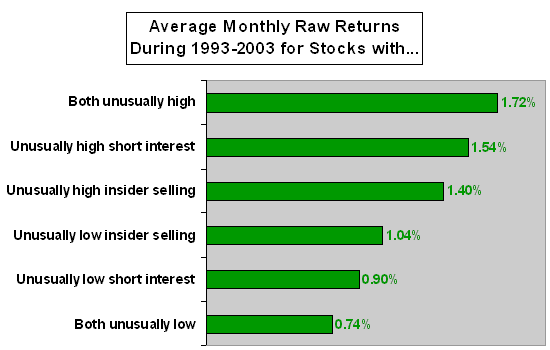
In summary, unusual trading by insiders helps isolate which short sellers know what they are doing, and vice versa.
The authors contend that the returns for the above hedging strategy “are economically large…and unlikely to be explained away by transaction costs.”
Frequently Asked Questions
What is unusual short interest and unusual insider trading in stock analysis?
Unusual short interest and unusual insider trading are measures of how far a firm's current short interest or insider trading activity deviates from its own historical norm. Each is calculated firm by firm by subtracting the historical mean from the current value and dividing by the historical standard deviation. The approach aims to separate informed trading from routine activity such as programmed hedging by short sellers and pre-planned diversification by executives.
Does combining insider trading with short interest improve stock return predictions?
Combining unusual insider trading with unusual short interest enhances stock return predictability in a study of NYSE/AMEX stocks from September 1991 to December 2003. A hedging strategy long stocks with unusually positive insiders and short sellers and short stocks with unusually negative insiders and short sellers earned an average 1.22% per month equal-weighted (0.82% value-weighted), before transaction costs. The authors argue these returns are unlikely to be explained away by transaction costs.
How do you identify informed short sellers using insider trading data?
Informed short sellers are identified by overlaying unusual short interest with unusual insider trading, each measured as a firm-specific deviation from its historical mean in standard deviation units. Stocks are sorted into thirds on each measure and portfolios are rebalanced monthly. Returns are adjusted for market return, size, book-to-market and momentum. When insiders are unusually negative, the third of stocks with the highest short interest earned -0.49% per month equal-weighted (-0.45% value-weighted).
Is short interest alone as good a predictor of stock returns as short interest combined with insider trading?
Short interest alone is a weaker predictor than short interest combined with insider trading. Using short interest alone, the third of firms with unusually highest (lowest) short interest earned an average monthly equal-weighted risk-adjusted return of -0.29% (0.49%). When insiders are neutral, short interest's predictive power weakens, especially for large capitalization stocks, while the combined signals produced larger returns such as -0.49% and 0.73% per month.
What are the limitations of using short interest and insider trading signals to trade stocks?
The reported returns exclude transaction costs and cover only NYSE/AMEX stocks from September 1991 to December 2003 with monthly rebalancing. Signals that disagree show no reliable edge: stocks with unusually negative insiders but unusually positive short interest, or the reverse, showed no significantly abnormal future returns. Value-weighted returns (0.82% per month for the hedge) are also smaller than equal-weighted returns (1.22%), indicating the effect is weaker among larger stocks.