
Are the stocks recommended by columnists in major business magazines good short-term and/or long-term picks? Can one trade these stocks around the publication event? In their 2006 working paper entitled “The Value of Columnists’ Stock Recommendations”, Dan Palmon, Ephraim Sudit and Ari Yezegel assess the short-term and long-term performance of buy recommendations made by columnists in Business Week (BW), Forbes and Fortune. Sensitive to the fact that magazine availability dates differ from nominal publication dates, they use a range of benchmarks and risk adjustments to measure the abnormal returns of these picks. Using 2,503 buy recommendations from the three magazines made during 2000-2003 along with associated price, fundamentals and benchmarking data, they conclude that:
- The choice of benchmark is critical to assessing performance of the recommendations. The columnists themselves tend to use a simple comparison to the S&P 500 index, ignoring commonly applied risk factors (market, size, value and momentum) and portfolio weighting (equal versus value).
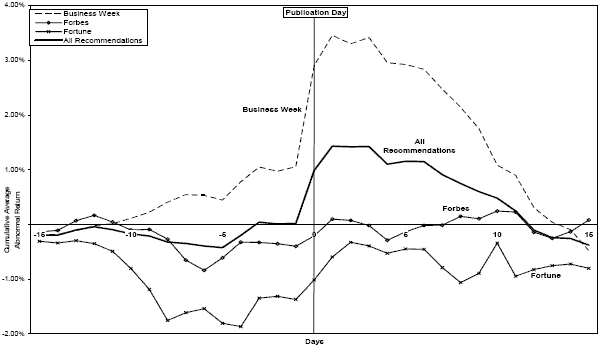
- From five trading days before to one trading day before public availability, there are significant average cumulative abnormal returns for BW (0.52%) and Forbes (0.44%) but not Fortune (0.17%) buy recommendations. (See the first chart below.)
- From the day before through the day after public availability, BW buy recommendations exhibit unusually high volume and large average abnormal returns (2.48%), while those for Forbes and Fortune show no volume impact and much smaller abnormal returns.
- The large abnormal returns of BW buy recommendations around the availability date tend to reverse over the next couple of weeks. This reversal suggests that publicity, not stock picking savvy, drives the returns.
- Over the next few months after public availability, Forbes buy recommendations tend to outperform those of BW and Fortune. (See the second chart below.)
- One year after public availability, none of the three magazines offer significant average abnormal returns from the buy recommendations of their columnists.
- In the short-term, recommendations directly from columnists significantly outperform those made by others and endorsed by columnists. In the long-term, there is no significant difference in average performance between direct and indirect recommendations.
The following chart, taken from the paper, displays the cumulative average abnormal returns from 15 trading days before to 15 trading days after the public availability date (Day 0) for buy recommendations from all three magazines. The benchmark for calculation of abnormal returns derives from a very broad, equally-weighted selection of stocks. The chart shows the large but transitory effect on returns of publication of recommendations in BW columns, suggesting a substantial publicity effect. Results for recommendations in Forbes and Fortune columns do not show such an effect. The best play for traders may be to short BW recommendations a few days after availability and hold for a few weeks.
The next chart, also from the paper, shows the longer-term cumulative average abnormal returns during the 60 trading days after the public availability date (Day 0) for buy recommendations from all three magazines. The benchmark for calculation of abnormal returns derives again from a very broad, equally-weighted selection of stocks. The chart shows that the recommendations from Forbes columns on average roughly match the benchmark, while those from columns in BW and Fortune significantly underperform.
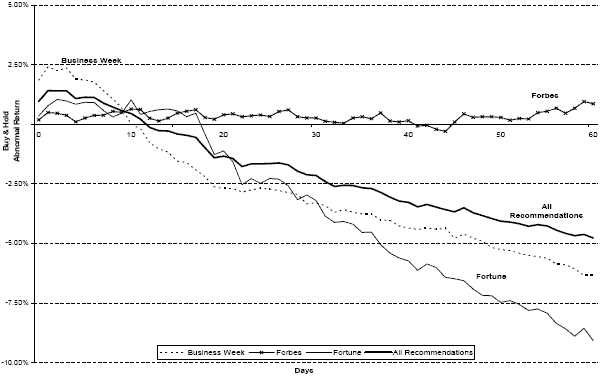
In summary, the buy recommendations of columnists in prominent business magazines on average underperform an equal-weighted benchmark over the weeks, months and first year after publication. Columnists in Forbes tend to outperform those in Business Week and Fortune.
Frequently Asked Questions
What is an abnormal return in stock performance analysis?
An abnormal return is the portion of a stock's return that exceeds or falls short of what a chosen benchmark or risk model predicts. In the study of columnists' stock picks, abnormal returns were measured against a broad, equally-weighted selection of stocks, and also with adjustments for market, size, value and momentum risk factors. The choice of benchmark was found to be critical to assessing performance.
Do stock recommendations from business magazine columnists beat the market?
Buy recommendations from business magazine columnists do not beat the market on average over the long term. In a study of 2,503 picks from Business Week, Forbes and Fortune during 2000-2003, the recommendations underperformed an equal-weighted benchmark over weeks, months and the first year after publication. One year after public availability, none of the three magazines showed significant average abnormal returns, though Forbes picks tended to do better than those of Business Week and Fortune.
How do researchers measure the performance of magazine stock recommendations around publication?
Researchers measure performance by calculating cumulative average abnormal returns around the date a magazine becomes publicly available, rather than its nominal publication date. The study of 2,503 buy recommendations from Business Week, Forbes and Fortune (2000-2003) tracked returns from 15 trading days before to 15 days after availability, and out to 60 days and one year. It used a range of benchmarks and risk adjustments, including market, size, value and momentum factors and equal versus value weighting.
Is the price jump after a magazine stock pick due to stock-picking skill or publicity?
The price jump after a Business Week stock pick appears to reflect publicity rather than stock-picking skill. Business Week buy recommendations showed unusually high volume and average abnormal returns of 2.48% from the day before through the day after public availability, but these gains tended to reverse over the next couple of weeks. Forbes and Fortune picks showed no volume impact and much smaller abnormal returns around availability.
What are the risks of trading on columnists' stock recommendations?
Trading on columnists' buy recommendations carries the risk that gains are transitory and the picks underperform afterward. In the 2000-2003 study, Business Week's short-term abnormal returns reversed within a couple of weeks, and Business Week and Fortune picks significantly underperformed the equal-weighted benchmark over the following 60 trading days. Columnists also commonly benchmark only against the S&P 500, ignoring risk factors and portfolio weighting, which can make their performance look better than it is.