
Is systematic selling of equity index put or call options an attractive strategy? In their December 2015 paper entitled “Index Options Realized Returns Distributions from Passive Investment Strategies”, Jose Dapena and Julian Siri analyze equity index call and put option returns from the perspective of a seller. They view a systematic option seller as an insurance company: (1) collecting option premiums at the time of sale; (2) maintaining capital in the form of a margin requirement; and, (3) cash-settling at expiration. They consider options written on the Dow Jones Industrial Average, the S&P 500 Index or the NASDAQ 100 Index with maturities of approximately 60, 180 or 365 days. They consider options with moneyness between 0.95 and 1.05. They estimate return by subtracting value at expiration from initial (bid) price and dividing the difference by initial, average or maximum margin required per the CBOE Rulebook. They calculate average and maximum margin requirements based on daily values while each option is active. Using bid prices for specified options during January 1996 through July 2013, they find that:
- Selling puts is more profitable than selling calls at approximately the same return volatility.
- Specifically, calculated with maximum margin required:
- Average returns from selling 60-day, 180-day or 365-day call options are 0.4%, -0.13% and -0.44%, respectively, with standard deviations 16.8%, 24.4% and 26.5%.
- Average returns from selling 60-day, 180-day or 365-day put options are 6.5%, 13.9% and 14.2%, respectively, with standard deviations 17.6%, 23.3% and 27.8%.
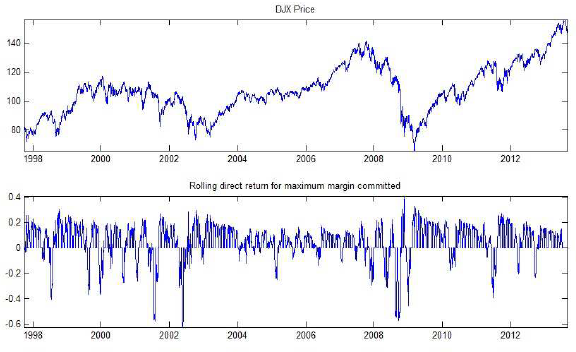
- However, the worst returns in all cases essentially wipe out committed capital (see, for example, the graphs below). In other words, the time series suffer crashes from which an investor cannot recover without adding capital.
The following graphs, taken from the paper, track over the sample period:
- In the upper graph, the Dow Jones Industrial Average divided by 100 (DJX).
- In the lower graph, contemporaneous returns (based on maximum margin required) for iteratively selling associated near at-the-money put options with about 60 days to expiration.
Results indicate that committing all capital to selling equity index put options often generates very attractive returns, but occasionally results in very large losses which may cluster.
In summary, evidence indicates that risking all capital on a strategy of selling unhedged equity index call or put options is untenable over the long run (even though selling puts is attractive based on average return).
Cautions regarding findings include:
- The treatment of required margin is ideal, in the sense that an option seller does not know at strategy initiation the maximum of the maximum margins required and would prudently maintain a large capital reserve. This reserve would reduce average strategy return.
- The samples of positions are not large in terms of option holding periods (for example, about 17.5 independent holding intervals for options with initial 365 days to expiration). In other words, the sample period may not be representative of all market conditions.
- Accounting for option sale/settlement fees would reduce reported returns.
See also:
- “Abnormal Returns from Selling Index Put Options?”
- “Is 40% Per Month Shorting Index Puts a Fair Return?”
- “Strategy Test”
- “Selling Calls or Puts According to Trend”
- “Simple Stock Index Option Strategies”
Frequently Asked Questions
What is systematic selling of equity index options?
Systematic selling of equity index options is a strategy of repeatedly writing put or call options on indices such as the Dow Jones Industrial Average, S&P 500 or NASDAQ 100. The seller acts like an insurance company: it collects option premiums upfront, maintains capital as a margin requirement, and cash-settles at expiration. The strategy is unhedged, so the seller bears the full risk of adverse index moves.
Is selling equity index put options more profitable than selling call options?
Selling equity index put options was more profitable than selling calls at about the same return volatility from January 1996 to July 2013. Using maximum margin, average returns for 60-, 180- and 365-day puts were 6.5%, 13.9% and 14.2%, versus 0.4%, -0.13% and -0.44% for calls. However, the worst returns in all cases essentially wiped out committed capital, so the study judges unhedged selling untenable over the long run.
How are returns from selling index options calculated when margin is required?
Return from selling an index option is calculated by subtracting the option's value at expiration from its initial bid price and dividing the difference by the margin required under the CBOE Rulebook. The study uses initial, average or maximum margin, with average and maximum based on daily values while each option is active. It covers options on the DJIA, S&P 500 or NASDAQ 100 with about 60, 180 or 365 days to maturity and moneyness between 0.95 and 1.05.
How do returns and risk from selling index puts compare with selling index calls?
Selling index puts produced much higher average returns than selling calls with similar volatility. For 60-day options, put standard deviation was 17.6% versus 16.8% for calls, yet average return was 6.5% versus 0.4%. Put selling often generated very attractive returns but occasionally produced very large losses that may cluster, while call selling averaged roughly zero or negative returns at longer maturities.
What are the limitations and risks of a strategy of selling index put options?
The worst outcomes from selling index puts essentially wipe out committed capital, and an investor cannot recover from such crashes without adding capital. The study's margin treatment is idealized because a seller cannot know the maximum margin required in advance and would hold a larger reserve, lowering returns. The sample is also small (about 17.5 independent holding intervals for 365-day options) and may not represent all market conditions, and option sale and settlement fees would reduce reported returns.