
Is the currency carry trade, as implemented by exchange-traded funds/notes (ETF/ETN), attractive? To investigate, we consider two currency carry trade ETF/ETNs, one live (with low trading volume) and one dead:
- PowerShares DB G10 Currency Harvest Fund (DBV) – tracks changes in the Deutsche Bank G10 Currency Future Harvest Index. This index consists of futures contracts on certain G10 currencies with up to 2:1 leverage to exploit the tendency that currencies with relatively high interest rates tend to appreciate relative to currencies with relatively low interest rates, reconstituted annually in November.
- iPath Optimized Currency Carry (ICITF) – provides exposure to the Barclays Optimized Currency Carry Index, which reflects the total return of a strategy that holds high-yielding G10 currencies financed by borrowing low-yielding G10 currencies. This fund stopped trading July 2018, but an indicative value is still available.
We focus on monthly return statistics, plus compound annual growth rates (CAGR) and maximum drawdowns (MaxDD). For reference (not benchmarking), we compare results to those for SPDR S&P 500 (SPY) and iShares Barclays 20+ Year Treasury Bond (TLT). Using monthly total returns for the two currency carry trade products, SPY and TLT as available through October 2020, we find that:
The following table summarizes sample periods, monthly performance data, CAGRs and MaxDDs for the two currency carry trade products, SPY and TLT over available sample periods. Monthly reward/risk is the ratio of average monthly return to standard deviation of monthly returns. Notable points are:
- The products are unattractive based on absolute returns.
- They have much deeper MaxDDs than TLT.
- Based on monthly return correlations, they might have some value to investors seeking diversification.
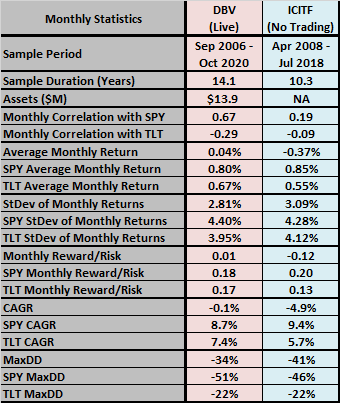
In summary, available evidence on attractiveness of currency carry trade ETF/ETNs is negative.
Cautions regarding findings include:
- Available sample periods are not long in terms of variety of global market conditions.
- As noted, trading in these products is thin or absent.
- While the absolute performance of the currency carry trade products is unattractive, they may still be performing as planned with respect to their benchmark indexes.
Frequently Asked Questions
What is a currency carry trade ETF?
A currency carry trade ETF is an exchange-traded fund or note that holds high-yielding currencies financed by borrowing low-yielding currencies, aiming to exploit the tendency of high-interest-rate currencies to appreciate against low-interest-rate ones. Examples include PowerShares DB G10 Currency Harvest Fund (DBV), which uses G10 currency futures with up to 2:1 leverage reconstituted annually in November, and iPath Optimized Currency Carry (ICITF), which tracked the Barclays Optimized Currency Carry Index.
Do currency carry trade ETFs deliver attractive returns?
Currency carry trade ETFs have not delivered attractive returns: DBV and ICITF were unattractive on absolute returns through October 2020, and the article concludes the available evidence on their attractiveness is negative. Both also had much deeper maximum drawdowns than TLT, though monthly return correlations suggest some potential diversification value.
How are currency carry trade ETFs evaluated for performance and risk?
Currency carry trade ETFs like DBV and ICITF were evaluated using monthly total returns through October 2020, along with compound annual growth rate (CAGR), maximum drawdown (MaxDD), and monthly reward/risk, defined as average monthly return divided by the standard deviation of monthly returns. SPY and TLT were used as reference points, not formal benchmarks, over each product's available sample period.
How do currency carry trade ETFs compare to stocks and Treasury bonds for diversification?
Currency carry trade ETFs such as DBV and ICITF showed much deeper maximum drawdowns than the long-term Treasury bond ETF TLT and were unattractive on absolute returns. Based on monthly return correlations with SPY and TLT, however, they might offer some diversification value to investors. SPY and TLT were used only for reference, not as formal benchmarks.
What are the limitations of judging currency carry trade ETFs by their performance?
Judging currency carry trade ETFs by performance has limits because the available sample periods are short and do not cover a wide variety of global market conditions. Trading in these products is also thin (DBV) or absent (ICITF stopped trading in July 2018). In addition, the funds may still be performing as planned relative to their benchmark indexes even though absolute returns were unattractive.