
Studies of the U.S. stock market indicate that some factors and indicators may have predictive power for future returns. Do these findings consistently translate to other large equity markets? In the July 2010 version of their paper entitled “The Cross-Section of German Stock Returns: New Data and New Evidence”, Sabine Artmann, Philipp Finter, Alexander Kempf, Stefan Koch and Erik Theissen apply a new set of single-sorted and double-sorted factor portfolios based on market beta, size, book-to-market ratio and momentum to test for beta effect, size effect, value premium and momentum in the German equity market. In the July 2010 version of their paper entitled “The Impact of Investor Sentiment on the German Stock Market”, Philipp Finter, Alexandra Niessen-Ruenzi and Stefan Ruenzi test the predictive power of a composite sentiment measure combining consumer confidence, net equity mutual funds flow, put-call ratio, aggregate trading volume, initial public offering (IPO) returns, number of IPOs and aggregate equity-to-debt ratio of new issues. Using data for 955 non-financial German firms for which sufficient data is available during the period 1960-2006 for the factor portfolios and 1993-2006 for the sentiment measure, these studies find that:
“The Cross-Section of German Stock Returns: New Data and New Evidence” informs beliefs as follows:
- There is no basis for belief that stock beta or firm size predict future returns.
- There is some basis for belief that book-to-market ratio predicts future returns.
- There is strong basis for belief that momentum predicts future returns.
- The best (worst) performance among 96 double-sorted quartile portfolios comes from that comprised of stocks with the highest (lowest) momentum and highest (lowest) book-to-market ratio, generating an average monthly gross return of 1.33% (-0.10%). The associated hedge portfolio gross monthly spread of 1.43% translates to an annualized return of 17%.
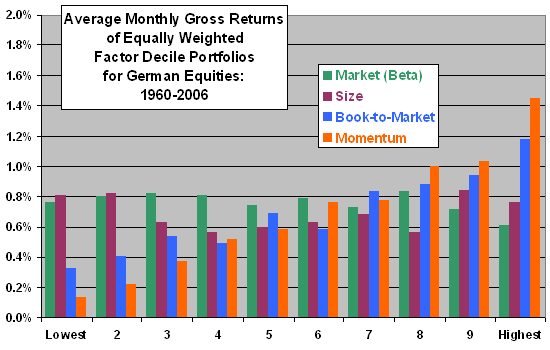
The following chart, constructed from data in the paper, summarizes average monthly gross returns for equally weighted decile portfolios of German stocks based on market (beta), size, book-to-market and momentum factors over the entire sample period. Market, size, and book-to-market portfolios are reformed at the end of June of each year and held for 12 months, while momentum portfolios are reformed monthly based on return over the past 11 months lagged by one month. Results suggest that momentum has the strongest, most consistent predictive power, followed by book-to-market ratio, while the market beta and size effects are absent.
“The Impact of Investor Sentiment on the German Stock Market” informs beliefs as follows:
- Investor sentiment has no predictive power for overall stock market returns.
- Sentiment has weak predictive power for the difference in future returns between stocks that are arguably sentiment-sensitive (high idiosyncratic volatility, small average trade size, young, small, unprofitable, no dividend) and stocks that are arguably sentiment-insensitive.
- This effect derives mostly from relative undervaluation of sentiment-sensitive stocks after periods of very low sentiment (consistent with investors reacting more strongly to bad news than good news).
- Sentiment-sensitive stocks underperform sentiment-insensitive stocks for a few months after instances of very low sentiment, but then outperform in the following quarters.
- Findings are consistent with the hypothesis that retail investors are more emotional than institutional investors and the fact that retail investing comprises a relatively small fraction of trading in German stocks.
Neither study considers trading frictions in portfolio formation and adjustment.
In summary, evidence from German stocks supports belief in the pervasiveness of a momentum effect and perhaps a value premium, but not market beta and size effects. Any sentiment effect is likely weak, specific to susceptible stocks and concentrated in intervals after very low sentiment.
Data snooping bias is a suspect when cross-market findings conflict.
Frequently Asked Questions
What is the momentum effect in stock returns?
The momentum effect is the tendency of stocks with strong past returns to keep outperforming stocks with weak past returns. In the German stock market study covering 1960-2006, momentum portfolios were formed monthly based on return over the past 11 months, lagged by one month. Momentum showed the strongest and most consistent predictive power of the factors tested.
Do momentum and value factors predict returns in German stocks?
Momentum and value factors do predict returns in German stocks, but momentum is much stronger. In a study of 955 non-financial German firms over 1960-2006, the strongest portfolio (highest momentum and highest book-to-market) earned an average gross monthly return of 1.33%, while the weakest earned -0.10%. The hedge portfolio spread of 1.43% per month equals about 17% annualized, and book-to-market was a weaker, 'some basis for belief' predictor.
How are factor portfolios built to test for beta, size, value and momentum effects?
Factor portfolios are built by sorting stocks into single-sorted and double-sorted groups based on market beta, size, book-to-market ratio and momentum. In the German study, market, size and book-to-market portfolios were reformed at the end of June each year and held 12 months, while momentum portfolios were reformed monthly. The tests used equally weighted decile portfolios and 96 double-sorted quartile portfolios, with average gross monthly returns compared across them.
Do stock market factors that work in the U.S. also work in other countries like Germany?
Stock market factors that work in the U.S. only partly hold up in Germany. German stocks over 1960-2006 supported a momentum effect and perhaps a value premium, but showed no market beta effect and no size effect. Investor sentiment also had no predictive power for overall German market returns and only weak power for the difference between sentiment-sensitive and sentiment-insensitive stocks.
What are the limitations of using factor and sentiment studies to predict stock returns?
Neither German study considered trading frictions in portfolio formation and adjustment, so reported gross returns may overstate achievable results. The sentiment findings were weak, limited to susceptible stocks and concentrated in periods after very low sentiment, and the sentiment measure covered only 1993-2006. Data snooping bias is a suspect when findings conflict across markets.