
Does the interaction of paradigmatic indicators of optimism (lumber demand) and pessimism (gold demand) tell investors when to take risk and when to avoid risk? In their May 2015 paper entitled “Lumber: Worth Its Weight in Gold: Offense and Defense in Active Portfolio Management”, Charles Bilello and Michael Gayed examine the recent relative performance of lumber (a proxy for economic activity via construction) and gold (a safe haven) as an indicator of future stock market and bond market performance. Specifically, if lumber futures outperform (underperform) spot gold over the prior 13 weeks, they go on offense (defense) the next week. They test this strategy on combinations of seven indexes comprising a spectrum of risk (listed lowest to highest): BofA Merrill Lynch 5-7 Year Treasury Index (Treasuries); CBOE S&P 500 Buy-Write Index (BuyWrite); S&P 500 Low Volatility Index (Low Volatility); S&P 500 Index (SP500); Russell 2000 Index (R2000); Morgan Stanley Cyclicals Index (Cyclicals); and, S&P 500 High Beta Index (High Beta). Using weekly nearest futures contract prices for random length lumber, weekly spot gold prices and weekly total returns for the seven test indexes during November 1986 (November 1990 for Low Volatility and High Beta) through January 2015, they find that:
- The lumber-gold relationship predicts U.S. stock market states:
- Realized volatility and implied volatility are on average substantially lower during weeks after lumber outperforms.
- 74% (87%) of the worst 5% (1%) of weeks for the S&P 500 Index occur after gold outperforms.
- A strategy that goes on offense after lumber outperforms gold and/or defense after lumber underperforms gold generally produces stronger absolute and risk-adjusted performance than buying and holding stock indexes (see the chart below).
- Results are robust to various time frames and across multiple economic and financial market cycles.
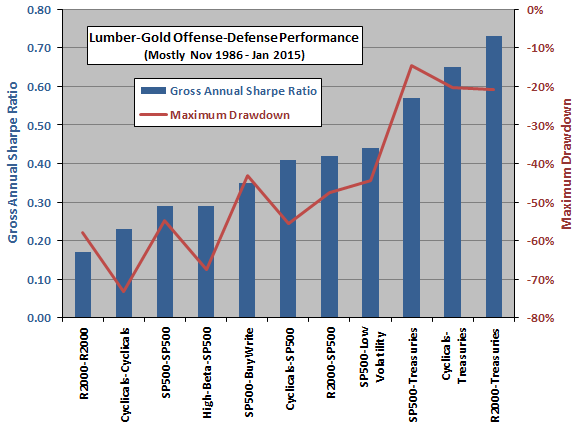
The following chart, constructed from data in the paper, summarizes gross annual Sharpe ratios and maximum (peak-to-trough) drawdowns for 11 offense-defense portfolios, reformed weekly. For each portfolio, the first index is that held when lumber futures outperform spot gold over the prior 13 weeks, and the second index is that held when spot gold outperforms lumber futures over the prior 13 weeks. Buy-and-hold benchmarks are those with the first and second indexes the same. Results indicate that:
- Timed offense and defense generally beat buy-and-hold on a gross basis.
- The best strategies use Treasuries rather than defensive stocks on defense.
In summary, evidence suggests that investors may be able to time financial markets by holding risk-on (risk-off) assets when lumber outperforms (underperforms) gold in the recent past.
Cautions regarding findings include:
- Tests employ indexes rather than tradable assets, thereby ignoring the costs and fees of maintaining a liquid fund. These expenses would reduce performance for all portfolios and may vary materially across indexes.
- Tests ignore the trading frictions associated with switching between offense and defense. These frictions would further reduce performance for switching strategies. While noting that turnover depends on the length of the interval used to measure lumber-gold relative performance, the authors do not quantify turnover.
- Testing many strategies on the same or similar data introduces snooping bias (luck), such that the best-performing strategy likely overstates expectations.
- There may be snooping bias in selection of the 13-week interval to measure lumber-gold relative performance. The authors state that “…time frames as short as 3 weeks and as long as 21 weeks also have predictive power.” However, they do not quantify sensitivity of performance to length of measurement interval.
- Interest rates generally decline over the entire sample period, supporting a bull market for Treasuries (the defensive component of the top three asset combinations). Interest rates may not continue to fall in the future.
Frequently Asked Questions
What is a lumber-gold timing strategy in investing?
A lumber-gold timing strategy uses the relative performance of lumber futures (a proxy for economic activity via construction) and spot gold (a safe haven) to decide between risk-on and risk-off assets. If lumber futures outperform spot gold over the prior 13 weeks, the investor goes on offense the next week; if they underperform, the investor goes on defense. The strategy was examined by Charles Bilello and Michael Gayed in a May 2015 paper.
Does the lumber-gold relationship predict stock market performance?
The lumber-gold relationship predicted U.S. stock market conditions in the study covering November 1986 to January 2015. Realized and implied volatility were substantially lower on average in weeks after lumber outperformed gold, and 74% (87%) of the S&P 500's worst 5% (1%) of weeks followed gold outperforming lumber. Timed offense-defense portfolios generally beat buy-and-hold on a gross Sharpe ratio basis, though results are before costs.
How is a lumber-gold offense-defense portfolio constructed and tested?
The lumber-gold portfolio compares the prior 13-week performance of nearest lumber futures (random length) with weekly spot gold prices, then rebalances weekly: offense if lumber outperforms, defense if gold outperforms. The authors tested combinations of seven indexes spanning low to high risk, from 5-7 year Treasuries to the S&P 500 High Beta Index, using weekly total returns from November 1986 (November 1990 for Low Volatility and High Beta) through January 2015. Performance was compared using gross annual Sharpe ratios and maximum drawdowns for 11 offense-defense portfolios against buy-and-hold benchmarks.
Is it better to use Treasuries or defensive stocks as the defensive side of a lumber-gold strategy?
Treasuries were the better defensive choice in the lumber-gold strategy than defensive stocks, as the best-performing strategies used Treasuries on defense. Timed offense-defense portfolios generally beat their buy-and-hold benchmarks on a gross basis across the risk spectrum. However, the Treasury advantage may reflect the generally declining interest rates over the sample period, which supported a bull market in Treasuries.
What are the limitations and risks of relying on the lumber-gold indicator?
The lumber-gold indicator results come with several caveats: tests use indexes rather than tradable assets and ignore fund costs and the trading frictions of switching, which would reduce performance. Testing many strategies on similar data creates snooping bias, including possibly in choosing the 13-week interval, and the authors did not quantify turnover or sensitivity to interval length. Falling interest rates over the sample period also flattered Treasuries as the defensive asset and may not continue.