Is an adaptive marketplace extinguishing the January effect? In their June 2008 paper entitled “The Persistence of the Small Firm/January Effect: Is it Consistent with Investors’ Learning and Arbitrage Efforts?”, Kathryn Easterday, Pradyot Sen and Jens Stephan investigate whether the stock market has adapted over time to diminish the small firm/January effect. Using returns and firm size data for a very large sample of stocks over three subperiods (1946-1962, 1963-1979, 1980-2007), theyconclude that:
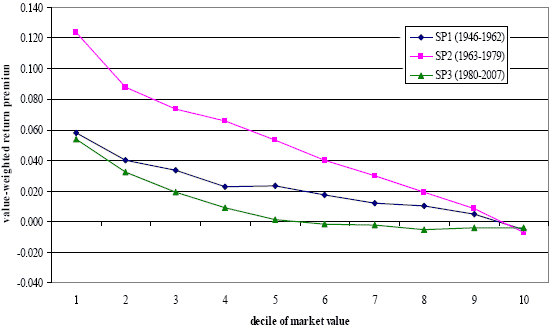
The January effect for small-capitalization firms exists for all three subperiods, and the effect declines monotonically as firm size increases. (See the chart below.)
Abnormal January returns are smaller after 1963-1979, but have merely reverted to pre-existing levels rather than disappeared. There is no evidence that the January effect declines systematically over time, and it continues to be significant through 2007.
The January effect is present for new (Nasdaq) as well as mature (NYSE, AMEX) markets.
Lack of unusual December-January trading volumes for small-capitalization stocks indicates that traders are not actively arbitraging the anomaly.
The following chart, taken from the paper, compares January premiums (value-weighted returns in excess of broad U.S. stock market returns) by market capitalization (decile of market value) for three subperiods (SP1, SP2, SP3). The January premium is most pronounced during SP2 (1963-1979). January return premiums for SP1 and SP3 are similar. In all subperiods, the January premium is concentrated in small-capitalization stocks.
In summary, the January effect for small-capitalization stockspersiststhroughout the past 60+ years.
Asset Class ETF Seasonalities? PremiumAverage monthly returns for nine asset class ETFs (SPY, IWM, EFA, EEM, TLT, LQD, VNQ, GLD, DBC) are mostly positive in April, July, November…
Style Performance by Calendar Month PremiumStyle ETFs show modest monthly return differences versus SPY, with value outperforming growth in Mar/Apr/Dec and growth leading in Oct/Nov (Aug 2001–Oct 2021; 20-year…
Sector Performance by Calendar Month PremiumAverage returns and return dispersion across nine Select Sector SPDR ETFs (XLB, XLE, XLF, XLI, XLK, XLP, XLU, XLV, XLY) differ somewhat by calendar…
“Sell in May” Over the Long Run Premium"Sell in May" stocks underperformed November-April stocks (CAGR not specified vs buy-and-hold benchmark; Apr 1871–Apr 2021; seasonal timing with 1% trading costs; S&P Composite…
Stock Market Continuation and Reversal Months? PremiumCalendar-month correlations between S&P 500 and Russell 2000 monthly returns and prior 3-, 6- and 12-month returns show unstable continuation/reversal patterns across subperiods and…