
Does choice of multi-asset portfolio rebalance date(s) materially affect performance? In their October 2018 paper entitled “Rebalance Timing Luck: The Difference Between Hired and Fired”, Corey Hoffstein, Justin Sibears and Nathan Faber investigate effects of varying portfolio rebalance date on performance. Specifically, they quantify noise (luck) from varying annual rebalance date for a 60% S&P 500 Index-40% 5-year constant maturity U.S. Treasury note (60-40) U.S. market portfolio. Using monthly total returns for these two assets during January 1922 through June 2018, they find that:
- Rebalance timing significantly affects performance, and this effect is not mean reverting. The 60-40 portfolio specified above, rebalanced annually, has:
- Gross annualized return 8.27% (8.49%) over the full sample period if rebalanced at the end of October (May). May rebalancing generates over 20% greater terminal wealth than October rebalancing.
- 7% greater return during February 2009 to February 2010 if rebalanced at the end of February rather than August.
- Has 0.36% standard deviation of 12-month rolling returns over the full sample period for 12 variations of the portfolio, each rebalanced at the end of a different calendar month (a measure of rebalance timing luck).
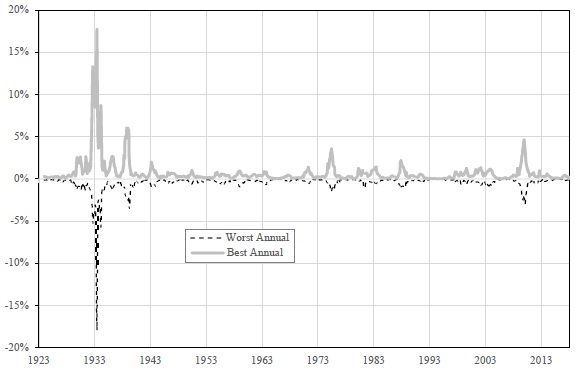
- Has rebalance timing luck that varies considerably over time, with subperiods of stability punctuated by explosive deviations (see the chart below).
- Investors can suppress rebalance timing luck by holding equally weighted portfolios with staggered rebalancing dates. N such portfolios suppress this noise by 1/N.
The following chart, taken from the paper, compares rolling 12-month returns for two 60-40 portfolios as specified above with the best and the worst end-of-month rebalance dates each year relative to the average for 12 portfolios rebalanced at the end of all 12 respective months. Results show that rebalance timing risk is more a tail effect than a consistent risk.
In summary, evidence indicates that choice of portfolio rebalancing schedule carries some performance risk and that holding multiple portfolios with different rebalancing schedules suppresses this risk.
Cautions regarding findings include:
- Examples employ indexes, which do not account for the costs and practices associated with liquid tracking funds. Such costs and practices could affect findings.
- Holding multiple portfolios with different rebalancing dates may drive materially greater trading frictions for some investors. Per the authors: “…increased rebalance frequency does imply a potential increase in the number of transactions, which can increase total explicit trading costs. However, those transactions are likely to be smaller in magnitude, thereby reducing expected market impact. Ultimately, the actual costs will largely be strategy dependent, and beyond the scope of this article.”
For another perspective from a similar analysis, see “Optimal Rebalancing Frequency/Months?” See also the more granular and complicated:
- “Optimal Monthly Cycle for SACEMS?”
- “Optimal Monthly Cycle for Simple Debt Class Mutual Fund Momentum Strategy?”
- “Optimal Monthly Cycle for Sector ETF Momentum Strategy?”
- “Optimal Cycle for Monthly SMA Signals?”
Frequently Asked Questions
What is rebalance timing luck in a multi-asset portfolio?
Rebalance timing luck is the variation in portfolio performance caused solely by which calendar date an investor chooses to rebalance, rather than by the strategy itself. For a 60% S&P 500 Index-40% 5-year U.S. Treasury note portfolio rebalanced annually, it is measured as the 0.36% standard deviation of 12-month rolling returns across 12 versions, each rebalanced at the end of a different month (January 1922 to June 2018).
Does the month you rebalance a 60-40 portfolio materially affect returns?
Yes, the rebalance month materially affects 60-40 portfolio returns, and the effect is not mean reverting. Over January 1922 to June 2018, annual rebalancing at the end of May produced 8.49% gross annualized return versus 8.27% for October, and May rebalancing generated over 20% greater terminal wealth. The effect is more a tail risk than a consistent one, with stable periods punctuated by explosive deviations.
How can investors reduce rebalance timing luck in a portfolio?
Investors can reduce rebalance timing luck by holding equally weighted portfolios with staggered rebalancing dates, where N such portfolios suppress the timing noise by 1/N. The study measured this noise by comparing 12 versions of a 60-40 S&P 500/5-year Treasury note portfolio, each rebalanced annually at the end of a different calendar month, using monthly total returns from January 1922 to June 2018.
How big is the difference between the best and worst rebalance dates for a 60-40 portfolio?
The difference between the best and worst rebalance dates for a 60-40 portfolio can be large over short windows even though it is small on average. Rebalancing at the end of February rather than August produced 7% greater return during February 2009 to February 2010, while the full-sample difference between May and October was 8.49% versus 8.27% annualized. This indicates that rebalance timing risk is more a tail effect than a consistent one.
What are the limitations of staggering rebalance dates to reduce timing luck?
The main limitations of staggering rebalance dates are that the analysis uses indexes, which ignore the costs and practices of liquid tracking funds, and that holding multiple portfolios with different rebalancing dates may create materially greater trading frictions for some investors. The authors note that more frequent rebalancing implies more transactions and higher explicit trading costs, though the transactions are likely smaller and may reduce market impact. Actual costs are strategy dependent and were beyond the scope of the study.