
What excess return have you gotten, do you expect, should you require, does the market imply for taking the risk of owning stocks? In his September 2006 paper entitled “Equity Premium: Historical, Expected, Required and Implied”, Pablo Fernandez addresses all these questions in a comprehensive overview/history and analysis of the equity risk premium in the U.S. and other countries. He begins with definitions of four perspectives on the equity premium, the first equal for all investors and the other three varying among investors:
- Historical equity premium (HEP) – the historical differential return of the stock market over treasury instruments.
- Expected equity premium (EEP) – the expected differential return of the stock market over treasury instruments.
- Required equity premium (REP) – the incremental return of a diversified portfolio (the market) over the risk-free rate (return of treasury instruments) required by an investor.
- Implied equity premium (IEP) – the equity premium that arises from assuming that the market price is correct.
He concludes that:
- Differences among HEP calculations are mainly due to the risk-free instrument and the stock indexes chosen.
- Over the past 25-45 years things (theory development, ascendancy of funds, electronic trading, regulation) changed. The relationship between interest rates and stock dividend/earnings yields has reversed.
- Standard asset pricing models fail to agree with HEP calculations (the equity premium puzzle) because the models are wrong and HEP is not predictive of future returns.
- Capital market data from before 1950 are not obviously useful for estimating future expected returns. In fact, HEP is generally not a good estimator for EEP.
- Assertion of specific values for EEP, REP and IEP for the overall stock market assume (unsupportably) that investors have homogeneous expectations and requirements.
- Since 1960, the difference between IEP and the expected dividend growth rate is proportional to the risk-free rate.
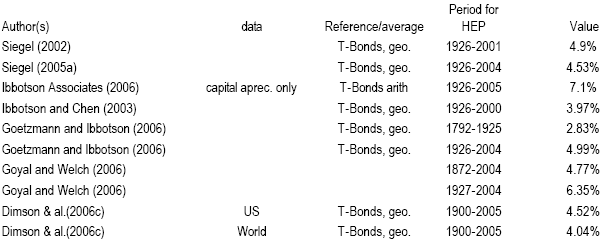
The following table, taken from the paper, lists long-term estimates for the historical equity premium (HEP) from various authors, generally using long-term Treasury bonds (T-Bonds) as the risk-free benchmark. It shows that most such estimates fall in the 4%-5% range.
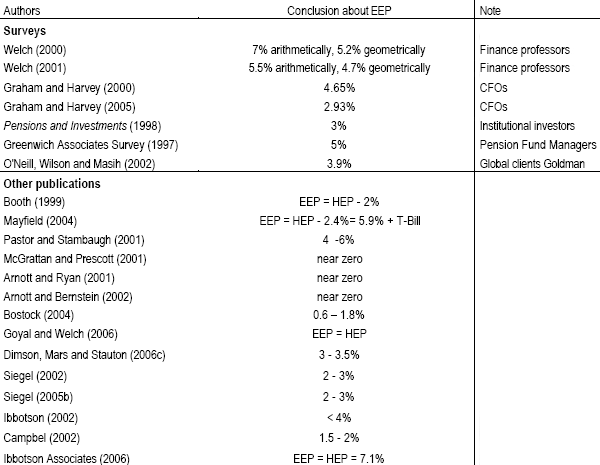
The next table, also from the paper, lists estimates for expected equity premium (EEP) from various authors. Future expectations in aggregate tend to the low side of HEP. The first seven estimates are based on surveys of experts, and the rest on other methods.
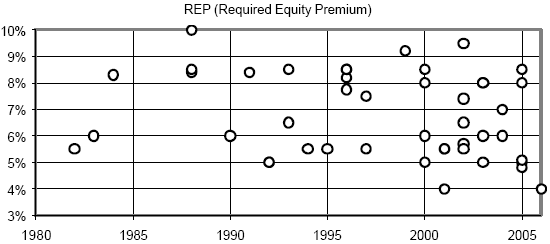
The following chart, again from the paper, shows estimates for the required equity premium (REP) from various important financial textbooks according to year of publication. The data show fairly wide dispersion for any given year and suggest a slight downward trend.
In summary, the author provides a comprehensive overview of equity risk premium concepts and values, stressing the mid-20th century break in key financial relationships.
Frequently Asked Questions
What is the equity risk premium and what are its main types?
The equity risk premium is the excess return of the stock market over the risk-free rate (treasury instruments) for bearing the risk of owning stocks. Pablo Fernandez defines four perspectives: historical (HEP, the same for all investors), expected (EEP), required (REP), and implied (IEP, which assumes the market price is correct). The last three vary among investors.
Does the historical equity risk premium predict future stock returns?
The historical equity premium (HEP) is generally not a good estimator of the expected equity premium (EEP) and is not predictive of future returns, according to Fernandez. Most long-term HEP estimates versus T-bonds fall in the 4%-5% range, but aggregate future expectations tend toward the low side of that range. Capital market data from before 1950 are not obviously useful for estimating future expected returns.
How is the equity risk premium calculated and estimated?
The historical equity risk premium is calculated as the stock market's historical return minus the return on treasury instruments, and differences among calculations come mainly from the risk-free instrument and stock index chosen. The expected premium is estimated through surveys of experts and other methods. The required premium is drawn from financial textbook recommendations, and the implied premium assumes the market price is correct.
What is the difference between the historical, expected, required, and implied equity risk premium?
The historical equity premium (HEP) is the same for all investors, while the expected (EEP), required (REP), and implied (IEP) premiums vary among investors. HEP looks backward at past stock returns over treasuries, EEP is the anticipated differential return, REP is the incremental return an investor demands, and IEP is derived by assuming market prices are correct. Textbook REP estimates show wide dispersion in any given year with a slight downward trend over time.
Why is a single market-wide equity risk premium value considered unreliable?
Asserting a specific value for the expected, required, or implied equity risk premium for the overall market unsupportably assumes investors have homogeneous expectations and requirements, per Fernandez. Historical premium calculations also vary with the risk-free instrument and stock index chosen. Standard asset pricing models fail to match historical premiums (the equity premium puzzle), and relationships between interest rates and dividend/earnings yields have reversed over the past 25-45 years.